

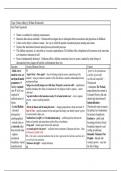
Topic: Tintern Abbey by William Wordsworth
Key Points/Arguments
Nature is a medium for exploring consciousness.
Memories fade and are unreliable – Wordsworth investigates how to distinguish between memories and projections of childhood.
Centres on the object’s relation to nature – the way in which the speaker encounters/projects meaning onto nature
Explores the interrelation between natural process and mental processes.
The Sublime experience, it is powerful as it exceeds comprehension. The Sublime offers a heightened self-awareness at the same time
as it threatens to subsume the self.
Poem is fundamentally dialectical – Pantheism offers a Sublime connection, however, poem is marked by deep feelings of
disconnection from younger self and his wish harmonise those two.
Structure Literary/Dramatic Devices Context
- blank verse/ S1 “poetry is the spontaneous
modern verse and ‘Again I hear/ - Once again’ – idea of returning using the senses, experiencing in the overflow of powerful,
unrhymed iambic moment – trying to construct a narrative of his life that has a seamless relationship between recollected tranquillity” –
pentameter past/present/future Wordsworth
‘hedge-rows, hardly hedge-rows, little lines/ Of sportive wood run wild’ – enjambement
fluidity (enjamb) - Anticipates The Prelude,
modifies boundary three times, he summons the very thing he wishes to supress… nature
suits W as he was unprecedented movement in
cultivated
sceptical of ‘vagrant dwellers in the houseless woods,/ Or of some hermits cave’ – tries to supress Literature History, that man
artificial nature of poverty – wants everything beautiful should right about himself.
rhyme S2 Industrialisation –
- Lyrical Ballads ‘Felt in the blood, and felt along the heart.’ – changes prepositions to body movement Wordsworth wants to supress
– personal/ Spot of Time – specific moments of time and space that shape your identity (nature’s power the political as it undermines
introspective/ to unconsciously shape you) the notions of pantheism.
autobiographical ‘burthen/heavy/weight’ and ‘breath/motion/asleep’ – conflicting diction between the Enclosure – public land
- instead relies on burden of mortality and materialism and the effects of meditation becoming privatised, found
an internal rather ‘living soul’ – liminal space between life and death boundaries oppressive and
than external order ‘eye made quiet by the power’ – oscillates between moments of pleasure and stress – links cutting up landscape.
to Romantic prophet belief
- opposes Romantic Visionary Poet
S3 – if he wants a constant meditation then he has to appreciate the bad times and how he is
mechanical revived back into meditation Prophet – blessed with
boundaries, wanted ‘darkness/ day-light’ – simple dichotomy visionary power – sees into
naturalised and S4 the life of things
Key Points/Arguments
Nature is a medium for exploring consciousness.
Memories fade and are unreliable – Wordsworth investigates how to distinguish between memories and projections of childhood.
Centres on the object’s relation to nature – the way in which the speaker encounters/projects meaning onto nature
Explores the interrelation between natural process and mental processes.
The Sublime experience, it is powerful as it exceeds comprehension. The Sublime offers a heightened self-awareness at the same time
as it threatens to subsume the self.
Poem is fundamentally dialectical – Pantheism offers a Sublime connection, however, poem is marked by deep feelings of
disconnection from younger self and his wish harmonise those two.
Structure Literary/Dramatic Devices Context
- blank verse/ S1 “poetry is the spontaneous
modern verse and ‘Again I hear/ - Once again’ – idea of returning using the senses, experiencing in the overflow of powerful,
unrhymed iambic moment – trying to construct a narrative of his life that has a seamless relationship between recollected tranquillity” –
pentameter past/present/future Wordsworth
‘hedge-rows, hardly hedge-rows, little lines/ Of sportive wood run wild’ – enjambement
fluidity (enjamb) - Anticipates The Prelude,
modifies boundary three times, he summons the very thing he wishes to supress… nature
suits W as he was unprecedented movement in
cultivated
sceptical of ‘vagrant dwellers in the houseless woods,/ Or of some hermits cave’ – tries to supress Literature History, that man
artificial nature of poverty – wants everything beautiful should right about himself.
rhyme S2 Industrialisation –
- Lyrical Ballads ‘Felt in the blood, and felt along the heart.’ – changes prepositions to body movement Wordsworth wants to supress
– personal/ Spot of Time – specific moments of time and space that shape your identity (nature’s power the political as it undermines
introspective/ to unconsciously shape you) the notions of pantheism.
autobiographical ‘burthen/heavy/weight’ and ‘breath/motion/asleep’ – conflicting diction between the Enclosure – public land
- instead relies on burden of mortality and materialism and the effects of meditation becoming privatised, found
an internal rather ‘living soul’ – liminal space between life and death boundaries oppressive and
than external order ‘eye made quiet by the power’ – oscillates between moments of pleasure and stress – links cutting up landscape.
to Romantic prophet belief
- opposes Romantic Visionary Poet
S3 – if he wants a constant meditation then he has to appreciate the bad times and how he is
mechanical revived back into meditation Prophet – blessed with
boundaries, wanted ‘darkness/ day-light’ – simple dichotomy visionary power – sees into
naturalised and S4 the life of things


