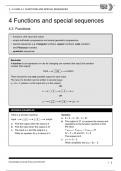
OCR GCSE MATHS 4.3 AND 4.4 FUNCTIONS AND SPECIAL SEQUENCES EXAM(QUESTIONS AND ANSWERS A+ GRADED)GUARANTEED PASS
4.3 AND 4.4 FUNCTIONS AND SPECIAL SEQUENCES ©Cambridge University Press and OCR 2021 2 Exercise 1 1 Here is a function. x ÷ 4 + 9 y The input is x and the output is y. Write an algebraic equation for y in terms of x. 2 Write the equation that connects the input (x) with the output (y). a x square × 2 y b x × 2 square y 3 The diagram shows a sequence of patterns. Pattern 1 Pattern 2 Pattern 3 Pattern 4 a Work out the number of circles in Pattern 8. b Complete the rule. Pattern number × .... + .... number of circles c Which pattern number has 40 circles? 4 Here are the first four patterns in a sequence. a How many white circles will there be in pattern 10? b What is the expression for the number of white circles in pattern n? c Write an expression for the total number of circles in pattern n. input output input output 4.3 AND 4.4 FUNCTIONS AND SPECIAL SEQUENCES ©Cambridge University Press and OCR 2021 3 Reminder An arithmetic sequence (also known as an arithmetic progression) is a sequence where the difference between each term is constant. For example: 2 4 6 8 + 2 + 2 + 2 A geometric sequence (also known as a geometric progression) has terms that are multiplied or divided by a constant to get the next term in the sequence. For example, 2, 4, 8, 16 or 16, 8, 4, 2, 1, 5 a An arithmetic progression has an nth term Work out the first five terms of this progression. b A geometric progression has an nth term . Work out the first five terms of this progression. c The first 4 terms of a sequence are Is the sequence arithmetic or geometric? 6 For each of these sequences, state if it is arithmetic or geometric. a 2, 3, 4, 5, … b 1, 2, 4, 8, … c d 4.4 Special sequences Reminder You need to be able to recognise the following sequences: Fibonacci sequences, e.g. 1, 1, 2, 3, 5, 8, 13, ... The next term is found by adding the previous two terms. Quadratic sequences have nth term rules that contain . The sequence for triangular numbers is 1, 3, 6, 10, 15, ... It is made from the pattern below. The sequence for square numbers is or 1, 4, 9, 16, … The sequence for cube numbers is or 1, 8, 27, 64, …
Written for
- Institution
- GCSE
- Course
- GCSE
Document information
- Uploaded on
- June 17, 2023
- Number of pages
- 4
- Written in
- 2022/2023
- Type
- Exam (elaborations)
- Contains
- Questions & answers
Subjects
-
43 and 44 functions and special sequences ©cambr

Also available in package deal