solving quadratic equations with imaginary solutions
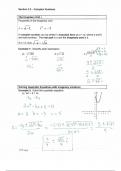
Solving quadratic equations with imaginary solutions involves finding the values of the variable that satisfy the equation but result in complex or imaginary numbers. A quadratic equation is typically written in the form ax^2 + bx + c = 0, where 'a', 'b', and 'c' are coefficients and 'x' is the variable. When the discriminant, which is b^2 - 4ac, is negative, the quadratic equation does not have real solutions. Instead, it yields complex solutions in the form of a+bi, where 'a' and 'b' are real numbers and 'i' represents the imaginary unit (√-1). To solve such equations, we can use the quadratic formula: x = (-b ± √(b^2 - 4ac))/(2a). When the discriminant is negative, the square root term (√(b^2 - 4ac)) becomes an imaginary number, indicating that the solutions are complex. Solving quadratic equations with imaginary solutions allows us to handle situations where the roots lie on the imaginary number line and provide a comprehensive understanding of the behavior and solutions of quadratic equations.
Written for
- Institution
-
Austin Community College
- Course
-
College algebra (64088)
Document information
- Uploaded on
- June 17, 2023
- Number of pages
- 2
- Written in
- 2022/2023
- Type
- Class notes
- Professor(s)
- Carmen mccullough
- Contains
- All classes
Subjects

Also available in package deal