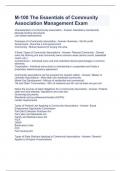
M-100 The Essentials of Community Association Management Exam
Characteristics of a Community Association - Answer- Mandatory membership Mutually binding documents Lien-based assessments Purposes of a Community Association - Answer- Business - Not for profit Government - Runs like a mini-government Community - Mutual reasons for buying into area 3 Basic Types of Community Associations - Answer- Planned Community - Owners owns his lot/living unit and community owns common areas (tennis courts, basketball courts, etc.). Condominium - Individual owns unit and undivided interest (percentage) in common elements. Cooperative - Individual owns stock or membership in cooperative and holds a proprietary lease/occupancy agreement. Community associations can be grouped into clusters called: - Answer- Master or Umbrella Associations - More than one residential community. Mixed-Use Development - Mixture of residential and commercial. "55 and Older" Communities - 80% of residents are 55+ and at least one per unit. Name the sources of legal obligations for a Community Association - Answer- Federal, state and local statutes, regulations and case law. Governing documents Standards set by professional bodies (AICPA) Lender requirements Types of Federal Law Applying to Community Associations - Answer- Equal Employment Opportunity Commission Fair Debt Collection Practices Act Fair Labor and Standards Act Family and Medical Leave Act FICA OSHA Bankruptcy Code FCC Fair Housing Act Types of State Statutes Applying to Community Associations - Answer- General - Applies to all types of associations Specifics - Applies to only one type of association (takes precedence over any general statutes and governing documents. Uniform - National Conference of Commissioners draft generic content-specific wording to encourage uniformity among the states. Purpose of Community Association Governing Documents - Answer- Provide legal structure and operation of a community association. Hierarchy of Governing Documents - Answer- Recorded map, plat or plan Declaration, CC&Rs, proprietary lease or occupancy agreement. Articles of Incorporation Bylaws Board Resolutions Declaration, CC&Rs, proprietary lease or occupancy agreement. - Answer- Declarations - Condo CC&Rs - Planned Community Proprietary Lease/Occupancy Agrmt - Coop Articles of Incorporation - Answer- Brings corporation into existence. Coops must incorporate because the the corporation owns all the property. Other types of communities may incorporate. Benefits of incorporating - Answer- Limit liability of individual owners. Right granted all corporations Easier to deal with utility companies, vendors, etc. Bylaws - Answer- Formally adopted regulations for the administration and management of a community association. - Meeting procedures including voting rights - Board powers and duties Board Resolutions - Answer- A motion that follows a set format and formally adopted by the board. Public Offering Statement - Answer- Provides association information to first prospective buyers in community. Required by state statute. Not considered a governing document. Types of Resolutions - Answer- Policy - Affects owners' rights and obligations. Administrative - Addresses the internal operations of community association. Special - Apply a policy or rule to a specific individual. General - Routine events. Criteria for Valid Rules - An
Written for
- Institution
- M-100
- Course
- M-100
Document information
- Uploaded on
- June 16, 2023
- Number of pages
- 6
- Written in
- 2022/2023
- Type
- Exam (elaborations)
- Contains
- Questions & answers
Subjects
-
m 100 the essentials of community association mana

Also available in package deal