Week 4:
Preparation: Chapter 7:
Unemployment
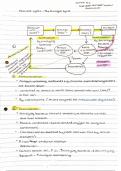
Natural rate of unemployment: the average rate of unemployment around which
the economy fluctuates.
L Labor force =E Employed workers + U Unemployed workers
If the labor market is in steady state – the unemployment rate is neither rising or
falling:
frate of job finding x U = srate of job separation x E
Because E = L – U, then fU = s(L – U)
f U/L = s (1 – U/L)
U/L = s/ (s + f)
U/L = 1/ (1 + f/s) -> The steady-state rate of unemployment U/L
depends on the rates of job separation s and the job finding f.
Any policy aimed at lowering the natural rate of unemployment must either
reduce the rate of job separation or increase the rate of job finding. Similarly,
any policy that affects the rate of job separation or job finding also changes the
natural rate of unemployment.
Frictional unemployment: the unemployment caused by the time it takes workers
to search for a job.
Sectoral shift: A change in the composition of demand among industries or
regions.
Unemployment insurance: A government programs increasing the amount of
frictional unemployment: workers collect a fraction of their wages for a certain
period after losing their jobs.
100 percent experience rated: when firms that lays off a worker are required to
bear the full cost of that worker’s unemployment benefits.
Partially experienced rated: When a firm lays off a worker and is charged for only
part of the worker’s unemployment benefits, the remainder comes from the
program’s general revenue.
Reason of unemployment: wage rigidity – the failure of wages to adjust to a level
at which labor supply = labor demand.
Structural unemployment: unemployment resulting from wage rigidity and job
rationing.
Earned income tax credit: amount that poor working families are allowed to
subtract from the taxes they owe.
Efficiency-wage theories: hold that high wages make workers more productive,
reduce labor turnover and that the average quality of a firm’s workforce depends
on the wage it pays its employees (kinda adverse selection), improves worker
effort (moral hazard).
Preparation: Chapter 7:
Unemployment
Natural rate of unemployment: the average rate of unemployment around which
the economy fluctuates.
L Labor force =E Employed workers + U Unemployed workers
If the labor market is in steady state – the unemployment rate is neither rising or
falling:
frate of job finding x U = srate of job separation x E
Because E = L – U, then fU = s(L – U)
f U/L = s (1 – U/L)
U/L = s/ (s + f)
U/L = 1/ (1 + f/s) -> The steady-state rate of unemployment U/L
depends on the rates of job separation s and the job finding f.
Any policy aimed at lowering the natural rate of unemployment must either
reduce the rate of job separation or increase the rate of job finding. Similarly,
any policy that affects the rate of job separation or job finding also changes the
natural rate of unemployment.
Frictional unemployment: the unemployment caused by the time it takes workers
to search for a job.
Sectoral shift: A change in the composition of demand among industries or
regions.
Unemployment insurance: A government programs increasing the amount of
frictional unemployment: workers collect a fraction of their wages for a certain
period after losing their jobs.
100 percent experience rated: when firms that lays off a worker are required to
bear the full cost of that worker’s unemployment benefits.
Partially experienced rated: When a firm lays off a worker and is charged for only
part of the worker’s unemployment benefits, the remainder comes from the
program’s general revenue.
Reason of unemployment: wage rigidity – the failure of wages to adjust to a level
at which labor supply = labor demand.
Structural unemployment: unemployment resulting from wage rigidity and job
rationing.
Earned income tax credit: amount that poor working families are allowed to
subtract from the taxes they owe.
Efficiency-wage theories: hold that high wages make workers more productive,
reduce labor turnover and that the average quality of a firm’s workforce depends
on the wage it pays its employees (kinda adverse selection), improves worker
effort (moral hazard).