Week 5 :
Preparation: Chap 8: Perfect
competition
Perfect competition based on three assumptions:
- Price taker: firm that has no influence over market price and thus take the
price as given. (Every firm in a perfect competitive market)
- Product Homogeneity
- Free entry and exit: Condition under which there are no special costs that
make it difficult for a firm to enter (or exit) an industry. So buyers can easily
switch from a seller to another and sellers can easily enter or exit a market.
Organization with objectives≠ from profit maximization= Cooperative – an
association of businesses or people jointly owned and operated by members for
mutual benefit. (common in agricultural markets).
A related type of organization is a condominium: A housing unit that is individually
owned but provides access to common facilities that are paid for and controlled
jointly by an association of owners.
Profit is the difference btw Total Revenue and Total Cost.
R = Pq; so π (q) = R(q) – C(q) (Each one depending on the output)
Marginal revenue is the change in revenue resulting from a one-unit increase in
output.
Maximization if MC = MR
Thus, ∆π / ∆q = ∆R / ∆q - ∆C / ∆q = 0
cause MR – MC = 0
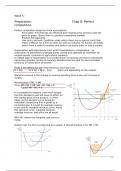
In a competitive industry, how much output
the firm decides to sell will have no effect on
the market price of the product. -> Price
taker, so the demand curve facing an
individual competitive firm is given by a
horizontal line. It is both its average revenue
curve and its marginal revenue curve. Along
this demand curve, marginal revenue,
average revenue, and price are all equal.
MR= MC where the marginal cost curve is
rising.
Output rule: If a firm is producing any output, it should produce it for MR = MC
Preparation: Chap 8: Perfect
competition
Perfect competition based on three assumptions:
- Price taker: firm that has no influence over market price and thus take the
price as given. (Every firm in a perfect competitive market)
- Product Homogeneity
- Free entry and exit: Condition under which there are no special costs that
make it difficult for a firm to enter (or exit) an industry. So buyers can easily
switch from a seller to another and sellers can easily enter or exit a market.
Organization with objectives≠ from profit maximization= Cooperative – an
association of businesses or people jointly owned and operated by members for
mutual benefit. (common in agricultural markets).
A related type of organization is a condominium: A housing unit that is individually
owned but provides access to common facilities that are paid for and controlled
jointly by an association of owners.
Profit is the difference btw Total Revenue and Total Cost.
R = Pq; so π (q) = R(q) – C(q) (Each one depending on the output)
Marginal revenue is the change in revenue resulting from a one-unit increase in
output.
Maximization if MC = MR
Thus, ∆π / ∆q = ∆R / ∆q - ∆C / ∆q = 0
cause MR – MC = 0
In a competitive industry, how much output
the firm decides to sell will have no effect on
the market price of the product. -> Price
taker, so the demand curve facing an
individual competitive firm is given by a
horizontal line. It is both its average revenue
curve and its marginal revenue curve. Along
this demand curve, marginal revenue,
average revenue, and price are all equal.
MR= MC where the marginal cost curve is
rising.
Output rule: If a firm is producing any output, it should produce it for MR = MC