Topic 7: Early Models of the Solar
System
Specification
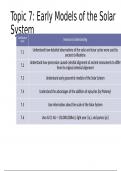
Point Necessary Understanding
7.1 Understand how detailed observations of the solar and lunar cycles were used by
ancient civilisations
Understand how precession caused celestial alignment of ancient monuments to differ
7.2 from its original celestial alignment
7.3 Understand early geocentric models of the Solar System
7.4 Understand the advantages of the addition of epicycles (by Ptolemy)
7.5 Use information about the scale of the Solar System
7.6 Use AU (1 AU = 150,000,000km), light year (l.y.), and parsec (pc)
, Understand how detailed observations of the solar and lunar cycles were used by
7.1
ancient civilisations
Ancients civilisations used detailed
observations of solar and lunar (1) Historically, farmers planned when
cycles for (1) agricultural, (2) plant and harvest crops and flowers bas
religious, and (3) calendar on lunar and solar cycles. For instance, t
systems that informed (4) waning moon phase was reported best f
alignment of ancient monuments. bleeding operations.
(2) Mesoamerican religious festivals
formed complex rituals locked by the so
cycles as the cycles of the Sun was
conceived as related to deity behaviou
(3) Many of the ancient calendar system
were based on the lunar (for months) an
solar (for years) cycle – lunisolar
calendar.
(4) Cultures erected structures to help
track cycles including Stonehenge and t
pyramids which had small shafts enabli
[1]
precise determination of cycle period o
the sun and moon.
System
Specification
Point Necessary Understanding
7.1 Understand how detailed observations of the solar and lunar cycles were used by
ancient civilisations
Understand how precession caused celestial alignment of ancient monuments to differ
7.2 from its original celestial alignment
7.3 Understand early geocentric models of the Solar System
7.4 Understand the advantages of the addition of epicycles (by Ptolemy)
7.5 Use information about the scale of the Solar System
7.6 Use AU (1 AU = 150,000,000km), light year (l.y.), and parsec (pc)
, Understand how detailed observations of the solar and lunar cycles were used by
7.1
ancient civilisations
Ancients civilisations used detailed
observations of solar and lunar (1) Historically, farmers planned when
cycles for (1) agricultural, (2) plant and harvest crops and flowers bas
religious, and (3) calendar on lunar and solar cycles. For instance, t
systems that informed (4) waning moon phase was reported best f
alignment of ancient monuments. bleeding operations.
(2) Mesoamerican religious festivals
formed complex rituals locked by the so
cycles as the cycles of the Sun was
conceived as related to deity behaviou
(3) Many of the ancient calendar system
were based on the lunar (for months) an
solar (for years) cycle – lunisolar
calendar.
(4) Cultures erected structures to help
track cycles including Stonehenge and t
pyramids which had small shafts enabli
[1]
precise determination of cycle period o
the sun and moon.