Psychopathology:
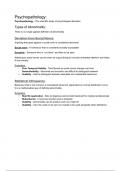
Psychopathology - The scientific study of psychological disorders
Types of Abnormality:
There is no single agreed definition of abnormality
Deviation from Social Norms:
Anything that goes against a social norm is considered abnormal
Social norm - A behaviour that is considered socially acceptable
Eccentric - Someone who is “out there” and likes to be seen
Adhering to social norms can be seen as a good thing as it avoids unwanted attention and helps
fit into society.
Evaluation:
- Poor Temporal Validity - Time Bound as social norms change over time
- Generalisability - Abnormal and eccentric are difficult to distinguish between
+ Usability - Able to distinguish between desirable and undesirable behaviour
Statistical Infrequency:
Behaviour that is not common is considered abnormal, dependent on normal distribution curve.
It is a mathematical way of defining abnormality.
Evaluation:
+ Real life application - Able to diagnose and provide treatment for medical professionals
- Reductionist - It removes emotion and is simplistic
- Usability - Abnormality can be positive such as a high IQ
- Usability - Can’t be used on its own as it needs to be used alongside other definitions
, Failure to Function adequately:
People are considered abnormal if they cannot cope well with everyday life and are unable to
manage demands of daily living.
This can be seen by:
Failure to function adequately: unable to do the things you need to do every day makes you
abnormal.
Observer discomfort: other people that witness the behaviours may not feel comfortable, e.g.
seeing someone swearing loudly in public.
Maladaptive behaviour: someone that does not respond well to a new situation and fails to
thrive in a new setting, e.g. people with social anxiety.
Violation of moral standards: behaviour that is not seen as right in society, may also be illegal,
e.g. someone that steals.
Personal distress: an individual with abnormal behaviour is also considered to be suffering to
some extent as a result of their behaviours, e.g. someone with schizophrenia.
Unconventional: behaviour that does not follow social norms and is not seen as common by
society, it may be eccentric and attract attention, e.g. someone with lots of tattoos and piercings.
Irrational: thoughts and behaviours that are without logical and reasonable foundations, e.g.
thinking people are out to get them.
Unpredictable: behaviour that appears to occur with no warnings and is out of the blue.
Evaluation:
+ Behaviour is Observable - someone failing to function can be seen by others around
the individual. This means that problems can be picked up by others and if the individual
is incapable of making a decision or helping themselves others can intervene.
- Usability - Lifestyle choice can be mistaken as failing to function such as travellers
having no home
- Subjective - Relies on people to know they are not functioning as you decide if you
falling to function
- Cultural bias - Abnormal in one culture is normal in another
Psychopathology - The scientific study of psychological disorders
Types of Abnormality:
There is no single agreed definition of abnormality
Deviation from Social Norms:
Anything that goes against a social norm is considered abnormal
Social norm - A behaviour that is considered socially acceptable
Eccentric - Someone who is “out there” and likes to be seen
Adhering to social norms can be seen as a good thing as it avoids unwanted attention and helps
fit into society.
Evaluation:
- Poor Temporal Validity - Time Bound as social norms change over time
- Generalisability - Abnormal and eccentric are difficult to distinguish between
+ Usability - Able to distinguish between desirable and undesirable behaviour
Statistical Infrequency:
Behaviour that is not common is considered abnormal, dependent on normal distribution curve.
It is a mathematical way of defining abnormality.
Evaluation:
+ Real life application - Able to diagnose and provide treatment for medical professionals
- Reductionist - It removes emotion and is simplistic
- Usability - Abnormality can be positive such as a high IQ
- Usability - Can’t be used on its own as it needs to be used alongside other definitions
, Failure to Function adequately:
People are considered abnormal if they cannot cope well with everyday life and are unable to
manage demands of daily living.
This can be seen by:
Failure to function adequately: unable to do the things you need to do every day makes you
abnormal.
Observer discomfort: other people that witness the behaviours may not feel comfortable, e.g.
seeing someone swearing loudly in public.
Maladaptive behaviour: someone that does not respond well to a new situation and fails to
thrive in a new setting, e.g. people with social anxiety.
Violation of moral standards: behaviour that is not seen as right in society, may also be illegal,
e.g. someone that steals.
Personal distress: an individual with abnormal behaviour is also considered to be suffering to
some extent as a result of their behaviours, e.g. someone with schizophrenia.
Unconventional: behaviour that does not follow social norms and is not seen as common by
society, it may be eccentric and attract attention, e.g. someone with lots of tattoos and piercings.
Irrational: thoughts and behaviours that are without logical and reasonable foundations, e.g.
thinking people are out to get them.
Unpredictable: behaviour that appears to occur with no warnings and is out of the blue.
Evaluation:
+ Behaviour is Observable - someone failing to function can be seen by others around
the individual. This means that problems can be picked up by others and if the individual
is incapable of making a decision or helping themselves others can intervene.
- Usability - Lifestyle choice can be mistaken as failing to function such as travellers
having no home
- Subjective - Relies on people to know they are not functioning as you decide if you
falling to function
- Cultural bias - Abnormal in one culture is normal in another