EYELASH EXTENSION TDLR REVIEW 2023
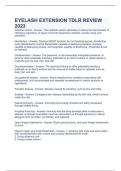
Infection control - Answer- The methods used to eliminate or reduce the transmission of infectious organisms. (4 types of harmful organisms; bacteria, viruses, fungi, and parasites) Disinfection - Answer- Destroys MOST bacteria, but not bacterial spores; disinfecting tools (disinfectants must be bactericidal; capable of destroying bacteria; virucidal, capable of destroying viruses; and fungicidal, capable of destroying . Pesticides & can be harmful) Contamination - Answer- The presence, or the reasonably anticipated presence, of blood or other potentially infectious materials on an item's surface or visible debris or residues such as dust, hair, and skin. Decomtamination - Answer- The removal of blood or other potentially infectious materials on an item's surface and the removal of visible debris or residues such as dust, hair, and skin. Occupational disease - Answer- Illness resulting from conditions associated with employment, such as prolonged and repeated overexposure to certain products or ingredients. Parasitic disease - Answer- Disease caused by parasites, such as lice and mites. Scabies - Answer- Contagious skin disease transmitted by the itch mite, which burrows under the skin Natural Immunity - Answer- Immunity that is partly inherited and partly developed through healthy living. Acquired immunity - Answer- Immunity that the body develops after it overcomes a disease, or through inoculation (such as vaccination) or through exposure to natural allergens such as pollen, cat dander, and ragweed. Open hinged implements - Answer- Brush grooved items, and open hinged implements to scrub Ways to clean your tools/implements - Answer- 1. Washing with soap and warm water, then scrubbing them with a clean and properly disinfected nail brush. 2. Using ultrasonic unit 3. Using a clean solvent * - Answer- If the label does NOT have the word concentrate in it, the product is already mixed. Bioburden - Answer- The number of viable organisms in or on an object or surface or the organic material on a surface or object before decontamination or sterilization. Phenolic disinfectants - Answer- Powerful tuberculocidal disinfectants. They are a form of formaldehyde, have a very high pH, and can damage the skin and eyes. (AKA carcinogens) Multiuse - Answer- Also known as reusable; items that can be cleaned, disinfected, and used on more than one person, even if the item is accidentally exposed to blood or body fluid. Single-use - Answer- Also known as disposable; items that cannot be used more than once. These items cannot be properly cleaned so that all visible residue is removed - such as pumice stones used for pedicures - or they are damaged or contaminated by cleaning and disinfecting. Porous - Answer- (adj.) Full of tiny holes; able to be penetrated by air or water Cross contamination - Answer- occurs when you, the esthetician, touch an object or product with the same hand or utensil Aseptic procedures - Answer- The process of properly handling sterilize and disinfected equipment and supplies to reduce contamination. BSI (Body Substance Isolation) - Answer- Assumes that all substances are infectious, procedures are set by OSHA and local policy. Developed in 1987. PPE (personal protective equipment) - Answer- Is to be worn for contact with all body fluids, even if blood is not visible. Standard precautions (SP) - Answer- Precautions such as wearing personal protective equipment to prevent skin and mucous membranes where contact with the client's blood, body fluids, secretions (except sweat), excretions, non-intact skin, breast milk and mucous membranes is likely. Workers must assume that all blood and body fluids are potential sources of infection, regardless of the perceived risk. Mycobacterium fortuitum - Answer- A microscopic germ that normally exists in tap water in small numbers. Methicillin - Answer- Resistant Staphylococcus aureus (MRSA) type of infectious bacteria that is highly resistant to conventional treatments such as antibiotics. Motility - Answer- Self-movement Active stage - Answer- During this stage bacteria grow and reproduce. (When they reach their largest size they divide into new cells. Division is called binary fusion. Inactive - Answer- Spore-forming stage Season for pink eye - Answer- Winter Acne - Answer- A chronic inflammatory skin disorder of the sebaceous glands characterized by comedones and blemishes; commonly known as acne simplex or acne vulgaris Acne excoriee - Answer- Disorder where clients purposely scrape off acne lesions, causing scarring and discoloration Atopic dematitis - Answer- A chronic, relapsing form of dermatitis (atopic is "excess inflammation from allergies.") and allergens trigger reactions that include dry, cracking skin. Eczema - Answer- An inflammatory, painful, itching disease of the skin; acute or chronic in nature with dry or moist lesions. This should be referred to a physician. Avoid contact and skin care treatments if a client has eczema. Seborrheic dermatitis is a common form of eczema as well as sebaceuos gland disorder; characterized by scaling around the nose, ears, scalp, eyebrows and mid-chest areas. This flaking mainly affects oilier areas. Erythema - Answer- Redness caused by inflammation Folliculitis - Answer- Hair grows under the surface instead of growing up and out of the follicle, causing a bacterial infection. Common in men, usually from shaving. (referred to as barbae folliculitis, folliculitis barbae, or barber's itch.) Pseudofolliculitis, also known as razor bumps, resembles folliculitis without pus or infection. Pruitis - Answer- Medical term for itching; persisting itching Psoriasis - Answer- An itchy skin disease characterized by red patches covered with white-silver scales; caused by an over-proliferation of skin cells that replicate too fast. Urticaria - Answer- Also known as hives. An allergic reaction by the body's histamine production. Verruca - Answer- Also known as wart. A hypertrophy of the papillae and epidermis caused by a virus. Infectious and contagious, verrucas can be spread. Bulla - Answer- Large blister containing a watery fluid; similar to a vesicle but larger. Carbuncle - Answer- Cluster of boils; large inflammation of the subcutaneous tissue caused by staphylococci bacterium; similar to a furuncle (boil) but larger. Crust - Answer- An accumulation of sebum and pus, sometimes mixed with epidermal material, formed by dead cells over a wound or blemish while it is healing. Disease - Answer- An abnormal state in which the body is not functioning normally Hospital disinfectants - Answer- Disinfectant that are effective for cleaning blood and body fluids. Can be used on any non porous surface in the salon. Non-porous - Answer- An item that is made or constructed of a material that has no pores or openings and cannot absorb liquids. Mycobacterium fortuitum - Answer- A microscopic germ that normally exists in tap water in small numbers. Antiseptics and Disinfectants - Answer- Chemical agents that kill or inhibit growth of microorganisms. Should be mix according to MFG instructions on the label so they are safe and effective. Quats (Quaternary Ammonium Compounds) - Answer- Disinfectants that are very effective when used properly in the salon. Decontamination Method #2 - Answer- Cleaning and then sterilizing Sanitize - Answer- The process of destroying or reducing organisms to a safe level. Bactericidal - Answer- Capable of destroying bacteria Virucidal - Answer- Capable of destroying viruses Phenol - Answer- Used to sanitize metallic implements in 5% dilute solution. -Carbolic acid; Caustic poison Systematic disease - Answer- Disease that affects the body as a whole Clean (cleaning) - Answer- A mechanical process (scrubbing) using soap and water or detergent and water to remove all visible dirt, debris, and many disease-causing germs. Cleaning also removes invisible debris that interferes with disinfection. . Chelating soaps - Answer- Detergents that break down stubborn films and remove the residue of products such as scrubs, salts, and masks. Tuberculocidal - Answer- Capable of destroying tuberculosis Decontamination Method #1 - Answer- Cleaning and then disinfecting with appropriate EPA-registered disinfectant by completely immersing implements for 5-10 minutes Sodium hypochlorite - Answer- Household bleach (10%) Immunity - Answer- Resistance to disease 90% - Answer- Ethyl Alcohol Concentration 70% - Answer- Isopropyl Alcohol Concentration Cleaning - Answer- The process of removing dirt, dust, blood, or other visible contaminants from a surface using soap/detergent and water.
Written for
- Institution
- EYELASH EXTENSION TDLR
- Course
- EYELASH EXTENSION TDLR
Document information
- Uploaded on
- June 13, 2023
- Number of pages
- 12
- Written in
- 2022/2023
- Type
- Exam (elaborations)
- Contains
- Questions & answers
Subjects
-
eyelash extension tdlr review 2023

Also available in package deal