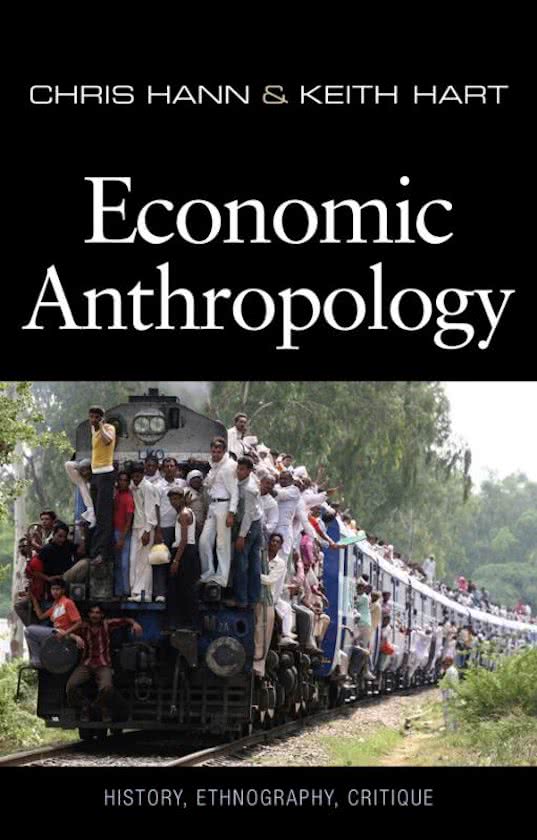
Uitwerking Hann & Hart – Economic Anthropology
Chapter I – Introduction: Economic Anthropology
Anthropology aims to discover the principles of social organization at every level.
Economic anthropology in the 19th century wanted to test the claim that a world economic
order must be founded on the principles that underpinned a Western industrial society.
o Focus on origins and evolution, as 19th century society had yet to reach its final form.
o It was a search for more just alternatives, liberal, socialist, anarchist, communist
In the 20th century anthropology became the data gatherer of “other” cultures.
o This led to a relativist paradigm opposite to universal economics.
o 1870-1940: are “savage” economies controlled by Western rationality?
o 1950-1960: clash within the discipline: formalists versus substantivists.
Formalists: tools of mainstream economics can be applied to anthropology.
Substantivists: anthropology requires institutional approaches.
o 1970-2000: neoliberal globalization, expansion into full range of human economics.
o Future: anthropologists should address the world economy as a whole.
Basic issue remains: do the principles of the dominant Western market economy rest on
universal validity? But at the same time it is crucial to avoid the image of one great historical
divide between the West and the Rest.
Some Issues of Method
Human economy is as old as humanity, but it’s difficult to understand forms of economic
management from archaeology. More productive is it to look at the local situation in present
day societies, that can often greatly differ from any Western notions.
Economic anthropology is mostly formed by the Western perspective of the US and Europe.
The book is mostly based on English literature and reference materials.
The Human Economy
The traditional meaning of economy: total aggregate of goods and services bought and sold
within a national territory.
o At the centre of this paradigm is production, driven by consumer demand.
o People endure the hardship of labour for non-essential goods that hold other values.
o Scarcity is asocial construct, not given by nature.
Exchange: certain resources flows that are governed by a degree of equality between parties.
This system uses a distinction between private (market/profit) and public (state/taxes) spheres.
• It’s engrained with a tension between regulation and free maximization of ‘value’.
This makes every economic transaction part of a world of (rational) choices, making it the only
master discipline besides biology by which human behaviour can be explained.
This dehumanizes the economy, and that’s what gives anthropological economy its validity.
Anthropology looks at the ‘human economy’: wellbeing and satisfaction of human needs, both
in the context of private markets and public goods, which often has no direct monetary value.
o It looks at standard of living, and the wide range of human needs and motivations.
When market mechanism are introduced to public goods it also introduces a change in morals.
o Humans are reduced to service providers and quality drops in the name of efficiency.
o Expansion of capitalism led to both improving living standards and exploitation.
At the same time markets are influenced by political institutions and social and moral rules.
Chapter I – Introduction: Economic Anthropology
Anthropology aims to discover the principles of social organization at every level.
Economic anthropology in the 19th century wanted to test the claim that a world economic
order must be founded on the principles that underpinned a Western industrial society.
o Focus on origins and evolution, as 19th century society had yet to reach its final form.
o It was a search for more just alternatives, liberal, socialist, anarchist, communist
In the 20th century anthropology became the data gatherer of “other” cultures.
o This led to a relativist paradigm opposite to universal economics.
o 1870-1940: are “savage” economies controlled by Western rationality?
o 1950-1960: clash within the discipline: formalists versus substantivists.
Formalists: tools of mainstream economics can be applied to anthropology.
Substantivists: anthropology requires institutional approaches.
o 1970-2000: neoliberal globalization, expansion into full range of human economics.
o Future: anthropologists should address the world economy as a whole.
Basic issue remains: do the principles of the dominant Western market economy rest on
universal validity? But at the same time it is crucial to avoid the image of one great historical
divide between the West and the Rest.
Some Issues of Method
Human economy is as old as humanity, but it’s difficult to understand forms of economic
management from archaeology. More productive is it to look at the local situation in present
day societies, that can often greatly differ from any Western notions.
Economic anthropology is mostly formed by the Western perspective of the US and Europe.
The book is mostly based on English literature and reference materials.
The Human Economy
The traditional meaning of economy: total aggregate of goods and services bought and sold
within a national territory.
o At the centre of this paradigm is production, driven by consumer demand.
o People endure the hardship of labour for non-essential goods that hold other values.
o Scarcity is asocial construct, not given by nature.
Exchange: certain resources flows that are governed by a degree of equality between parties.
This system uses a distinction between private (market/profit) and public (state/taxes) spheres.
• It’s engrained with a tension between regulation and free maximization of ‘value’.
This makes every economic transaction part of a world of (rational) choices, making it the only
master discipline besides biology by which human behaviour can be explained.
This dehumanizes the economy, and that’s what gives anthropological economy its validity.
Anthropology looks at the ‘human economy’: wellbeing and satisfaction of human needs, both
in the context of private markets and public goods, which often has no direct monetary value.
o It looks at standard of living, and the wide range of human needs and motivations.
When market mechanism are introduced to public goods it also introduces a change in morals.
o Humans are reduced to service providers and quality drops in the name of efficiency.
o Expansion of capitalism led to both improving living standards and exploitation.
At the same time markets are influenced by political institutions and social and moral rules.