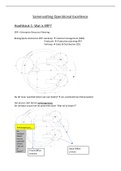
Lecture 1 – Business analysis for responsible organizations
Responsible organizing is about creating multiple types of value simultaneously. This
is a complex system, system approaches (theories) help understand these. There
are system approaches (theories) that help to understand these complex systems.
Responsible organization = organization that considers multiple value creations for
stakeholders (not only profit, also societal). It is based on:
Stakeholder theory = interconnectedness between organization and its stakeholders,
organizations should not only create value for shareholders, also stakeholders
System lens = the view that a system is an interconnected set of elements that is
coherently organized in a way that it achieves something
The system approach is about seeing the system as a whole, seeing interrelations,
seeing feedback (loops) and spotting non-linearities or delays.
Lecture 2 – Basics of system dynamics
System thinking = the whole perspective, language, and tools to understand systems,
a problem in a system is in the system, caused by own behavior
Conventional thinking = the original way of thinking about systems, hard approach
System consists of three things: elements (tangible or intangible), interconnections
and a function or purpose (most important, but hardest one to see)
Tragedy of the common = when a resource is used unlimited resource exhausted
Solution: set quotas or other limitations
Dampened oscillations = delay
Oscillation = object in system moves back and forth, returns to initial state after while
Dynamic equilibrium = inflow and outflow balance themselves, the stock is constant
Integrated reporting framework = framework of how organization creates value (short
and long term), insight about resources and relationships and evaluating
performance in context of environment, it reports both financial and nonfinancial.
Important is: capitals (green), business
model, and value creation
Integrated report six capitals = six resources that companies should include in
report(green:
Financial (investments)
Manufactured (buildings, equipment’s)
Intellectual (knowledge-based intangibles from employees)
Human (people’s competencies, motivation)
Social and relationships (with community in which firm operates)
Natural (renewable and non-renewable environmental resources)
, You have to take all six capitals into account, all needs to be good!!(not just financial)
Functions of stocks:
Stocks act as delays, buffers, or shock absorbers. Because, even when inflow
or outflow changes radically, the stock will take time to change.
Also, stocks allow inflows and outflows to be independent and temporarily out
of balance, there will always be an amount in the stock.
Reinforcing feedback loop = leads to exponential growth or exponential decline, it’s
the same as positive feedback loops
Balancing feedback loop = leads to goal seeking behavior, one stock is desired level,
it’s the same as negative feedback loops
One of the most common system structures, is when you have two-goal seeking
feedback loops, one reinforcing and one balancing. There is always one loop that
dominates the other (mostly the reinforcing one at the inflow side).
A delay in a balancing feedback loop makes a system likely to oscillate:
Delay in the inflow increase inflow outflow decreases (bc delay stock too high
Lecture 3 – Stakeholder theory and system dynamics
Stakeholder theory = analyze the relationship between a business and the groups of
individuals who can affect or are affected by it
Stakeholders are all connected, so stakeholder interests are joint serving
stakeholder is the best long-term strategy
Primary stakeholders: customers, employees, suppliers, financiers, communities
Secondary stakeholders: media, government, competitors, special interest groups
Stakeholder interests are joint. Serving these, is best long-term strategy.
Salience model = guidelines on how to map, manage, and engage with stakeholders.
Eight stakeholders with two categories:
Responsible organizing is about creating multiple types of value simultaneously. This
is a complex system, system approaches (theories) help understand these. There
are system approaches (theories) that help to understand these complex systems.
Responsible organization = organization that considers multiple value creations for
stakeholders (not only profit, also societal). It is based on:
Stakeholder theory = interconnectedness between organization and its stakeholders,
organizations should not only create value for shareholders, also stakeholders
System lens = the view that a system is an interconnected set of elements that is
coherently organized in a way that it achieves something
The system approach is about seeing the system as a whole, seeing interrelations,
seeing feedback (loops) and spotting non-linearities or delays.
Lecture 2 – Basics of system dynamics
System thinking = the whole perspective, language, and tools to understand systems,
a problem in a system is in the system, caused by own behavior
Conventional thinking = the original way of thinking about systems, hard approach
System consists of three things: elements (tangible or intangible), interconnections
and a function or purpose (most important, but hardest one to see)
Tragedy of the common = when a resource is used unlimited resource exhausted
Solution: set quotas or other limitations
Dampened oscillations = delay
Oscillation = object in system moves back and forth, returns to initial state after while
Dynamic equilibrium = inflow and outflow balance themselves, the stock is constant
Integrated reporting framework = framework of how organization creates value (short
and long term), insight about resources and relationships and evaluating
performance in context of environment, it reports both financial and nonfinancial.
Important is: capitals (green), business
model, and value creation
Integrated report six capitals = six resources that companies should include in
report(green:
Financial (investments)
Manufactured (buildings, equipment’s)
Intellectual (knowledge-based intangibles from employees)
Human (people’s competencies, motivation)
Social and relationships (with community in which firm operates)
Natural (renewable and non-renewable environmental resources)
, You have to take all six capitals into account, all needs to be good!!(not just financial)
Functions of stocks:
Stocks act as delays, buffers, or shock absorbers. Because, even when inflow
or outflow changes radically, the stock will take time to change.
Also, stocks allow inflows and outflows to be independent and temporarily out
of balance, there will always be an amount in the stock.
Reinforcing feedback loop = leads to exponential growth or exponential decline, it’s
the same as positive feedback loops
Balancing feedback loop = leads to goal seeking behavior, one stock is desired level,
it’s the same as negative feedback loops
One of the most common system structures, is when you have two-goal seeking
feedback loops, one reinforcing and one balancing. There is always one loop that
dominates the other (mostly the reinforcing one at the inflow side).
A delay in a balancing feedback loop makes a system likely to oscillate:
Delay in the inflow increase inflow outflow decreases (bc delay stock too high
Lecture 3 – Stakeholder theory and system dynamics
Stakeholder theory = analyze the relationship between a business and the groups of
individuals who can affect or are affected by it
Stakeholders are all connected, so stakeholder interests are joint serving
stakeholder is the best long-term strategy
Primary stakeholders: customers, employees, suppliers, financiers, communities
Secondary stakeholders: media, government, competitors, special interest groups
Stakeholder interests are joint. Serving these, is best long-term strategy.
Salience model = guidelines on how to map, manage, and engage with stakeholders.
Eight stakeholders with two categories: