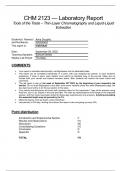
CHM 2123 — Laboratory Report
Tools of the Trade – Thin-Layer Chromatography and Liquid-Liquid
Extraction
Student(s) Name(s) Asha Doughty
and Number(s) : 300226452
This report is: Individual
Date: September 29, 2022
Teaching Assistant: Samuel Delisle
Weekly Lab Period Thursday
COMMENTS
• Your report is submitted electronically via Brightspace into the dedicated folder.
• This report can be completed individually or in pairs, with your assigned lab partner, to each student’s
preference. If done in pairs, each student must submit an identical copy of the pre-lab. Make sure to
include both your names and student numbers above. Both students will receive the same marks and
comments.
• This lab report is due on the week of September 26th 2022, by the beginning of your respective lab
section. Do not trust Brightspace’s due date: since every students share the same Brightspace page, the
due date found online is for the last section of the week.
• Your results and discussion will cover both reactions done for this experiment. Type all the answers using
Arial font, size 12 pt, directly in the cells provided. The cells are representative of the length of the expected
answer, and their sizes have been locked to discourage superfluously long answers. Anything exceeding
this expected length may be ignored by the TA.
• Molecular figures must be drawn using ChemDraw.
• Late penalty is 20%/day, starting the moment the report is due and going up every 24h.
Point distribution
Introduction and Experimental Section /7
Results and Observations /15
Discussion /36
Consolidating Questions /16
Conclusion /3
Appendix /2
TOTAL /79
,Introduction and Experimental Section
Explain briefly (3-5 sentences), in your words, the specific objectives of your experiment.
Include a short description of the theory relevant to accomplishing your goals. (5 pts)
In this experiment, we had to separate a mixture of two organic, colored, chemicals into a
separate organic solvent. This was done through liquid-liquid extractions. The aqueous phase
participated in an acid-base reaction with only one of the chemicals, making it charged. Since
like dissolves like, the newly charged molecule will preferentially dissolve in the aqueous
phase, while the other, organic, chemical remains in the organic phase. To check the results,
thin layer chromatography was used on the mixture as well as the newly separated compounds
and was compared with pure samples of the two chemicals.
Briefly explain the roles of Parts A & B in this experiment toward your final goal. (2 pts)
The role of Part A was to determine which phase (organic or aqueous) each colorant
preferentially dissolves in. These results indicate the solubility of each dye as it interacts with
different pHs in the aqueous layer. The results will be used to determine which aqueous phase
(acidic, basic, neutral) is needed to obtain the most effective separation.
The role of Part B was to determine which organic mobile phase was the most effective during
a TLC of each pure colorant. The better mobile phase is then used for the liquid-liquid
extractions of mixed colorants.
, Results and Observations
Identify the dye mixture that was provided to you by naming the two dyes found therein. (1 pt)
Nile blue and carotene
Summarize your visual observations from Part A by indicating the color of each respective
phases in the following table. (3 pts)
Sudan Sudan Neutral
pH Layer Nile Blue Carotene
Blue Orange Red
Organic Blue Clear Clear Yellow Clear
Acid
Aqueous Clear Orange Green Clear Mauve
Pale
Organic Blue Clear Yellow Yellow
Neutral Yellow
Aqueous Clear Yellow Blue Clear Pink
Organic Blue Yellow Orange Yellow Yellow
Basic Pale
Aqueous Clear Clear Clear Dark Yellow
Yellow
Any further comments can be included in the box below:
Provide a point-form list of relevant visual observations (at least 5) made during the liquid-liquid
extraction steps (Parts C & D). (3 pts)
• Top layer (organic) was dark orange in color
• Bottom layer (aqueous) was dark blue in color
• Tiny solid flakes of both colorants were observed in the separatory funnel
• After the chemicals were allowed to settle in the separatory funnel, the bottom layer
became a clearer and more distinct blue
• A minute amount of organic phase was seen in the third extraction of the aqueous
phase as shown by an orange tint.
Tools of the Trade – Thin-Layer Chromatography and Liquid-Liquid
Extraction
Student(s) Name(s) Asha Doughty
and Number(s) : 300226452
This report is: Individual
Date: September 29, 2022
Teaching Assistant: Samuel Delisle
Weekly Lab Period Thursday
COMMENTS
• Your report is submitted electronically via Brightspace into the dedicated folder.
• This report can be completed individually or in pairs, with your assigned lab partner, to each student’s
preference. If done in pairs, each student must submit an identical copy of the pre-lab. Make sure to
include both your names and student numbers above. Both students will receive the same marks and
comments.
• This lab report is due on the week of September 26th 2022, by the beginning of your respective lab
section. Do not trust Brightspace’s due date: since every students share the same Brightspace page, the
due date found online is for the last section of the week.
• Your results and discussion will cover both reactions done for this experiment. Type all the answers using
Arial font, size 12 pt, directly in the cells provided. The cells are representative of the length of the expected
answer, and their sizes have been locked to discourage superfluously long answers. Anything exceeding
this expected length may be ignored by the TA.
• Molecular figures must be drawn using ChemDraw.
• Late penalty is 20%/day, starting the moment the report is due and going up every 24h.
Point distribution
Introduction and Experimental Section /7
Results and Observations /15
Discussion /36
Consolidating Questions /16
Conclusion /3
Appendix /2
TOTAL /79
,Introduction and Experimental Section
Explain briefly (3-5 sentences), in your words, the specific objectives of your experiment.
Include a short description of the theory relevant to accomplishing your goals. (5 pts)
In this experiment, we had to separate a mixture of two organic, colored, chemicals into a
separate organic solvent. This was done through liquid-liquid extractions. The aqueous phase
participated in an acid-base reaction with only one of the chemicals, making it charged. Since
like dissolves like, the newly charged molecule will preferentially dissolve in the aqueous
phase, while the other, organic, chemical remains in the organic phase. To check the results,
thin layer chromatography was used on the mixture as well as the newly separated compounds
and was compared with pure samples of the two chemicals.
Briefly explain the roles of Parts A & B in this experiment toward your final goal. (2 pts)
The role of Part A was to determine which phase (organic or aqueous) each colorant
preferentially dissolves in. These results indicate the solubility of each dye as it interacts with
different pHs in the aqueous layer. The results will be used to determine which aqueous phase
(acidic, basic, neutral) is needed to obtain the most effective separation.
The role of Part B was to determine which organic mobile phase was the most effective during
a TLC of each pure colorant. The better mobile phase is then used for the liquid-liquid
extractions of mixed colorants.
, Results and Observations
Identify the dye mixture that was provided to you by naming the two dyes found therein. (1 pt)
Nile blue and carotene
Summarize your visual observations from Part A by indicating the color of each respective
phases in the following table. (3 pts)
Sudan Sudan Neutral
pH Layer Nile Blue Carotene
Blue Orange Red
Organic Blue Clear Clear Yellow Clear
Acid
Aqueous Clear Orange Green Clear Mauve
Pale
Organic Blue Clear Yellow Yellow
Neutral Yellow
Aqueous Clear Yellow Blue Clear Pink
Organic Blue Yellow Orange Yellow Yellow
Basic Pale
Aqueous Clear Clear Clear Dark Yellow
Yellow
Any further comments can be included in the box below:
Provide a point-form list of relevant visual observations (at least 5) made during the liquid-liquid
extraction steps (Parts C & D). (3 pts)
• Top layer (organic) was dark orange in color
• Bottom layer (aqueous) was dark blue in color
• Tiny solid flakes of both colorants were observed in the separatory funnel
• After the chemicals were allowed to settle in the separatory funnel, the bottom layer
became a clearer and more distinct blue
• A minute amount of organic phase was seen in the third extraction of the aqueous
phase as shown by an orange tint.