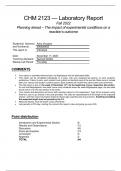
CHM 2123 — Laboratory Report
Fall 2022
Planning ahead – The impact of experimental conditions on a
reaction’s outcome
Student(s) Name(s) Asha Doughty
and Number(s) : 300226452
This report is: Individual
Date: November 17, 2022
Teaching Assistant: Samuel Delisle
Weekly Lab Period Thursday
COMMENTS
• Your report is submitted electronically via Brightspace into the dedicated folder.
• This report can be completed individually or in pairs, with your assigned lab partner, to each student’s
preference. If done in pairs, each student must submit an identical copy of the pre-lab. Make sure to include
both your names and student numbers above. Both students will receive the same marks and comments.
• This lab report is due on the week of November 14th, by the beginning of your respective lab section.
Do not trust Brightspace’s due date: since every students share the same Brightspace page, the due date
found online is for the last section of the week.
• Your results and discussion will cover both reactions done for this experiment. Type all the answers using
Arial font, size 12 pt, directly in the cells provided. The cells are representative of the length of the expected
answer, and their sizes have been locked to discourage superfluously long answers. Anything exceeding
this expected length may be ignored by the TA.
• Molecular figures must be drawn using ChemDraw.
• Late penalty is 20%/day, starting the moment the report is due and going up every 24h.
Point distribution
Introduction and Experimental Section /8
Results and Observations /15
Discussion /45
Post-Lab Question /19
Conclusion /5
Appendix /2
TOTAL /94
,Introduction and Experimental Section
Explain briefly, and in your words, the objectives of this experiment, and a short description of the
procedure and techniques employed to achieve your goal. This description should include your
initial hypothesis regarding the identity of the products as well as (if relevant) the purpose of the
various reagents used. In addition, explain how the relevance of the key steps. (8 pts)
The goal of this experiment was to prove or disprove a hypothesis regarding the product of a
reaction between 4-methoxyacetophenone and sodium hypochlorite under acidic and basic
conditions. Before the experiment, it was hypothesized that the reaction would yield expected
product 4 under acidic conditions, and product 1 under basic.
For the acidic reaction, 4-methoxyacetophenone, acetic acid, and bleach were mixed using a stir
plate. To determine if the reaction was complete, a TLC was performed. Afterwards, water was
added to precipitate the unknown product. This unknown product was filtered using a vacuum
filtration set up and then weighed to obtain a crude mass value. Then, a recrystallization was
performed to purify the crude solid product. The crude solid was boiled in a solution of 1:1
methanol and water. Once the solid had dissolved, the mixture cooled in room temperature then
in an ice bath to precipitate the recrystallized solid. This recrystallized solid was filtered using
vacuum filtration and then further dried using a water aspirator set up. Once dry, the
recrystallized solid was weighed and underwent melting point analysis and TLC. The results of
the melting point analysis and TLC would indicate whether the hypothesis was proved or
disproved.
For the basic reaction, 4-methoxyacetophenone, sodium hypochlorite, and sodium hydroxide
were boiled in a reflux apparatus set up. To determine if the reaction was complete, a TLC was
performed. Next, acetone was added to the mixture and the mixture continued to boil. Later, the
mixture was cooled in an ice bath. Following, a liquid liquid extraction was performed. The
unknown product was found in the aqueous phase. Therefore, three washed were executed with
ethyl acetate to wash out any organic impurities. The aqueous solution was put in an ice bath
and drops of HCl were added to precipitate out a product. This precipitated product was vacuum
filtered and dried using a water aspirator. The solid product was weighed and underwent melting
point analysis and TLC. The results of the melting point analysis and TLC would indicate whether
the hypothesis was proved or disproved.
, Results and Observations
Provide a point-form list of meaningful visual observations made for each reaction, including the
purification steps. For each observation, briefly explain how this observation is relevant to the
reaction at hand. (4 pts)
Acidic conditions Basic conditions
• When 4-methoxyacetohenone, acetic • When 4-methoxyacetophenone,
acid, and bleach were stirred, the bleach, and sodium hydroxide were
solution was a foggy yellow with solid boiled in a reflux apparatus, the
yellow clumps. The absence of a purple solution was a clear yellow. This color
color, which was expected, indicated change was indicative of a reaction
that there was an error in the reaction. occurring.
• After the crude product was boiled and • When HCl was added to the mixture
cooled in an ice bath, the resulting submerged in an ice bath, the solution
mixture was a slurry brown. This turned into a foggy white. This
indicated that a solid has precipitated. indicated that a solid has precipitated.
• When the recrystallized solid was dried
using a water aspirator set-up, the
brown/purply liquid was filtered into the
volumetric flask, leaving behind a pasty
yellow solid. This indicated that the
water aspirator was successful in
drying the solid.
• The final recrystallizes solid was a
gooey clay-like texture. Since it was
expected that the final product be
crystalline, there was an error in the
procedure.
Based on the identity of each product, fill the following tables. (5 pts)
Product’s molar Product’s molar
184.63 136.16
mass mass
Mass Mass
Compound mmoles Compound mmoles
(g) (g)
4-Methoxyacetophenone 4-Methoxyacetophenone
(Acidic Rxn) 1.13 7.50 (Basic Rxn) 0.68 4.50
Crude A 0.92 5.0 Purified B 0.93 6.8
Recrystallized A 0.48 2.6
Final yield Final yield
(%) (%)
Fall 2022
Planning ahead – The impact of experimental conditions on a
reaction’s outcome
Student(s) Name(s) Asha Doughty
and Number(s) : 300226452
This report is: Individual
Date: November 17, 2022
Teaching Assistant: Samuel Delisle
Weekly Lab Period Thursday
COMMENTS
• Your report is submitted electronically via Brightspace into the dedicated folder.
• This report can be completed individually or in pairs, with your assigned lab partner, to each student’s
preference. If done in pairs, each student must submit an identical copy of the pre-lab. Make sure to include
both your names and student numbers above. Both students will receive the same marks and comments.
• This lab report is due on the week of November 14th, by the beginning of your respective lab section.
Do not trust Brightspace’s due date: since every students share the same Brightspace page, the due date
found online is for the last section of the week.
• Your results and discussion will cover both reactions done for this experiment. Type all the answers using
Arial font, size 12 pt, directly in the cells provided. The cells are representative of the length of the expected
answer, and their sizes have been locked to discourage superfluously long answers. Anything exceeding
this expected length may be ignored by the TA.
• Molecular figures must be drawn using ChemDraw.
• Late penalty is 20%/day, starting the moment the report is due and going up every 24h.
Point distribution
Introduction and Experimental Section /8
Results and Observations /15
Discussion /45
Post-Lab Question /19
Conclusion /5
Appendix /2
TOTAL /94
,Introduction and Experimental Section
Explain briefly, and in your words, the objectives of this experiment, and a short description of the
procedure and techniques employed to achieve your goal. This description should include your
initial hypothesis regarding the identity of the products as well as (if relevant) the purpose of the
various reagents used. In addition, explain how the relevance of the key steps. (8 pts)
The goal of this experiment was to prove or disprove a hypothesis regarding the product of a
reaction between 4-methoxyacetophenone and sodium hypochlorite under acidic and basic
conditions. Before the experiment, it was hypothesized that the reaction would yield expected
product 4 under acidic conditions, and product 1 under basic.
For the acidic reaction, 4-methoxyacetophenone, acetic acid, and bleach were mixed using a stir
plate. To determine if the reaction was complete, a TLC was performed. Afterwards, water was
added to precipitate the unknown product. This unknown product was filtered using a vacuum
filtration set up and then weighed to obtain a crude mass value. Then, a recrystallization was
performed to purify the crude solid product. The crude solid was boiled in a solution of 1:1
methanol and water. Once the solid had dissolved, the mixture cooled in room temperature then
in an ice bath to precipitate the recrystallized solid. This recrystallized solid was filtered using
vacuum filtration and then further dried using a water aspirator set up. Once dry, the
recrystallized solid was weighed and underwent melting point analysis and TLC. The results of
the melting point analysis and TLC would indicate whether the hypothesis was proved or
disproved.
For the basic reaction, 4-methoxyacetophenone, sodium hypochlorite, and sodium hydroxide
were boiled in a reflux apparatus set up. To determine if the reaction was complete, a TLC was
performed. Next, acetone was added to the mixture and the mixture continued to boil. Later, the
mixture was cooled in an ice bath. Following, a liquid liquid extraction was performed. The
unknown product was found in the aqueous phase. Therefore, three washed were executed with
ethyl acetate to wash out any organic impurities. The aqueous solution was put in an ice bath
and drops of HCl were added to precipitate out a product. This precipitated product was vacuum
filtered and dried using a water aspirator. The solid product was weighed and underwent melting
point analysis and TLC. The results of the melting point analysis and TLC would indicate whether
the hypothesis was proved or disproved.
, Results and Observations
Provide a point-form list of meaningful visual observations made for each reaction, including the
purification steps. For each observation, briefly explain how this observation is relevant to the
reaction at hand. (4 pts)
Acidic conditions Basic conditions
• When 4-methoxyacetohenone, acetic • When 4-methoxyacetophenone,
acid, and bleach were stirred, the bleach, and sodium hydroxide were
solution was a foggy yellow with solid boiled in a reflux apparatus, the
yellow clumps. The absence of a purple solution was a clear yellow. This color
color, which was expected, indicated change was indicative of a reaction
that there was an error in the reaction. occurring.
• After the crude product was boiled and • When HCl was added to the mixture
cooled in an ice bath, the resulting submerged in an ice bath, the solution
mixture was a slurry brown. This turned into a foggy white. This
indicated that a solid has precipitated. indicated that a solid has precipitated.
• When the recrystallized solid was dried
using a water aspirator set-up, the
brown/purply liquid was filtered into the
volumetric flask, leaving behind a pasty
yellow solid. This indicated that the
water aspirator was successful in
drying the solid.
• The final recrystallizes solid was a
gooey clay-like texture. Since it was
expected that the final product be
crystalline, there was an error in the
procedure.
Based on the identity of each product, fill the following tables. (5 pts)
Product’s molar Product’s molar
184.63 136.16
mass mass
Mass Mass
Compound mmoles Compound mmoles
(g) (g)
4-Methoxyacetophenone 4-Methoxyacetophenone
(Acidic Rxn) 1.13 7.50 (Basic Rxn) 0.68 4.50
Crude A 0.92 5.0 Purified B 0.93 6.8
Recrystallized A 0.48 2.6
Final yield Final yield
(%) (%)