Week 4: Infection and immunity I
Innate immunity and infections
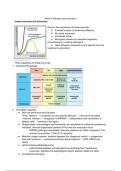
Picture: the importance of innate immunity.
● A limited number of performed effectors
● No clonal expansion
● Immediate action
● Recognise classes of molecules frequently
encountered on invading pathogens.
● Allow defensive measures until a specific immune
response is generated.
Three categories of innate immunity:
1. Anatomic/Physiologic:
2. Immediate response
● Both are performed and inducible.
>First, infection → recognition by non-specific effectors → removal of the agent
>Second, infection → recognition of M/PAMP → inflammation and recruitment of
effector cells → removal of the agent.
● Phagocytosis: macrophages and neutrophils are specialised in killing and swallowing
microbes. Immune-suppressed patients (HIV) have low neutrophil count.
○ PAMPS (pathogen-associated molecular patterns) are often recognised. This
requires co-evolution. CLRs & FC receptors
● Reactive oxygen species: bacteria ingested into phagocyte vesicle → phagosome
fuse with lysosome → lysosomal enzymes digest organism → ROS (H2O2 and
HOCl)
● Antimicrobial peptides/lysozyme:
○ Antimicrobial peptides: kill pathogens by perturbing their membranes.
○ Lysosome: hydrolise the peptidoglycan layers between NAM and NAG.
● Complement activation:
, ○ C5a, C3a = inflammation → recruitment of neutrophils → not tissue resident
→ increase vascular permeability & chemotaxis
○ C3b = phagocytosis of macrophages
○ MAC = lysis of the microbe
● Iron/nutrients withholding: the host ensures a low amount of iron by the storage
inside the complex with ferritin (F). NRAMP1 also lowers the Fe3+ amount in the
phagosomal membrane.
3. Early induced response by inflammation: Second response.
● Transmembrane receptors (immediate response) = CLR & FC receptors
● Transmembrane receptors (early induced) = TLR
○ TLR: recognize different associated molecular patterns (PAMPs) in different
locations.
○ TLR signals via MyD88 and activate IRAK4 → active IRAK4 leads to active
NfkB → translocates to the nucleus and binds regulatory regions of
pro-inflammatory genes like TNFa and CXCL8 → neutrophil recruitment =
type I IFN response
○ MyD88 deficiency = susceptible to invasive infections but resistant to normal
common bacteria
○ IRAK4 deficiency = recurrent severe infections
● Cytosolic receptors (early induced) = NOD, NLR, RLR, CDS
○ NOD: cytosolic innate receptors that recognise peptidoglycan layer. Signalling
is very similar to TLR.
○ NLR: inflammasome → caspase 1 activation → proapoptotic (inflammatory
cell death)
○ RLR & CDS: activate NfkB → interferon reponse
IL-1B & TNF-a = blood vessels more permeable, more effector molecules into the tissue.
CXL8 = recruits neutrophils from the blood and guides them to the tissue.
Type 1 TNF response:
● Resistance to viral replication in all cells.
● Increase expression of ligands for receptors of NK cells
● Activate NK cells to kill virus-infected cells.
Role of NK cells in innate anti-viral immunity:
Innate immunity and infections
Picture: the importance of innate immunity.
● A limited number of performed effectors
● No clonal expansion
● Immediate action
● Recognise classes of molecules frequently
encountered on invading pathogens.
● Allow defensive measures until a specific immune
response is generated.
Three categories of innate immunity:
1. Anatomic/Physiologic:
2. Immediate response
● Both are performed and inducible.
>First, infection → recognition by non-specific effectors → removal of the agent
>Second, infection → recognition of M/PAMP → inflammation and recruitment of
effector cells → removal of the agent.
● Phagocytosis: macrophages and neutrophils are specialised in killing and swallowing
microbes. Immune-suppressed patients (HIV) have low neutrophil count.
○ PAMPS (pathogen-associated molecular patterns) are often recognised. This
requires co-evolution. CLRs & FC receptors
● Reactive oxygen species: bacteria ingested into phagocyte vesicle → phagosome
fuse with lysosome → lysosomal enzymes digest organism → ROS (H2O2 and
HOCl)
● Antimicrobial peptides/lysozyme:
○ Antimicrobial peptides: kill pathogens by perturbing their membranes.
○ Lysosome: hydrolise the peptidoglycan layers between NAM and NAG.
● Complement activation:
, ○ C5a, C3a = inflammation → recruitment of neutrophils → not tissue resident
→ increase vascular permeability & chemotaxis
○ C3b = phagocytosis of macrophages
○ MAC = lysis of the microbe
● Iron/nutrients withholding: the host ensures a low amount of iron by the storage
inside the complex with ferritin (F). NRAMP1 also lowers the Fe3+ amount in the
phagosomal membrane.
3. Early induced response by inflammation: Second response.
● Transmembrane receptors (immediate response) = CLR & FC receptors
● Transmembrane receptors (early induced) = TLR
○ TLR: recognize different associated molecular patterns (PAMPs) in different
locations.
○ TLR signals via MyD88 and activate IRAK4 → active IRAK4 leads to active
NfkB → translocates to the nucleus and binds regulatory regions of
pro-inflammatory genes like TNFa and CXCL8 → neutrophil recruitment =
type I IFN response
○ MyD88 deficiency = susceptible to invasive infections but resistant to normal
common bacteria
○ IRAK4 deficiency = recurrent severe infections
● Cytosolic receptors (early induced) = NOD, NLR, RLR, CDS
○ NOD: cytosolic innate receptors that recognise peptidoglycan layer. Signalling
is very similar to TLR.
○ NLR: inflammasome → caspase 1 activation → proapoptotic (inflammatory
cell death)
○ RLR & CDS: activate NfkB → interferon reponse
IL-1B & TNF-a = blood vessels more permeable, more effector molecules into the tissue.
CXL8 = recruits neutrophils from the blood and guides them to the tissue.
Type 1 TNF response:
● Resistance to viral replication in all cells.
● Increase expression of ligands for receptors of NK cells
● Activate NK cells to kill virus-infected cells.
Role of NK cells in innate anti-viral immunity: