Medical Immunology (328 questions with correct answers)
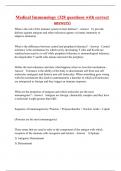
What is the role of the immune system in host defense? - Answer To provide defense against antigens and other infectious agents via innate immunity or adaptive immunity. What is the difference between central and peripheral tolerance? - Answer Central tolerance is the mechanism by which newly developing T cells and B cells are rendered non-reactive to self while peripheral tolerance is immunological tolerance developed after T and B cells mature and enter the periphery. Define the term tolerance and state what happens when we lose this mechanism - Answer Tolerance is the ability of the body to discriminate self from non self molecules (antigens) and destroy non-self molecules. When something goes wrong with this mechanism this leads to autoimmunity a disorder in which self molecules are interpreted as foreign and they trigger an immune response. What are the properties of antigens and which molecules are the most immunogenic? - Answer Antigens are foreign, chemically complex and they have a molecular weight greater than 6kD. Sequence of immunogenicity: Proteins > Polysaccharides > Nucleic Acids > Lipids (Proteins are the most immunogenic) Three terms that are used to refer to the component of the antigen with which receptors of the immune cells recognize and interact - Answer 1) Epitope
Written for
- Institution
- Medical Immunology
- Course
- Medical Immunology
Document information
- Uploaded on
- June 9, 2023
- Number of pages
- 100
- Written in
- 2022/2023
- Type
- Exam (elaborations)
- Contains
- Questions & answers
Subjects
-
medical immunology 328 questions with correct ans

Also available in package deal