1
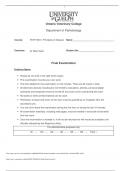
Ontario Veterinary College
Department of Pathobiology
Course: PATH*3610 Principles of Disease Name:_________________________________
Examiner: Dr Rob Foster Student No: ____________________________
Final Examination
Instructions
• Please do not write in the right hand margin.
• This examination must be your own work.
• The time allotted for the examination is 120 minutes. There are 60 marks in total.
• All electronic devices including but not limited to calculators, phones, personal digital
assistants and computers must be turned off and must not be used during the exam.
• No books or other printed material can be used.
• Permission to leave and return to the room must be granted by an invigilator who will
accompany you.
• You are not to leave the examination during the first hour or during the last 15 minutes.
• All examination materials, including note pages, must be handed in and shall not be taken
from the room.
• Once the examination is handed in, it will not be returned nor will results be available until
officially released by the Registrars office.
For administrative purposes only
Q1 …… Q2 …… Q3 …… Q4 …… Q5 …… Q6 …… Total =
This study source was downloaded by 100000850872992 from CourseHero.com on 06-08-2023 19:58:08 GMT -05:00
https://www.coursehero.com/file/8856178/Path3610-Final-Exam-Answers/
, 2
QUESTION 1 (10 MARKS)
Read the following excerpt and answer the questions that follow.
On Wed 22 Jan 2009, CDC's Special Pathogens Branch retrospectively diagnosed a case of Marburg hemorrhagic
fever in a U.S. traveler. The patient developed illness 4 days after returning to the U.S., was hospitalized,
discharged, and fully recovered. Initial testing of samples collected during the patient's acute illness in January
2008 did not initially show evidence of Marburg virus infection. Testing of a convalescent sample indicated a
possible previous infection.The recovered patient had visited the "python cave" in Maramagambo Forest, Queen
Elizabeth Park, western Uganda.
Marburg virus is a zoonotic virus that occurs in tropical areas of Africa, and causes a severe, often fatal,
hemorrhagic fever in humans and non-human primates. It can also be transmitted through direct contact with a
symptomatic patient or materials contaminated with infectious body fluids. The virus is thought to enter
endothelial cells, which then die and release the virus into the blood.
a) What does ‘zoonotic’ mean? (1 mark)
Spread from animals to humans
b) What is the mechanism of the development of fever? (2 marks)
Inflammation – cytokines – systemic – increases body temperature
c) The ‘initial testing of samples’ reported above was examination of the blood for
immunoglobulin against Marburg virus. Why was it negative? (2 marks)
Insufficient time for response to occur,
Also accept Ig bound to Ag
d) List the 3 general abnormalities or mechanisms that result in haemorrhage (all kinds of
haemorrhage, not just in this disease), and give an example of each. (3 marks)
Endothelial problem - trauma
Platelet problem -thrombocytopenia
Clotting factor problem - haemophilia
e) Which of these is likely to be responsible in Marburg haemorrhagic fever? (1 mark)
Endothelial problem
f) What kind of haemorrhage would you expect to see given your answer to (e) above? (1
mark)
Appropriate to answer – should be petechia
This study source was downloaded by 100000850872992 from CourseHero.com on 06-08-2023 19:58:08 GMT -05:00
https://www.coursehero.com/file/8856178/Path3610-Final-Exam-Answers/
Ontario Veterinary College
Department of Pathobiology
Course: PATH*3610 Principles of Disease Name:_________________________________
Examiner: Dr Rob Foster Student No: ____________________________
Final Examination
Instructions
• Please do not write in the right hand margin.
• This examination must be your own work.
• The time allotted for the examination is 120 minutes. There are 60 marks in total.
• All electronic devices including but not limited to calculators, phones, personal digital
assistants and computers must be turned off and must not be used during the exam.
• No books or other printed material can be used.
• Permission to leave and return to the room must be granted by an invigilator who will
accompany you.
• You are not to leave the examination during the first hour or during the last 15 minutes.
• All examination materials, including note pages, must be handed in and shall not be taken
from the room.
• Once the examination is handed in, it will not be returned nor will results be available until
officially released by the Registrars office.
For administrative purposes only
Q1 …… Q2 …… Q3 …… Q4 …… Q5 …… Q6 …… Total =
This study source was downloaded by 100000850872992 from CourseHero.com on 06-08-2023 19:58:08 GMT -05:00
https://www.coursehero.com/file/8856178/Path3610-Final-Exam-Answers/
, 2
QUESTION 1 (10 MARKS)
Read the following excerpt and answer the questions that follow.
On Wed 22 Jan 2009, CDC's Special Pathogens Branch retrospectively diagnosed a case of Marburg hemorrhagic
fever in a U.S. traveler. The patient developed illness 4 days after returning to the U.S., was hospitalized,
discharged, and fully recovered. Initial testing of samples collected during the patient's acute illness in January
2008 did not initially show evidence of Marburg virus infection. Testing of a convalescent sample indicated a
possible previous infection.The recovered patient had visited the "python cave" in Maramagambo Forest, Queen
Elizabeth Park, western Uganda.
Marburg virus is a zoonotic virus that occurs in tropical areas of Africa, and causes a severe, often fatal,
hemorrhagic fever in humans and non-human primates. It can also be transmitted through direct contact with a
symptomatic patient or materials contaminated with infectious body fluids. The virus is thought to enter
endothelial cells, which then die and release the virus into the blood.
a) What does ‘zoonotic’ mean? (1 mark)
Spread from animals to humans
b) What is the mechanism of the development of fever? (2 marks)
Inflammation – cytokines – systemic – increases body temperature
c) The ‘initial testing of samples’ reported above was examination of the blood for
immunoglobulin against Marburg virus. Why was it negative? (2 marks)
Insufficient time for response to occur,
Also accept Ig bound to Ag
d) List the 3 general abnormalities or mechanisms that result in haemorrhage (all kinds of
haemorrhage, not just in this disease), and give an example of each. (3 marks)
Endothelial problem - trauma
Platelet problem -thrombocytopenia
Clotting factor problem - haemophilia
e) Which of these is likely to be responsible in Marburg haemorrhagic fever? (1 mark)
Endothelial problem
f) What kind of haemorrhage would you expect to see given your answer to (e) above? (1
mark)
Appropriate to answer – should be petechia
This study source was downloaded by 100000850872992 from CourseHero.com on 06-08-2023 19:58:08 GMT -05:00
https://www.coursehero.com/file/8856178/Path3610-Final-Exam-Answers/