Lead Compound Discovery, Pharmacophore Identification and Structure Activity
Relationships
Lead compound- interacts with the process under study (not very
effective and have side effects)
Natural products- plants, microbiology, venom and animals
Screening existing libraries, evaluation of existing drugs, exploiting side
effects of existing drugs, metabolism of initial compounds and exploiting
natural ligands
Identifying SARs/pharmacophore- identify vital parts of molecule,
synthetic simplification and enhanced activity through manipulation
Improve lead compound using Lipinski’s rules
1869 Crum, Brown and Fraser- one chemical group giving one response
1897 Paul Ehrlich- discover important functional groups for
pharmacological activity and modifying them to improve potency, safety
and selectivity
1936 Ing- antagonists have the same functional groups as agonists but
also have additional interactions
Structure activity- types of functional groups, number of functional
groups and arrangement of functional groups
Drug receptor Interactions:
Covalent- rarely seen, irreversible bonding, mainly DNA interactions and
40-110 kcal/mol
Ionic- drugs can bind and dissociate at medium strength 5-10 kcal/mol
Hydrogen bonds- exchange oxygen for sulphur to weaken attraction but
weak so must be additive 2-5 kcal/mol
Hydrophobic- pi-pi aromatic and alkyl groups fit in aromatic pockets
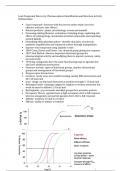
Occupancy Theory- agonists have a high occupancy elicit a full response
whereas antagonists and partial agonists don’t elicit a full response
Affinity- tendency to bind to receptor
Efficacy- ability to initiate a response
,
Relationships
Lead compound- interacts with the process under study (not very
effective and have side effects)
Natural products- plants, microbiology, venom and animals
Screening existing libraries, evaluation of existing drugs, exploiting side
effects of existing drugs, metabolism of initial compounds and exploiting
natural ligands
Identifying SARs/pharmacophore- identify vital parts of molecule,
synthetic simplification and enhanced activity through manipulation
Improve lead compound using Lipinski’s rules
1869 Crum, Brown and Fraser- one chemical group giving one response
1897 Paul Ehrlich- discover important functional groups for
pharmacological activity and modifying them to improve potency, safety
and selectivity
1936 Ing- antagonists have the same functional groups as agonists but
also have additional interactions
Structure activity- types of functional groups, number of functional
groups and arrangement of functional groups
Drug receptor Interactions:
Covalent- rarely seen, irreversible bonding, mainly DNA interactions and
40-110 kcal/mol
Ionic- drugs can bind and dissociate at medium strength 5-10 kcal/mol
Hydrogen bonds- exchange oxygen for sulphur to weaken attraction but
weak so must be additive 2-5 kcal/mol
Hydrophobic- pi-pi aromatic and alkyl groups fit in aromatic pockets
Occupancy Theory- agonists have a high occupancy elicit a full response
whereas antagonists and partial agonists don’t elicit a full response
Affinity- tendency to bind to receptor
Efficacy- ability to initiate a response
,