MPTC Final Exam Review Questions and Answers 2023
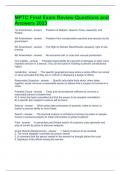
MPTC Final Exam Review Questions and Answers 2023 1st Amendment Freedom of Religion, Speech, Press, Assembly, and Petition 4th Amendment Freedom from unreasonable searches and seizures by the government 5th Amendment The Right to Remain Silent/Double Jeopardy, right to due process 8th Amendment No excessive bail, or cruel and unusual punishment Civil Liability Potential responsibility for payment of damages or other court-imposed sanction in a lawsuit. (You can be sued for violating a persons constitutional rights). Jurisdiction The specific geographical area where a police officer can arrest or serve (provided that they are in uniform or displaying a badge of office). Reasonable Suspicion Specific articulable facts which, when taken together, would convince a reasonable person to believe that a suspect is involved in a crime. Probable Cause Facts and circumstances sufficient to convince a reasonable person to believe that: A) A crime has been committed and that the person to be arrested committed it. B) A specific item subject to seizure will be found Seizure When police take possession of property, make an arrest, or restrict a persons ability to move freely. Search The physical invasion or intrusions of privacy by police on people, homes or personal property to obtain information or gather evidence. Frisk A warrantless and limited search of a persons outer garments and area of control by police to discover weapons. Arrest Warrant Requirements 1. Name of person to be arrested 2. The crime allegedly committed by person named 3. A command that the person named in the warrant be brought before the court 4. Signature of the official issuing the warrant. Arrest without a warrant A) for a felony in the officer's presence or with probable cause B) A crime committed in the officer's presence that amounts to a breach of the peace. C) Certain misdemeanors committed in the past when arrest is authorized by statute. D) Certain misdemeanors committed in an officer's presence Search incident to arrest A search of a person and their area of control after arrest looking for fruits, instrumentalities, and evidence of the crime for which they have been arrested. Consent search When a person waives their 4th amendment rights for officers to search places where the person consenting has a reasonable expectation of privacy. CONSENT MUST BE VOLUTARY AND INFORMED! Plain View Doctrine Police may seize evidence of a crime without a warrant that is in plain view and no reasonable expectation of privacy exists. Curtilage The area immediately surrounding a dwelling Exigent Circumstances Exigent circumstance exist when there is probable cause and: A) Likelihood of danger to police or other without immediate action. B) Likelihood of imminent removal or destruction of evidence C) Risk of flight. Inventories Administrative, non investigatory searches pursuant to written departmental procedures and justified as a means of protecting property. Citizen arrest A private citizen may lawfully arrest someone who has in fact already committed a felony. A police officer acting outside of his jurisdiction (if not in pursuit) would be considered to be acting as a citizen. Direct Evidence Evidence that directly links a person to a crime without relying on inference or other evidence. Physical Evidence Tangible items/object that may be direct or circumstantial evidence Testimonial Evidence Includes statements made by, victims, witnesses, suspects and police.
Written for
- Institution
- MPTC
- Course
- MPTC
Document information
- Uploaded on
- June 8, 2023
- Number of pages
- 3
- Written in
- 2022/2023
- Type
- Exam (elaborations)
- Contains
- Questions & answers

Also available in package deal