DEFINITIONS OF ABNORMALITY
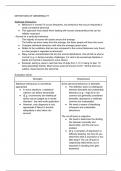
Statistical infrequency
● Behaviour is normal if it occurs frequently, any behaviour that occurs frequently is
rarely considered abnormal
● This approach most useful when dealing with human characteristics that can be
reliably measured
• Scores for a particular behaviour
- The majority of scores will cluster around the average
- The further we move away from the average, the fewer people will have this score
● Compare individual behaviour with what the average person does
● Refers to the conditions that are rare compared to the normal (behaviour only found
in a few people is regarded as abnormal)
● Many human characteristics fall into the normal distributions, this will tell us what is
‘normal’ (e.g. in facing everyday challenges, it is rare to be excessively fearless or
fearful and normal to experience some stress)
● Example: asking a class to rate their fear of dogs from 1-10 (1 being no fear, 10
being absolutely fearful). Most scores would sit around 4,5,6,7. Where there are
outliers, these become the abnormal.
Evaluation (AO3)
Strengths Weaknesses
Statistical infrequency is sometimes Some abnormal behaviour is desirable
appropriate ● The definition does not distinguish
● In some situations, a statistical between desirable and undesirable
criterion can define abnormality behaviour (e.g. v high IQ is not
● (E.g. uncommonly low intellectual common but generally considered
ability may be judged as a mental desirable, depression is relatively
disorder) - has real world application common but undesirable)
● However, such diagnosis is only ● We need a means of identifying
appropriate if failure to function infrequent and undesirable
adequately is also taken into behaviours
account
The cut-off point is subjective
● We need to determine the dividing
line between normality and
abnormality, and this can be a
problem
● (E.g. A symptom of depression is
difficulty sleeping, but how do you
determine what is excessive or too
little sleep? The cut off point is
subjectively determined, but is
important in deciding who gets
treatment)
Statistical infrequency
● Behaviour is normal if it occurs frequently, any behaviour that occurs frequently is
rarely considered abnormal
● This approach most useful when dealing with human characteristics that can be
reliably measured
• Scores for a particular behaviour
- The majority of scores will cluster around the average
- The further we move away from the average, the fewer people will have this score
● Compare individual behaviour with what the average person does
● Refers to the conditions that are rare compared to the normal (behaviour only found
in a few people is regarded as abnormal)
● Many human characteristics fall into the normal distributions, this will tell us what is
‘normal’ (e.g. in facing everyday challenges, it is rare to be excessively fearless or
fearful and normal to experience some stress)
● Example: asking a class to rate their fear of dogs from 1-10 (1 being no fear, 10
being absolutely fearful). Most scores would sit around 4,5,6,7. Where there are
outliers, these become the abnormal.
Evaluation (AO3)
Strengths Weaknesses
Statistical infrequency is sometimes Some abnormal behaviour is desirable
appropriate ● The definition does not distinguish
● In some situations, a statistical between desirable and undesirable
criterion can define abnormality behaviour (e.g. v high IQ is not
● (E.g. uncommonly low intellectual common but generally considered
ability may be judged as a mental desirable, depression is relatively
disorder) - has real world application common but undesirable)
● However, such diagnosis is only ● We need a means of identifying
appropriate if failure to function infrequent and undesirable
adequately is also taken into behaviours
account
The cut-off point is subjective
● We need to determine the dividing
line between normality and
abnormality, and this can be a
problem
● (E.g. A symptom of depression is
difficulty sleeping, but how do you
determine what is excessive or too
little sleep? The cut off point is
subjectively determined, but is
important in deciding who gets
treatment)