LESSON 4
.1.2.1 Demand
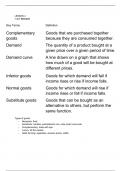
Key Terms Definition
Complementary Goods that are purchased together
goods because they are consumed together.
Demand The quantity of a product bought at a
given price over a given period of time.
Demand curve A line drawn on a graph that shows
how much of a good will be bought at
different prices.
Inferior goods Goods for which demand will fall if
income rises or rise if income falls.
Normal goods Goods for which demand will rise if
income rises or fall if income falls.
Substitute goods Goods that can be bought as an
alternative to others, but perform the
same function.
Types of goods:
- Necessity: food
- Substitute: car/bike, petrol/electric car, coke (sub)/ coca-cola
- Complementary: hotel with spa
- Luxury: all the sweets
- Habit forming: cigarettes, amazon prime, netflix
, Demand can be measured
VOLUME : ⤶ ⤷ VALUE:
How many items are bought Sales value
.Factors that can affect demand
- Prices
- Incomes
- Tastes & fashions
- Competitor actions
- Social & demographic
- Seasonal
- Government action
- Advertising/ marketing
(What would make consumers buy more of these goods? [photo on the PPT])
- Promotion
- Demonstration
Actuality
- Increasing demand→ Houses, Petrol, Diamonds
- Decreasing demand→ Smoking, Alcohol/Beer, Gun, Cannabis (if it was
legal⇒
More is available, less is the demand)
.From the video
DEMAND= Desire and willingness to purchase something at a given price
EFFECTIVE DEMAND= Desire, willingness and ability to purchase something at a given
price
Exceptions:
.1.2.1 Demand
Key Terms Definition
Complementary Goods that are purchased together
goods because they are consumed together.
Demand The quantity of a product bought at a
given price over a given period of time.
Demand curve A line drawn on a graph that shows
how much of a good will be bought at
different prices.
Inferior goods Goods for which demand will fall if
income rises or rise if income falls.
Normal goods Goods for which demand will rise if
income rises or fall if income falls.
Substitute goods Goods that can be bought as an
alternative to others, but perform the
same function.
Types of goods:
- Necessity: food
- Substitute: car/bike, petrol/electric car, coke (sub)/ coca-cola
- Complementary: hotel with spa
- Luxury: all the sweets
- Habit forming: cigarettes, amazon prime, netflix
, Demand can be measured
VOLUME : ⤶ ⤷ VALUE:
How many items are bought Sales value
.Factors that can affect demand
- Prices
- Incomes
- Tastes & fashions
- Competitor actions
- Social & demographic
- Seasonal
- Government action
- Advertising/ marketing
(What would make consumers buy more of these goods? [photo on the PPT])
- Promotion
- Demonstration
Actuality
- Increasing demand→ Houses, Petrol, Diamonds
- Decreasing demand→ Smoking, Alcohol/Beer, Gun, Cannabis (if it was
legal⇒
More is available, less is the demand)
.From the video
DEMAND= Desire and willingness to purchase something at a given price
EFFECTIVE DEMAND= Desire, willingness and ability to purchase something at a given
price
Exceptions: