EMA1501
Assignment 2 (ANSWERS)
Semester 1 2023
, EMA1501 ASSIGNMENT 2
QUESTION 1
Bruner’s theory focuses on levels of knowing and operates on three levels, that is,
enactive, iconic and symbolic levels.
1.1 Discuss the three types of knowledge and provide an example of each. Do not use
the examples in the study guide, create your own. (9)
Enactive knowledge is acquired through physical interaction with objects and the child's
own movement. This encompasses the child's actions such as sorting or counting objects.
An example of enactive learning would be when a child moves around the classroom to
touch objects that have a similar shape to a box or when they use their fingers to count.
Iconic knowledge involves mental processes where the child employs representations of
tangible objects, such as using pictures of objects. The focus here is on visual and
perceptual information. For instance, children may be given a picture of three butterflies
and asked to draw a flower for each butterfly.
Symbolic knowledge refers to the capacity to utilize abstract symbols. In mathematics, the
aim is to achieve the highest level of symbolic knowledge. This means that a child starts by
physically counting two real apples (enactive), then progresses to counting two pictures of
apples (iconic), and eventually employs number symbols to represent the equation 1 + 1 =
2.
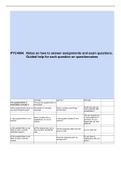
1.1 Generate a three-column table where you evaluate how learning takes place
according to: Piaget
• Vygotsky
• Bruner
Piaget Vygotsky Bruner
Assignment 2 (ANSWERS)
Semester 1 2023
, EMA1501 ASSIGNMENT 2
QUESTION 1
Bruner’s theory focuses on levels of knowing and operates on three levels, that is,
enactive, iconic and symbolic levels.
1.1 Discuss the three types of knowledge and provide an example of each. Do not use
the examples in the study guide, create your own. (9)
Enactive knowledge is acquired through physical interaction with objects and the child's
own movement. This encompasses the child's actions such as sorting or counting objects.
An example of enactive learning would be when a child moves around the classroom to
touch objects that have a similar shape to a box or when they use their fingers to count.
Iconic knowledge involves mental processes where the child employs representations of
tangible objects, such as using pictures of objects. The focus here is on visual and
perceptual information. For instance, children may be given a picture of three butterflies
and asked to draw a flower for each butterfly.
Symbolic knowledge refers to the capacity to utilize abstract symbols. In mathematics, the
aim is to achieve the highest level of symbolic knowledge. This means that a child starts by
physically counting two real apples (enactive), then progresses to counting two pictures of
apples (iconic), and eventually employs number symbols to represent the equation 1 + 1 =
2.
1.1 Generate a three-column table where you evaluate how learning takes place
according to: Piaget
• Vygotsky
• Bruner
Piaget Vygotsky Bruner