NYS EMT Written Exam 2021 With Complete Solution
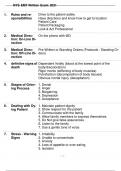
NYS EMT Written Exam 2021 With Complete Solution 1. Rules and re- sponsibilities 2. Medical Direc- tion: On-Line Di- rection 3. Medical Direc- tion: Off-Line Di- rection 4. definitve signs of death 5. Stages of Griev- ing Process 6. Dealing with Dy- ing Patient 7. Stress - Warning Signs Drive to the patient safely Have directions and know how to get to location Patient Care Patient Packaging Look & Act Professional On the phone with MD Pre-Written or Standing Orders (Protocols - Standing Or- ders) Dependent lividity (blood at the lowest point of the body/discoloration) Rigor mortis (stiffening of body muscles) Putrefaction (decomposition of body tissues) Obvious mortal injury (decapitation) 1. Denial 2. Anger 3. Bargaining 4. Depression 5. Acceptance 1. Maintain patient dignity 2. Show respect for the patient 3. Communicate with the family 4. Allow family members to express themselves 5. Do Not give false assurances 6. Listen to the family 7. Use a gentle tone of voice 1. Irritability 2. Unable to concentrate 3. Anxiety 4. Loss of appetite or over eating 5. Isolation 8. Dealing with Stress 6. Loss of interest in work, sex, etc. 7. Increased alcohol use Critical Incident Stress Debriefing: (CISD) program in which severely stressful job-related incidents are discussed. These meeting are held within 24 to 72 hours after an incident. 9. Standard of Care The way another equally trained person would act to treat a patient 10. Scope of Prac- tice The Skills you are allowed to use 11. Duty to Act an EMT has a duty to act only when on duty 12. Public Health Law 800 13. Good Samaritan Law EMT Cannot be held liable unless negligence is proven Does not cover EMT in New York State 14. Negligence Failure to provide same level of care as another equally trained EMT 15. Abandonment Termination of patient care without transferring care to equal or higher medical Authority 16. Refusal of Care (CMA) 17. Assault/Harass- ment is when anyone over the age of 18 & competent refused care. Also applies if under the age of 18 if patient is preg- nant, married or an emancipated minor seeking treatment for a sexually transmitted disease Unlawfully placing a patient in fear of bodily harm 18. Confidentiality anything discussed between EMT and patient care can- not be disclosed unless to designated individuals such as hospital personal involved in patients care 19. Negligence In Depth Deviating from the standard of care resulting in further injury to the patient. Not performing as reasonable person would act given the same circumstances. 20. Breach of Duty by Omission Nonfeasance : EMT Failed to perform his/her duties 21. Breach of Duty by Commission Misfeasance: The EMT perfumed an approved action IM- PROPERLY Malfeasance: The EMT performs a action above there level of training 22. Proximate Cause Your Negligence DIRECTLY caused pain/suffering/injury 23. Liability legal responsibility 24. Plaintiff Individual bringing suit 25. Defendant Individual being sued 26. Assault Unlawfully placing a person in fear or immediate bodily harm without the persons consent 27. Battery Unlawfully touching a person; this includes providing emergency care without consent 28. False Imprison- ment Transporting a competent patient against their will 29. Consent Expressed or Ac- tual When patient speaks or acknowledges that they want you to provide care and transport 30. Informed Con- sent patient is explained everything that is going to be done and they have provided Consent for the EMT to provide care 31. Implied Consent when a person is unconscious and unable to give consent or a period threat to life or limb exists 32. Special Report- ing Child Abuse 33. Types of Position Supine Suspected Child Abuse and Maltreatment (S.C.A.M) must be done in the case of Child Abuse (DSS 2221A) Laying face up, body flush to ground 34. Prone Postion Laying face down, on stomach 35. Lateral Postion lying on patients side 36. Recovery Posi- tion Patients is on side, usually left side 37. Fowler Position sitting upright with legs extended 38. Semi Fowler Po- sition 39. Cephalic Direc- tion sitting at a 45-degree angle with legs extended at the head 40. Caudal Direction at the feet 41. Abduction Direc- tion 42. Adduction Direc- tion Moving away from the midline Moving toward the midline 43. Anterior Body Locations Front 44. Posterior Body Location Back 45. Right Body Loca- tion The Patient Right 46. Left Body Loca- tion The Patients left 47. Lateral Body Lo- cataion Towards the outside 48. Medial Body Lo- cation Towards the inside or middle 49. Superior Body Location Closer to the head, higher 50. Inferior Body Lo- cation Farther from the head, lower 51. Proximal Body Location Closer to the torso 52. Distal Body Lo- cation Farther from the torso 53. Dorsal Body Lo- cation Towards the spine 54. Alveoli are where oxygen and carbon dioxide exchange 55. Diaphragm is the muscle that controls breathing 56. The Brain is the organ that controls breathing 57. Aorta largest artery in the body 58. Artery carries OXYGENATED blood AWAY from the heart 59. Capillary Smallest blood vessels. Connects arterioles and venues for the exchange of O2 and CO2 60. Contusion Swollen, raised and warm to the touch 61. Ecchymosis a bruise. Internal bleeding but does not break the skin 62. Epistaxis Nose Bleed 63. Hematoma A mass of blood or pooling of blood in the soft tissues beneath the skin 64. Perfusion The Circulation of blood through the tissue or organ 65. Hypovolemic Shock bleeding shock, due to loss of fluid (blood or plasma) 66. Vena Cava Largest vein in the body 67. Veins Carries blood from the tissues back to the heart 68. Cardiovascular System the hearts and vessels 69. Arterial Blood Bright red in color, Spurts with each heartbeat 70. Venous Blood Dark Marron in Color, flows steadily 71. Capillary Blood oozed from the wound, color in between vein and artery 72. Bleeding & Blood 1. 5-6l of blood in the average adult body 2. 10-12pints of blood In the average adult body 73. Blood Consits of White Blood Cells (Leukocytes)- fight infection Red Blood Cells (Erythrocytes)- Carry O2 Platelets - Clot the blood Plasma - Fluid that carries the formed elements of blood 74. Types of Blood Vessels Arteries - Carry Blood Away From The Heart Veins - Carry Blood To The Heart Arterioles - Smaller Arteries In The Body Venules - Smaller Veins In The Body Capillaries - Smallest Vessels That Connect Arterioles and Venules 75. Shock refers to the state of collapse and failure of the Cardio- vascular system, which leads to inadequate perfusion (Hypoperfusion). As the body loses perfusion, the body compensates by redirecting blood flow from non-essential organs to essential ones. 76. Disentanglement Removal of car away from patient. Approach a helicopter from 3 to 9o'clock in front of the Pilot Helicopter needs a landing zone of 100x100 feet 77. CPR Require- ments 78. AED Pads Usage 79. Gaining Access Complex Access : Use of Tools to get to the patient Simple Access: Try Doors and Windows First 80. 3 Unbreakable 1. An ambulance cannot disregard the VTL without due Rules regard 2. An Ambulance cannot pass a school bus with flashing lights 3. Do not go around a railroad gate 81. Parking Cues Always park upwind and uphill 82. Multiple MCI is when you have more patients than resources Causaulty First ambulance on the scene is in charge Incident Driver becomes Transportation Office EMT becomes Triage Office
Written for
- Institution
- NYS EMT
- Course
- NYS EMT
Document information
- Uploaded on
- June 4, 2023
- Number of pages
- 38
- Written in
- 2022/2023
- Type
- Exam (elaborations)
- Contains
- Questions & answers
Subjects
-
nys emt written exam 2021 with complete solution

Also available in package deal