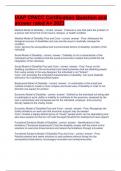
IAAP CPACC Certification Question and answer rated A+ 2023
IAAP CPACC Certification Question and answer rated A+ 2023Medical Model of Disability Presents a view that pairs the problem of a person with direct link to the trauma, disease, or health condition Medical Model of Disability Pros and Cons Pros: Addresses the biological sources of disabilities and can provide ways to medically manage the condition Cons: Ignores the sociopolitical and environmental factors of disability; problem of the individual Social Model of Disability Disability is not a characteristic of the individual but the conditions that the social environment creates that prohibit the full integration of the individual. Social Model of Disability Pros and Cons Pros: Focus on the disabling conditions in the environment and clearing barriers that are disabling people from using society in the way designed, the individual is not "broken" Cons: Can downplay the embodied characteristics of disability, Can push disability advocacy into a polarizing political space Biophysical Model of Disability A combination of the social and medical models to create a more complex and broad view of disability in order to not diminish one aspect for another Economic Model of Disability Defined by the individual not being able to participate in work, ability or inability to contribute to the economy, assessed by the loss in productivity and consequences for the individual, employer, and economy; directly related to the charity model Economic Model of Disability Pros and Cons Pros: Recognizes the bodily limitations on work and that economic support may be needed Cons: Creates a legally defined group of "needy" people which can be stigmatizing and also leave people out that do not meet the legal threshold for disabled but need support Functional Solutions Model of Disability Identifications of the limitations ("functional impairments") that the disability creates with the intent to find solutions to overcome those barriers and reduce the limitations through innovation Functional Solutions Model of Disability Pros and Cons Pros: Results-oriented and seeks solutions to real problems without diving into the sociopolitical implications, encourages innovation and entrepreneurship Cons: Can shift cost burden to the person instead of the building or organization; profit driven can cause organization to miss the target audience and usefulness, can miss sociopolitical root cause Social Identity or Cultural Affiliation Model of Disability identity by affiliation; deriving personal identity from membership in a like-minded group (eg. Deaf Culture) Social Identity or Cultural Affiliation Model of Disability Pros and Cons Pros: Accepts the disability completely and uses it as a point of pride Cons: Can be negated or brought down by feeling excluded by not fitting the groups expectations Charity Model of Disability Sees those with disability as unfortunate or needy and those that help as charitable and kind contributors Charity Model of Disability Pros and Cons Pros: inspires generosity Cons: condescending, person is an "object of pity", Often short-term fixes that sacrifice effective long-term solutions for the immediate effectiveness
Written for
- Institution
- IAAP CPACC Certification
- Course
- IAAP CPACC Certification
Document information
- Uploaded on
- June 4, 2023
- Number of pages
- 23
- Written in
- 2022/2023
- Type
- Exam (elaborations)
- Contains
- Questions & answers
Subjects
-
iaap cpacc certification question and answer rated
-
medical model of disability presents a view that p
-
medical model of disability pros and cons pros ad
-
social model of disability disability is not a

Also available in package deal