EEG Registry Part 2, Test Prep
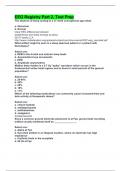
EEG Registry Part 2, Test Prep The absence of sleep cycling in a 37 week conceptional age infant. a. Abnormal b. Normal Clear EEG differences between wakefulness and sleep emerge at about 36-37 weeks C.A. What artifact might be seen in a sleep deprived patient or a patient with Narcolepsy? Select one: a. REM in the frontal and anterior temp leads b. Asymmetrical eye movements c. ERG d. Amplitude asymmetries Midline theta rhythm is a 5-7 Hz "spiky" waveform which occurs in the frontocentral vertex head regions and is found in what percent of the general population? Select one: a. 20-40% b. 50% c. 25% d. 10% e. <1% Which of the following medications can commonly cause increased theta and beta activity at therapeutic doses? Select one: a. chloral hydrate b. antidepressants c. antihistamines d. analgesics Antidepressants Since a common ground electrode placement is at Fpz, ground lead recording artifact usually manifests itself as ________________. Select one: a. Alpha at Fpz b. Eye blink artifact in an illogical location, where an electrode has high impedance c. rhythmic theta in the occipitals d. 60 Hz at Fpz Runs of notched theta in the 6 Hz range, appearing focally in the mid-temporals over one or both hemispheres during drowsiness and light sleep. Select one: a. This is a normal variant called RMTD, or Rhythmic Mid-temporal Theta Discharge. b. This is a normal variant called 14 and 6 Hz positive spikes. Incorrect c. This is likely an artifact caused by movement of the tongue. d. This is an abnormal epileptogenic pattern. e. This is a normal variant called Mu rhythm. a. This is a normal variant called RMTD, or Rhythmic Mid-temporal Theta Discharge. Involuntary movements: (select all that apply) Select one or more: a. Myoclonic jerks b. Tics and Tremmors c. Respiration artifact d. Ballistocardiographic artifact A, B, C, D In the Illustration, the same data is modified and reformatted in the second sample. What parameter changed in the following sample? How does this help? Select one: a. Decreased sensitivity to better resolve the spikes b. Increased time base (analysis time/display time/epoch) or decrease paper speed, to scrunch up the waveforms to better resolve focal slowing c. Decreased time base (analysis time/display time/epoch) or increase equivalent paper speed to spread out the waveforms to better resolve the fast activity and spikes. d. Increased sensitivity, to better resolve the low amplitude activity Incorrect OSHA stands for ________. Select one: a. Occupational Safety in Housing Administration b. Oceanic Safety and Health Administration c. Occupational Safety and Health Administration d. Occupational Safety and Hazard Administration Occupational Safety and Health Administration Per the, "Occupational Safety and Health Act of 1970" Number of distinct neurological diseases: Select one: a. precisely 386 b. less than 700 c. more than 8,000 Incorrect d. over 1,400 e. fewer than 100
Written for
- Institution
- EEG Registry
- Course
- EEG Registry
Document information
- Uploaded on
- June 3, 2023
- Number of pages
- 20
- Written in
- 2022/2023
- Type
- Exam (elaborations)
- Contains
- Questions & answers
Subjects
- eeg registry part 2
-
test prep the absence of slee