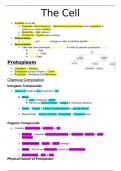
The Cell
Smallest unit of life.
Organelle (Cell Inclusions) – Membrane-bound structure found cytoplasm &
performs a certain function.
Eukaryote – Has nucleus
Prokaryote – Doesn’t have nucleus.
Differentiation
Size, shape and structure change in order to perform specific functions.
Specialisation
Cells that have developed characteristics in order to perform a particular function.
Muscle Cells
Glandular Cells
Nerve Cells
Protoplasm
Cytoplasm + Nucleus
Endoplasm (Ground Plasm) – Centre
Ectoplasm – Bordering Cell Membrane
Chemical Composition
Inorganic Compounds
Lacks C-H bonds & isn’t produced in cell.
Water
Main component (≤90%)
Serves as solvent median + reagent in chemical reactions.
Gases – Oxygen & Carbon Dioxide dissolve in ground plasma.
Mineral Salts – Sodium Chloride, Phosphates + Potassium ions.
Organic Compounds
Contains Hydrocarbons & produced in cell.
Proteins – Important structural component of membrane, enzymes & some
hormones.
Carbohydrates – Sugars & Starch (energy)
Lipids – Part of cell membranes, stored as reserve energy.
Nucleic Acids – RNA & DNA
Physical Nature of Protoplasm
, NOT EXAMINABLE
Solvent – Liquid in which substance is dissolved (water in biological systems).
Solute – Particles/substance being dissolved.
Solution – Solvent + Solutes
Type Explanation Diagram
True Solution Homogenous Salt
Salts, sugars, gases dissolved
in water
Water
Suspension Heterogeneous
Organelles floating in ground
plasm
Emulsion Solvent & solute both liquid
Colloidal Solution Solute too big to sink but too
small to sink.
Ionized ∴ repel
Aggregate Particles remain in suspension
and form strings/clumps.
Hold water between particles.
States:
Sol – Endoplasm
(Ground plasm)
Gel – Ectoplasm
Reversible
through:
Temperature,
Pressure, pH
Smallest unit of life.
Organelle (Cell Inclusions) – Membrane-bound structure found cytoplasm &
performs a certain function.
Eukaryote – Has nucleus
Prokaryote – Doesn’t have nucleus.
Differentiation
Size, shape and structure change in order to perform specific functions.
Specialisation
Cells that have developed characteristics in order to perform a particular function.
Muscle Cells
Glandular Cells
Nerve Cells
Protoplasm
Cytoplasm + Nucleus
Endoplasm (Ground Plasm) – Centre
Ectoplasm – Bordering Cell Membrane
Chemical Composition
Inorganic Compounds
Lacks C-H bonds & isn’t produced in cell.
Water
Main component (≤90%)
Serves as solvent median + reagent in chemical reactions.
Gases – Oxygen & Carbon Dioxide dissolve in ground plasma.
Mineral Salts – Sodium Chloride, Phosphates + Potassium ions.
Organic Compounds
Contains Hydrocarbons & produced in cell.
Proteins – Important structural component of membrane, enzymes & some
hormones.
Carbohydrates – Sugars & Starch (energy)
Lipids – Part of cell membranes, stored as reserve energy.
Nucleic Acids – RNA & DNA
Physical Nature of Protoplasm
, NOT EXAMINABLE
Solvent – Liquid in which substance is dissolved (water in biological systems).
Solute – Particles/substance being dissolved.
Solution – Solvent + Solutes
Type Explanation Diagram
True Solution Homogenous Salt
Salts, sugars, gases dissolved
in water
Water
Suspension Heterogeneous
Organelles floating in ground
plasm
Emulsion Solvent & solute both liquid
Colloidal Solution Solute too big to sink but too
small to sink.
Ionized ∴ repel
Aggregate Particles remain in suspension
and form strings/clumps.
Hold water between particles.
States:
Sol – Endoplasm
(Ground plasm)
Gel – Ectoplasm
Reversible
through:
Temperature,
Pressure, pH