
Meiosis
Introduction:
● Meiosis = special type of cell division that halves the number of chromosomes. Four
genetically different haploid daughter cells are formed from one diploid cell.
● It’s important because:
○ Haploid gametes are produced
○ The doubling effect of fertilisation on chromosome number of future generations is
overcome
○ Genetic variation occurs
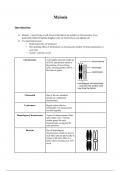
Chromosome A threadlike structure made up
of DNA and protein found in
the nucleus of most living
cells, carrying genetic info in
the form of genes
Chromatid One of the two identical
strands of a replicated
chromosome
Centromere Region where the two
chromatids of a chromosome
are held together
Homologous Chromosomes A pair of chromosomes of the
same shape, size + having
similar genes for each
characteristic occupying the
same position
Bivalent Pair of homologous
chromosomes which lie next to
each other and are physically in
contact with each other at a
point where crossing over will
occur
, Unreplicated Chromosomes An unreplicated
“chromosome” has a single
double-stranded DNA
molecule
Replicated Chromosomes A replicated “chromosome”
has 2 identical double-stranded
DNA molecules
Interphase Phase in the cell cycle when
DNA replication occurs
Diploid (2n) 2 complete set of chromosomes
in a cell
Haploid (n) 1 Complete sets of
chromosomes in a cell
Gene A segment of DNA in a
chromosome = contains code
for particular characteristics
Centrosome Organelle (contains 2
centrioles) found in animal
cells
Centriole Structures formed when
centrosome divides into 2: they
move to opp ends of cell
during cell division
Introduction:
● Meiosis = special type of cell division that halves the number of chromosomes. Four
genetically different haploid daughter cells are formed from one diploid cell.
● It’s important because:
○ Haploid gametes are produced
○ The doubling effect of fertilisation on chromosome number of future generations is
overcome
○ Genetic variation occurs
Chromosome A threadlike structure made up
of DNA and protein found in
the nucleus of most living
cells, carrying genetic info in
the form of genes
Chromatid One of the two identical
strands of a replicated
chromosome
Centromere Region where the two
chromatids of a chromosome
are held together
Homologous Chromosomes A pair of chromosomes of the
same shape, size + having
similar genes for each
characteristic occupying the
same position
Bivalent Pair of homologous
chromosomes which lie next to
each other and are physically in
contact with each other at a
point where crossing over will
occur
, Unreplicated Chromosomes An unreplicated
“chromosome” has a single
double-stranded DNA
molecule
Replicated Chromosomes A replicated “chromosome”
has 2 identical double-stranded
DNA molecules
Interphase Phase in the cell cycle when
DNA replication occurs
Diploid (2n) 2 complete set of chromosomes
in a cell
Haploid (n) 1 Complete sets of
chromosomes in a cell
Gene A segment of DNA in a
chromosome = contains code
for particular characteristics
Centrosome Organelle (contains 2
centrioles) found in animal
cells
Centriole Structures formed when
centrosome divides into 2: they
move to opp ends of cell
during cell division


