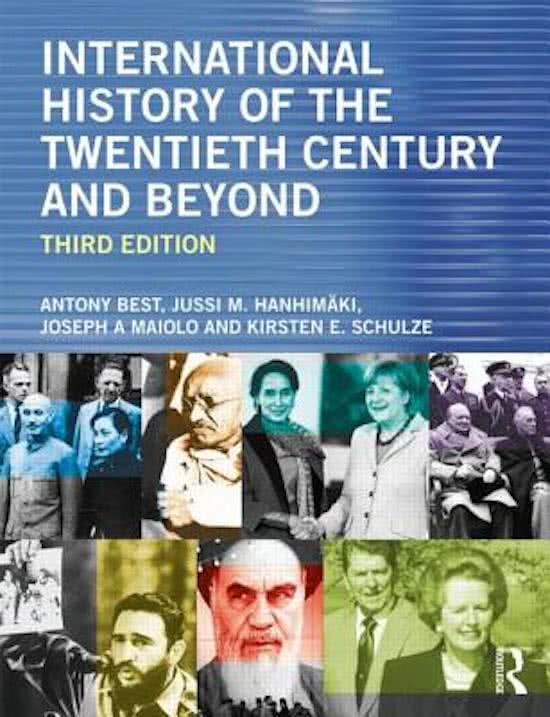
Summary Best “International History of The 20th Century and Beyond”
Ch 13 + 17 (week 4) Ch 15 + 16 (week5) Glob II International Track.
In addition: Read the conclusion in the book for each chapter.
Ch 13 Neutralism, development and the rise of the 3rd World, 1945 – 2014
With the cold war most people assumed that the bipolar system (Communism vs Capitalism) was the
norm. Some countries tried not to get sucked to either side and declared their neutrality.
Europe: Switzerland and Sweden. They had a long tradition of Neutrality.
For most so called third world countries in Asia and Africa however not picking a side came from the
conviction that doing so would endanger their national security and newly gained independence. And
that the Cold War diverted attention from their priorities: Expediting Western Decolonisation and the
tackling of economic underdevelopment. They unified themselves in several organizations that
pursued the interests mentioned above. These organizations will be discussed further on.
Neutrality in Cold War Europe
Some countries elected not to join NATO or the Warsaw Pact. We have to distinct two groups:
- Those with a long-standing tradition of Neutrality: Sweden and Switzerland.
- Emerging Non-Alignment nations: Austria, Finland, Yugoslavia.
Austria: Became neutral as a compromise to end Soviet occupation (in 1955) that was in place after
WWII, but like Switzerland cleary gravitated towards the West.
Finland: its post war political leaders considered a friendly relationship with the USSR a precondition
for internal democracy. Trade with the USSR represented 25-35% of Finlands foreign trade. It made
several security and foreign policy concessions to the USSR (Security Pact in 1948)
Yugoslavia: Whilst a socialist state under the Dictator Tito, it broke relations with Russia in 1948
(Tito-Stalin break) and received military assistance from the US. Despite this Tito did not align
himself with the West and Yugoslavia became an important player in the Non-Aligned Movement
India and the path to Bandung
Most 3rd world countries choose not to align themselves in order to avoid involvement in Great Power
conflicts. Most of them had in common that they had recently gained their independence from their
formal imperial rulers, thus were not willing to compromise their sovereignty. They also felt the cold
war distracted from their main issues: eradication of imperialism and economic underdevelopment.
India (independent August 1947), under the leadership of Jawaharlal Nehru, was the first state to
clearly set out the Non-Alignment policies. He followed a strict independent policy for India and
believed other asian countries should do the same: He organized two Asian Relations Conferences
(april 1947 and Jan 1949 (as a response to the Dutch intervention in Indonesia)) to further his beliefs.
- Voted against the PRC being labelled an aggressor state in the Korean conflict. And called for the
PRC to take China’s seat in the UN security council
- Refused to sign San-Francisco Peace Treaty 1951, (they believed it forced Japan into the Western
cold war camp.)
- april 1954 Signing of Border treaty between India and PRC, based on Peaceful Co-existence
- Nehru was a fierce supporter of a neutral Indochina as the best means of stability for the region.
- Bandung Afro-Asian Conference April 1955, 29 states attending. Intention to foster a sense of
solidarity between newly independent states. Most states in attendance were Asian, and some African
newly independent nations (Though most African countries were not de-colonized yet). The
conference is seen as the first step towards establishing a Third World lobby in international politics.
Most important issues: Need for prohibition of Weapons of Mass Destruction, need to fix prices of
commodities, and the endorsement of the general application of Peaceful Co-existence.
1
Ch 13 + 17 (week 4) Ch 15 + 16 (week5) Glob II International Track.
In addition: Read the conclusion in the book for each chapter.
Ch 13 Neutralism, development and the rise of the 3rd World, 1945 – 2014
With the cold war most people assumed that the bipolar system (Communism vs Capitalism) was the
norm. Some countries tried not to get sucked to either side and declared their neutrality.
Europe: Switzerland and Sweden. They had a long tradition of Neutrality.
For most so called third world countries in Asia and Africa however not picking a side came from the
conviction that doing so would endanger their national security and newly gained independence. And
that the Cold War diverted attention from their priorities: Expediting Western Decolonisation and the
tackling of economic underdevelopment. They unified themselves in several organizations that
pursued the interests mentioned above. These organizations will be discussed further on.
Neutrality in Cold War Europe
Some countries elected not to join NATO or the Warsaw Pact. We have to distinct two groups:
- Those with a long-standing tradition of Neutrality: Sweden and Switzerland.
- Emerging Non-Alignment nations: Austria, Finland, Yugoslavia.
Austria: Became neutral as a compromise to end Soviet occupation (in 1955) that was in place after
WWII, but like Switzerland cleary gravitated towards the West.
Finland: its post war political leaders considered a friendly relationship with the USSR a precondition
for internal democracy. Trade with the USSR represented 25-35% of Finlands foreign trade. It made
several security and foreign policy concessions to the USSR (Security Pact in 1948)
Yugoslavia: Whilst a socialist state under the Dictator Tito, it broke relations with Russia in 1948
(Tito-Stalin break) and received military assistance from the US. Despite this Tito did not align
himself with the West and Yugoslavia became an important player in the Non-Aligned Movement
India and the path to Bandung
Most 3rd world countries choose not to align themselves in order to avoid involvement in Great Power
conflicts. Most of them had in common that they had recently gained their independence from their
formal imperial rulers, thus were not willing to compromise their sovereignty. They also felt the cold
war distracted from their main issues: eradication of imperialism and economic underdevelopment.
India (independent August 1947), under the leadership of Jawaharlal Nehru, was the first state to
clearly set out the Non-Alignment policies. He followed a strict independent policy for India and
believed other asian countries should do the same: He organized two Asian Relations Conferences
(april 1947 and Jan 1949 (as a response to the Dutch intervention in Indonesia)) to further his beliefs.
- Voted against the PRC being labelled an aggressor state in the Korean conflict. And called for the
PRC to take China’s seat in the UN security council
- Refused to sign San-Francisco Peace Treaty 1951, (they believed it forced Japan into the Western
cold war camp.)
- april 1954 Signing of Border treaty between India and PRC, based on Peaceful Co-existence
- Nehru was a fierce supporter of a neutral Indochina as the best means of stability for the region.
- Bandung Afro-Asian Conference April 1955, 29 states attending. Intention to foster a sense of
solidarity between newly independent states. Most states in attendance were Asian, and some African
newly independent nations (Though most African countries were not de-colonized yet). The
conference is seen as the first step towards establishing a Third World lobby in international politics.
Most important issues: Need for prohibition of Weapons of Mass Destruction, need to fix prices of
commodities, and the endorsement of the general application of Peaceful Co-existence.
1