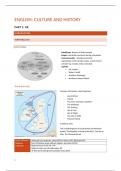
ENGLISH: CULTURE AND HISTORY
PART 1: UK
INTRODUCTION
TERMINOLOGY
LOCATIONS
- Inhabitants: Britons or British people
- Empire: the British territories during colonialism
- Commonwealth: : intergovernmental
organization of 56 member states, mostly former
colonies (eg. Canada, India, Australia)
- Capitals:
o UK: London
o Wales: Cardiff
o Scotland: Edinburgh
o Northern Ireland: Belfast
The British Isles
Contains 920 islands, most important:
- Great Britain
- Ireland
- The Inner and Outer Hebrides
- The Shetlands
- The Orkneys
- Isle of Man
- Isle of Wight
- The Isles of Scilly
- Channel Islands
4 political units:
The United Kingdom of Great Britain and Northern
Ireland, The Republic of Ireland (aka Eire), The Isle of
Man, The Channel Islands
Ethnic diversity white ppl (vast majority, around 87%), Asians (7%), Black ppl (3%)
Religions Most Christians & ppl without religion, also Islam (6,5%)
Migration Migrants born in the UK: 14%
Migrants with non-UK nationality: 8%
they have both grown (numbers from 2019)
1
, Overseas territories:
o Pieces of the British empire, not part of the UK
o They have their own government (<-> UK is responsible for defense & foreign relations)
o Citizens have British passports
Gibraltar:
o Spain tried to integrate Gibraltar into Spain, but the ppl don’t want to be part of Spain
o Brexit: problem occurred, Gibraltar would be cut off from Spain
brexit arrangement does not apply for Gibraltar: it stays part of Shengen area
POLITICS AND FLAG
Main parties Labour & Conservative Party
(Tories)
others: Liberal Democrats (Lib-
Dems), Scottish National Party
(SNP), Democratic Unionist Party
(DUP)
Parliament House of Lords & House of
Commons
MP Member of Parliament
PM Prime Minister
Number 10 the office of the Prime Minister
CONTEMPORARY CONDITIONS
DIVIDED BRITAIN
- Political, cultural and ethnic distinctiveness of Wales, Scotland, Northern Ireland and England
o Wales, Scotland & NI independant political system
o Scotland wants to be an independant country
- Cultural and economic gaps between north and south
o North: industrial, more poor
o South: agriculture, more wealthy -> London has dominant influence
- Brexit: caused ideological divide
2
, POLITICAL CHAOS
Johnson: Party-gate during covid resigned Truss elected resigned Sunak elected
<-> ‘elected’? Not a real election, only members of the Conservative Party voted
RECENT EVENTS
Economy British pound drops
Health Covid & National Healthcare system in crisis
Housing Cost of living crisis: inflation
Energy Household energy prices highest in Europe, fear of blackouts
UK EDUCATION
Compulsory school age = 18
Primary education (prep school) 4 years old until 11 years old
Secondary education (senior school) 11 years old until 16 years old
Further education (college) 16 years old until 18 years old (college ≠university)
Classist school system: unfair
Public schools: You have to pay, independent and selective, ‘better education’ (actual private schools)
State schools: Free, government funded, not available to international students
Grammar schools: subset of public schools, best schools you can go to
tuition fees: 1998: £1000/year 2010: £9000/year (students often need a loan: leads to student debts)
HIGHER EDUCATION
- Undergraduate = bachelor (3-4 years)
sandwich courses: some of your studies take place working in the field or studying abroad
- Graduate or postgraduate = master (1-2 years) & PHD is 3-5 years
STANDARDISED TESTS
SAT Statutory Assessment Test for all students, this tests the National Curriculum ( all
students take the same tests + all schools teach the same things)
11+ exam If you want to attend a grammar school, you have to take this test
GCSE (year 11) General Certificate of Secondary Education
A Levels (year 13) Advanced levels if you want to go to university
UK MEDIA
Free press: The press is not under government regulation and independent
Printed media started in the 18th century: more ppl could go to school more readers
Dissemination (verspreiding) of ideology through the media (with political and social influence)
3
PART 1: UK
INTRODUCTION
TERMINOLOGY
LOCATIONS
- Inhabitants: Britons or British people
- Empire: the British territories during colonialism
- Commonwealth: : intergovernmental
organization of 56 member states, mostly former
colonies (eg. Canada, India, Australia)
- Capitals:
o UK: London
o Wales: Cardiff
o Scotland: Edinburgh
o Northern Ireland: Belfast
The British Isles
Contains 920 islands, most important:
- Great Britain
- Ireland
- The Inner and Outer Hebrides
- The Shetlands
- The Orkneys
- Isle of Man
- Isle of Wight
- The Isles of Scilly
- Channel Islands
4 political units:
The United Kingdom of Great Britain and Northern
Ireland, The Republic of Ireland (aka Eire), The Isle of
Man, The Channel Islands
Ethnic diversity white ppl (vast majority, around 87%), Asians (7%), Black ppl (3%)
Religions Most Christians & ppl without religion, also Islam (6,5%)
Migration Migrants born in the UK: 14%
Migrants with non-UK nationality: 8%
they have both grown (numbers from 2019)
1
, Overseas territories:
o Pieces of the British empire, not part of the UK
o They have their own government (<-> UK is responsible for defense & foreign relations)
o Citizens have British passports
Gibraltar:
o Spain tried to integrate Gibraltar into Spain, but the ppl don’t want to be part of Spain
o Brexit: problem occurred, Gibraltar would be cut off from Spain
brexit arrangement does not apply for Gibraltar: it stays part of Shengen area
POLITICS AND FLAG
Main parties Labour & Conservative Party
(Tories)
others: Liberal Democrats (Lib-
Dems), Scottish National Party
(SNP), Democratic Unionist Party
(DUP)
Parliament House of Lords & House of
Commons
MP Member of Parliament
PM Prime Minister
Number 10 the office of the Prime Minister
CONTEMPORARY CONDITIONS
DIVIDED BRITAIN
- Political, cultural and ethnic distinctiveness of Wales, Scotland, Northern Ireland and England
o Wales, Scotland & NI independant political system
o Scotland wants to be an independant country
- Cultural and economic gaps between north and south
o North: industrial, more poor
o South: agriculture, more wealthy -> London has dominant influence
- Brexit: caused ideological divide
2
, POLITICAL CHAOS
Johnson: Party-gate during covid resigned Truss elected resigned Sunak elected
<-> ‘elected’? Not a real election, only members of the Conservative Party voted
RECENT EVENTS
Economy British pound drops
Health Covid & National Healthcare system in crisis
Housing Cost of living crisis: inflation
Energy Household energy prices highest in Europe, fear of blackouts
UK EDUCATION
Compulsory school age = 18
Primary education (prep school) 4 years old until 11 years old
Secondary education (senior school) 11 years old until 16 years old
Further education (college) 16 years old until 18 years old (college ≠university)
Classist school system: unfair
Public schools: You have to pay, independent and selective, ‘better education’ (actual private schools)
State schools: Free, government funded, not available to international students
Grammar schools: subset of public schools, best schools you can go to
tuition fees: 1998: £1000/year 2010: £9000/year (students often need a loan: leads to student debts)
HIGHER EDUCATION
- Undergraduate = bachelor (3-4 years)
sandwich courses: some of your studies take place working in the field or studying abroad
- Graduate or postgraduate = master (1-2 years) & PHD is 3-5 years
STANDARDISED TESTS
SAT Statutory Assessment Test for all students, this tests the National Curriculum ( all
students take the same tests + all schools teach the same things)
11+ exam If you want to attend a grammar school, you have to take this test
GCSE (year 11) General Certificate of Secondary Education
A Levels (year 13) Advanced levels if you want to go to university
UK MEDIA
Free press: The press is not under government regulation and independent
Printed media started in the 18th century: more ppl could go to school more readers
Dissemination (verspreiding) of ideology through the media (with political and social influence)
3