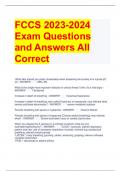
FCCS 2023 -2024 Exam Questions and Answers All Correct .What labs should you order immediately when assessing the acutely ill or injured pt? (2) - ANSWER A BG, BG What is the single most important indicator of critical illness? (hint: it's a vital sign) - ANSWER Tachypnea Increase in depth of breathing - ANSWER Kussmaul/hyperpnea Increase in depth of breathing, also called Kussmaul or hyp erpnea, may indicate what severe acid/base abnormality? - ANSWER severe metabolic acidosis Periodic breathing with apnea or hypopnea - ANSWER Cheyne -Stokes Periodic breathing with apnea or hypopnea (Cheyne -stokes breathing) may indicate what? - ANSWER Severe brainstem injury or cardiac dysfunction When you assess the A (airway) in a critically ill patient, what are you look/listening/feeling for? - ANSWER *LOOK:* cyanosis, altered respiratory pattern and rate, use of accessory respiratory muscles, tracheal tug, paradoxical breathing, altered consciousness *LISTEN:* noisy breathing (grunting, stridor, wheezing, gurgling); silence indicates complete obstruction *FEEL:* decreased or absent airflow When you assess the B (breathing) in a critically ill patient, what are you look/listening/feeling for? - ANSWER *LOOK:* cyanosis, altered respiratory pattern and rate, use of accessory respi ratory muscles, tracheal tug, paradoxical breathing, *equality and depth of breaths, O2 sats*, altered consciousness *LISTEN:* dyspnea, inability to talk, noisy breathing, dullness to percussion, auscultation of breath sounds *FEEL:* symmetry and extent of chest movements, position of trachea, crepitus, abd. distension What is pulsus paradoxus? - ANSWER decrease in >10mmHG in systole during inspiration When you assess the C (circulation) in a critically ill patient, what are you look/listening/fe eling for? - ANSWER *LOOK:* reduced peripheral perfusion (pallor) and delayed cap refill, hemorrhage (obvious or concealed), AMS, dyspnea, decreased urine output, jugular venous distension *LISTEN:* altered heart sounds, carotid bruits *FEEL:* pre cordial cardiac pulsation, central and peripheral pulses (assessing rate, quality, regularity, symmetry), cool extremities How do you intubate in someone with a cervical spine injury? - ANSWER Immobilize with C -collar, then elevate mandible/open the mouth Which airway is not used if airway reflexes are intact, as it may cause gagging/laryngospasm/emesis: nasopharyngeal airway or oropharyngeal airway? - ANSWER oropharyngeal airway Oropharyngeal airway - ANSWER a curved device in serted through the patient's mouth into the pharynx to help maintain an open airway Nasopharyngeal airway - ANSWER Airway adjunct inserted into the nostril of an unresponsive patient, or a patient with an altered level of consciousness who is una ble to maintain airway patency independently. When is a nasopharyngeal airway contraindicated? - ANSWER -LeFort II or III fracture -*Basilar skull fracture* -CSF rhinorrhea -Raccoon eyes -Periorbital edema -*Coagulopathy* -Previous transsphenoidal hypophysectomy or Caldwell -Luc procedure MC cause of airway obstruction - ANSWER pt's tongue When is bag mask ventilation indicated? - ANSWER Pt apneic Spontaneous tidal volumes are inadequate Reduce work of br eathing Hypoxemia is associated with poor spontaneous ventilation In bag mask ventilation, how many bpm? how long should the breaths be over? - ANSWER 10 -12 bpms over 1 second for each breath Risks to too many breaths with bag mask resuscitation ? - ANSWER hyperventilation respiratory alkalemia gastric distension What % O2 should be delivered in bag mask ventilation? - ANSWER 100% Sellick maneuver - ANSWER cricoid pressure Indications for tracheal intubation - ANSWER airway protection relief of obstruction provision of mechanical ventilator and O2 therapy respiratory failure shock hyperventilation reduction of the work of breathing facilitation of suctioning/pulmonary toilet Maximum lidocaine dose - ANSWER 300mg Name the NMBs used for intubation - ANSWER succinylcholine vecuronium/rocuronium/cisatracurium Which NMB will you see fasciculations with? - ANSWER succinylcholine When is succinylcholine contraindicated? - ANSWER ocular injury, head injury, hyperkalemia, burn/crush/rhabdo may precipitate malignant hyperthermia What are the benefits to using sux instead of rocuronium? - ANSWER Shorter duration of action (useful if you ne ed to do a mental status exam soon) What are the benefits to using rocuronium over sux? - ANSWER Less side effects, longer duration of action Intubation can increase intracranial pressure. In a PT with already intracranial htn, what medicine can be given to blunt this response? - ANSWER Lidocaine 1 -1.5mg/kg
Exam (elaborations)
FCCS Exam Questions and Answers All Correct
FCCS Exam Questions and Answers All Correct .What labs should you order immediately when assessing the acutely ill or injured pt? (2) - ANSWER ABG, BG What is the single most important indicator of critical illness? (hint: it's a vital sign) - ANSWER Tachypnea Increase in depth of breathing - ANSWER Kussmaul/hyperpnea Increase in depth of breathing, also called Kussmaul or hyperpnea, may indicate what severe acid/base abnormality? - ANSWER severe metabolic acidosis Periodic breathing with apnea or hypopnea - ANSWER Cheyne-Stokes Periodic breathing with apnea or hypopnea (Cheyne-stokes breathing) may indicate what? - ANSWER Severe brainstem injury or cardiac dysfunction When you assess the A (airway) in a critically ill patient, what are you look/listening/feeling for? - ANSWER *LOOK:* cyanosis, altered respiratory pattern and rate, use of accessory respiratory muscles, tracheal tug, paradoxical breathing, altered consciousness *LISTEN:* noisy breathing (grunting, stridor, wheezing, gurgling); silence indicates complete obstruction *FEEL:* decreased or absent airflow When you assess the B (breathing) in a critically ill patient, what are you look/listening/feeling for? - ANSWER *LOOK:* cyanosis, altered respiratory pattern and rate, use of accessory respiratory muscles, tracheal tug, paradoxical breathing, *equality and depth of breaths, O2 sats*, altered consciousness *LISTEN:* dyspnea, inability to talk, noisy breathing, dullness to percussion, auscultation of breath sounds *FEEL:* symmetry and extent of chest movements, position of trachea, crepitus, abd. distension What is pulsus paradoxus? - ANSWER decrease in >10mmHG in systole during inspiration When you assess the C (circulation) in a critically ill patient, what are you look/listening/feeling for? - ANSWER *LOOK:* reduced peripheral perfusion (pallor) and delayed cap refill, hemorrhage (obvious or concealed), AMS, dyspnea, decreased urine output, jugular venous distension *LISTEN:* altered heart sounds, carotid bruits *FEEL:* precordial cardiac pulsation, central and peripheral pulses (assessing rate, quality, regularity, symmetry), cool extremities How do you intubate in someone with a cervical spine injury? - ANSWER Immobilize with C-collar, then elevate mandible/open the mouth Which airway is not used if airway reflexes are intact, as it may cause gagging/laryngospasm/emesis: nasopharyngeal airway or oropharyngeal airway? - ANSWER oropharyngeal airway Oropharyngeal airway - ANSWER a curved device inserted through the patient's mouth into the pharynx to help maintain an open airway Nasopharyngeal airway - ANSWER Airway adjunct inserted into the nostril of an unresponsive patient, or a patient with an altered level of consciousness who is unable to maintain airway patency independently
Show more
Read less
Institution
FCCS
Course
FCCS
Whoops! We can’t load your doc right now. Try again or contact support.
Written for
- Institution
- FCCS
- Course
- FCCS
Document information
- Uploaded on
- May 31, 2023
- Number of pages
- 30
- Written in
- 2022/2023
- Type
- Exam (elaborations)
- Contains
- Questions & answers
Subjects
- fccs
- fccs 2023 2024 exam
-
fccs 2023 2024 exam questions and answers all correct
-
what labs should you order immediately when assessing the acutely ill or injured pt
-
what is the single most important i
Content preview
$12.99
Get access to the full document:

100% satisfaction guarantee
Immediately available after payment
Both online and in PDF
No strings attached
Also available in package deal
Package deal
Bundle For FCCS Exam Questions with All Correct Answers
2
8
2023
$ 102.72
More info