Probability and Statistics II week 7
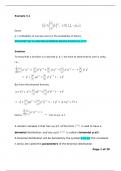
Example 3.1 Given , p = probability of success and q is the probability of failure. Show that f (x) is a discrete probability density function (p. d. f). Solution To show that a function is a discrete p. d. f. we have to show that its sum is unity, i.e., But from the binomial formula; Hence f (x) is a p. d. f. A random variable X that has a p.d.f. of the form is said to have a binomial distribution, and any such is called a binomial p.d.f. A binomial distribution will be denoted by the symbol b (n, p). The constants n and p are called the parameters of the binomial distribution. Thus, if we say X is b (5, 1/3), we mean that X has the binomial p.d.f. Remark The binomial distribution serves as an excellent mathematical model in a number of experimental situations, e.g. a random experiment, the outcome of which can be classified in but one of the two mutually exclusive and exhaustive ways, say, success or failure (for example, head or tail, life or death, effective or noneffective, e.t.c.) Theorem 3.1 The mean and the variance of the binomial distribution are: and . Proof where we omitted the term corresponding to x = 0, which is 0, and cancelled the x against the first factor of in the denominator of . Then, factoring out the factor n in and one factor p, we get and, letting and , this becomes since the last summation is the sum of all the values of a binomial distribution with the parameters m and p, and hence equal to 1. To find expressions for and , let us make use of the fact that and first evaluate . Duplicating for all practical purposes the steps used before, we thus get
Written for
- Institution
- Probability
- Course
- Probability
Document information
- Uploaded on
- May 30, 2023
- Number of pages
- 20
- Written in
- 2022/2023
- Type
- Class notes
- Professor(s)
- Prof kinyanjui
- Contains
- Week 7
Subjects
-
111 negative binomial distribution

Also available in package deal