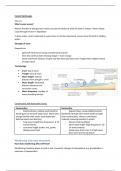
Coastal landscapes
Waves
What causes waves?
Waves: transfer of energy from wind to sea due to friction of wind on water’s surface. Waves shape
coast through erosion + deposition
In deep water, water molecules in wave move in circular movement, waves move forward in shallow
water.
Strength of wave
Depends on:
- Speed of wind (more energy transferred to waves)
- Time the wind has been blowing longer = more energy
- Fetch (maximum distance of open sea that wind can blow over): longer fetch, higher chance
of large waves
Terminology
Crest: top of wave
Trough: base of wave
Wave height: vertical
distance from trough to crest
Wave length: horizontal
distance between two
successive crests
Wave frequency: number of
waves breaking/minute
Constructive and destructive waves
Constructive Destructive
- Sheltered bays, sloping sandy beaches - Exposed bays, steep pebble beaches
Swash goes far forward (large area). Wave loses Backwash stronger than swash (both stronger
energy (friction with sand), weak backwash- than constructive). Waves comb beach
build up beach (not destroy) material, lowering beaches in winter
- Long wave length (low frequency)- 8-10 - Waves erode headland
waves/minute - Short wave length (high frequency)- 10-
- Low wave height (under 1m), gently 14 waves/minute
sloping wave front - Steep wave front, over 1m high wave,
does not travel far up beach
Weathering and mass movement
How does weathering affect cliff face?
Weathering: breaking down on rock in situ. Caused by changes in atmosphere, e.g. precipitation +
extremes of temperature
, Chemical weathering- Caused by chemical reaction (rainwater decomposes/eats rock)
Carbonation- carbonic acid in rainwater reacts with CaCO 3 (limestone) = sodium
bicarbonate. This is soluble- limestone carried in solution
Hydrolysis- acidic rainwater causing rock to rot (granite clay)
Oxidation- rocks broken down by O2 and water, giving iron-rich rocks rust-coloured surface
Mechanical (physical) weathering- Rocks disintegrated, associated with extremes of temperature
Freeze-thaw weathering: water enters cracks, freezes in cold temperatures (night), ice
expands by 9%, creating pressure. Temperature increases, ice thaws, process repeats,
causing fragments to break off (scree at base of cliff)
Salt weathering: salt spray from ocean gets into crack, salt crystallises, creating pressure,
weakening structure
How does mass movement happen?
Mass movement: downslope movement of rock, soil, or mud under influence of gravity. Usually
triggered by heavy rainfall, scale of damage determined by extent of weathering
Sliding- Downhill movement of large amount of rock, soil and mud occurs on
landslide steep cliffs weakened by weathering
- Rain infiltrates soil, percolates into rocks, making it heavier.
- Heavier, saturated rock falls along slip plane (line of weakness-
fault/bedding plane).
- Slide starts by tearing vegetation, descent aided by lubrication
from wet rocks.
- Cliffs in Durdle Door, Dorset, suffered large landslides.
Sliding- Large amount of rock slips along fairly straight slip plane.
rock Rock falls as a block, maintains contact with cliff
slide Leading edge = pile of rocks in sea
Sliding- Wet + rapid, occur on slopes > 10°, e.g. Monmouth Beach (Lyme Regis,
mud Dorset)
slide Vegetation sparse, cannot hold in place
Rock Bare, well-jointed rocks prone to freeze-thaw weathering falling
falls rocks lose contact with cliff face. Form scree slope at bottom.
Common on vertical cliffs
Burton Bradstock, Dorset- 400 tonnes fell from 49m vertical cliff In July
2012
Slumping Has concave slip plane
Material rotated backwards onto cliff face, e.g. Barton-on-Sea,
Hampshire, slumping at 30cm/day
Marine processes
Processes of coastal erosion
Marine erosion: removal of material by waves
Higher rate of erosion where;
Rock has many joints
Coastline exposed to large fetch (Needles, Isle of Wight, 8000km fetch)
Strong winds = destructive waves (winter)
Waves
What causes waves?
Waves: transfer of energy from wind to sea due to friction of wind on water’s surface. Waves shape
coast through erosion + deposition
In deep water, water molecules in wave move in circular movement, waves move forward in shallow
water.
Strength of wave
Depends on:
- Speed of wind (more energy transferred to waves)
- Time the wind has been blowing longer = more energy
- Fetch (maximum distance of open sea that wind can blow over): longer fetch, higher chance
of large waves
Terminology
Crest: top of wave
Trough: base of wave
Wave height: vertical
distance from trough to crest
Wave length: horizontal
distance between two
successive crests
Wave frequency: number of
waves breaking/minute
Constructive and destructive waves
Constructive Destructive
- Sheltered bays, sloping sandy beaches - Exposed bays, steep pebble beaches
Swash goes far forward (large area). Wave loses Backwash stronger than swash (both stronger
energy (friction with sand), weak backwash- than constructive). Waves comb beach
build up beach (not destroy) material, lowering beaches in winter
- Long wave length (low frequency)- 8-10 - Waves erode headland
waves/minute - Short wave length (high frequency)- 10-
- Low wave height (under 1m), gently 14 waves/minute
sloping wave front - Steep wave front, over 1m high wave,
does not travel far up beach
Weathering and mass movement
How does weathering affect cliff face?
Weathering: breaking down on rock in situ. Caused by changes in atmosphere, e.g. precipitation +
extremes of temperature
, Chemical weathering- Caused by chemical reaction (rainwater decomposes/eats rock)
Carbonation- carbonic acid in rainwater reacts with CaCO 3 (limestone) = sodium
bicarbonate. This is soluble- limestone carried in solution
Hydrolysis- acidic rainwater causing rock to rot (granite clay)
Oxidation- rocks broken down by O2 and water, giving iron-rich rocks rust-coloured surface
Mechanical (physical) weathering- Rocks disintegrated, associated with extremes of temperature
Freeze-thaw weathering: water enters cracks, freezes in cold temperatures (night), ice
expands by 9%, creating pressure. Temperature increases, ice thaws, process repeats,
causing fragments to break off (scree at base of cliff)
Salt weathering: salt spray from ocean gets into crack, salt crystallises, creating pressure,
weakening structure
How does mass movement happen?
Mass movement: downslope movement of rock, soil, or mud under influence of gravity. Usually
triggered by heavy rainfall, scale of damage determined by extent of weathering
Sliding- Downhill movement of large amount of rock, soil and mud occurs on
landslide steep cliffs weakened by weathering
- Rain infiltrates soil, percolates into rocks, making it heavier.
- Heavier, saturated rock falls along slip plane (line of weakness-
fault/bedding plane).
- Slide starts by tearing vegetation, descent aided by lubrication
from wet rocks.
- Cliffs in Durdle Door, Dorset, suffered large landslides.
Sliding- Large amount of rock slips along fairly straight slip plane.
rock Rock falls as a block, maintains contact with cliff
slide Leading edge = pile of rocks in sea
Sliding- Wet + rapid, occur on slopes > 10°, e.g. Monmouth Beach (Lyme Regis,
mud Dorset)
slide Vegetation sparse, cannot hold in place
Rock Bare, well-jointed rocks prone to freeze-thaw weathering falling
falls rocks lose contact with cliff face. Form scree slope at bottom.
Common on vertical cliffs
Burton Bradstock, Dorset- 400 tonnes fell from 49m vertical cliff In July
2012
Slumping Has concave slip plane
Material rotated backwards onto cliff face, e.g. Barton-on-Sea,
Hampshire, slumping at 30cm/day
Marine processes
Processes of coastal erosion
Marine erosion: removal of material by waves
Higher rate of erosion where;
Rock has many joints
Coastline exposed to large fetch (Needles, Isle of Wight, 8000km fetch)
Strong winds = destructive waves (winter)