Knopman Marks Securities Industry Essentials
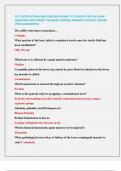
Knopman Marks Securities Industry Essentials Flash Cards (SIE) Question and Answer 2023. Do the following Investment Companies/Products offer continuous share offering or fixed share counts? Mutual Funds Closed-End Funds UIT ETF Correct Answer: Mutual Funds: Continuous Closed-End Funds: Fixed UIT: Fixed ETF: Fixed What Term signifies that a share of common stock can be freely transferred, assigned, or delivered to another entity? a) Fungible b) Negotiable c)Portable d)Endorsable Correct Answer: b - A negotiable security is one that can be freely transferred, assigned, or delivered. Note that not all securities are negotiable. ABC Company is paying a quarterly dividend to common stockholders. On which date must an investor legally own shares, on the books of the issuer, to be entitled to receive the divided? a) Declaration Date b) Record Date c) Payable Date d)Ex-dividend Date Correct Answer: b - The dividend is announced by the board on the declaration date. It is then paid on the payable date to shareholders of record on the record date. New investors must buy the stock before the ex-dividend date to be shareholders of record on the record date. Remember that the books are locked in, for dividend payment purposes, on the record date. What determine the amount of interest paid on a floating rate bond? a. the market value of the bond b. the general health of the company c. the value of a widely accepted bond benchmark d. the supply and demand characteristics of the bond issue Correct Answer: c - Interest rates of floating rate (adjustable rate, variable rate) bonds are determined by the level of popular bond index or benchmark, such as LIBOR. For example, the rate may be LIBOR +2%. The advantages of these bonds are that they have little or no interest rate risk - i.e., they don't decline in market value, if rates rise. How does a sinking fund protect bond investors? a. provides call protection b. adds a yield booster c. protects principal against rising rates d. ensures funding to retire bonds at maturity Correct Answer: d- a sinking fund provision requires the issuer to regularly set aside money for redeeming bonds. The money is held in escrow by a third party, which ensures that the issuer has sufficient funds to retire bonds at maturity. A bond issue has three potential call dates int he future. Which of these will be used in calculating yield to call? (YTC) a. The first b. The last c. An average of the three d. None, because YTC calculation defaults on to the maturity date in the even to multiple call dates Correct Answer: a - it is always the first call date (plus any call premium on that date) that is used in the YTC calculation Which of the following bonds will appreciate the most as interest rates fall? a. 10 yr., zero coupon bond b. 10 yrs., 5% bond c. 30 yrs., zero coupon bond d. 30 yrs., 5% bond Correct Answer: c - long term, low coupon bonds (including zero) are the most susceptible to changing interest rates. Therefore, as interest rates fall, the price of the 30 yrs., zero coupon bond will appreciate the most Paula wants to buy an investment grade corporate bond. What is the lowest S&P rating to consider? a. BBB b. BB c. B d.CCC Correct Answer: a - BBB is S&P's lowest investment grade bond rating. For Moody's, the comparable rating is Baa. Bonds that are rated below these categories are considered non-investment grade. A convertible bond can be converted into common stock of the bond issuer at a price of $20 per share. The bond is currently selling for $800. What is the conversion ratio? a. 40:1 b. 50:1 c.80:1 d. It can't be determined from given info Correct Answer: b - to calculate the conversion ratio, divide par value by the conversion price. $1,000/$20 = $50 Hal owns corporate bonds currently selling at $1,200. Their par value is $1,000. The conversion ratio is 30:1 What is the parity price of the underlying stock? a. $20.00 b. $30.00 c.$33.33 d.$40.00 Correct Answer: d - To solve for parity price of a stock, divide the current market value of the bond by the conversion ratio. In this case: $1,200/30 = $40 Parity Price. The underlying common stock would need to be worth more than $40 for a profit to be realized on the conversion of the bonds to stock.
Written for
- Institution
- Knopman
- Course
- Knopman
Document information
- Uploaded on
- May 28, 2023
- Number of pages
- 81
- Written in
- 2022/2023
- Type
- Exam (elaborations)
- Contains
- Questions & answers
Subjects
- knopman marks
-
knopman marks securities industry essentials flash cards sie question and answer 2023
-
knopman marks securities industry essentials f
-
do the following investment companiesproducts off