Please select one option
Incorrect option
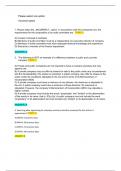
1. Please select the _INCORRECT_ option. In accordance with the Companies Act, the
requirements for the composition of an audit committee are: TOPIC 5
A) Consist of at least 3 members
B) Members of audit committee must be a independent non-executive director of company
C) Members of audit committee must have adequate financial knowledge and experience
D) Should be a member of the finance department
ANSWER: D
2. The following is NOT an example of a difference between a public and a private
company TOPIC 5
A) Private and public companies are not required to have a company secretary but may
appoint one.
B) A private company may not offer its shares for sale to the public under any circumstances
and the transferability of its shares is restricted. A public company may offer its shares to the
public under the conditions stipulated in the Act and in terms of its Memorandum of
Incorporation (MOI)
C) A private company must have a minimum of one director. No maximum is stipulated in
the Act. A public company must have a minimum of three directors. No maximum is
stipulated. However, the company’s Memorandum of Incorporation (MOI) may stipulate a
higher number.
D) A private company must include the words “proprietary” and “limited” or the abbreviation
of the words in its name, that is, (Pty) Ltd. A public company must not include the word
“proprietary” or its abbreviation but must include only “limited” or its abbreviation in its name.
ANSWER: A
3. How long after appointing its company secretary should a company file the notice of
appointment? TOPIC 5
A) Within 5 business days
B) Within 10 business days
C) Within 21 business days
D) Within 30 business days
ANSWER: B
Incorrect option
1. Please select the _INCORRECT_ option. In accordance with the Companies Act, the
requirements for the composition of an audit committee are: TOPIC 5
A) Consist of at least 3 members
B) Members of audit committee must be a independent non-executive director of company
C) Members of audit committee must have adequate financial knowledge and experience
D) Should be a member of the finance department
ANSWER: D
2. The following is NOT an example of a difference between a public and a private
company TOPIC 5
A) Private and public companies are not required to have a company secretary but may
appoint one.
B) A private company may not offer its shares for sale to the public under any circumstances
and the transferability of its shares is restricted. A public company may offer its shares to the
public under the conditions stipulated in the Act and in terms of its Memorandum of
Incorporation (MOI)
C) A private company must have a minimum of one director. No maximum is stipulated in
the Act. A public company must have a minimum of three directors. No maximum is
stipulated. However, the company’s Memorandum of Incorporation (MOI) may stipulate a
higher number.
D) A private company must include the words “proprietary” and “limited” or the abbreviation
of the words in its name, that is, (Pty) Ltd. A public company must not include the word
“proprietary” or its abbreviation but must include only “limited” or its abbreviation in its name.
ANSWER: A
3. How long after appointing its company secretary should a company file the notice of
appointment? TOPIC 5
A) Within 5 business days
B) Within 10 business days
C) Within 21 business days
D) Within 30 business days
ANSWER: B