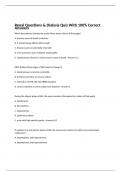
Renal Questions & Dialysis Quiz With 100% Correct Answers
Which descriptions characterize acute kidney injury (Select all that apply) A. primary cause of death is infection B. it almost always affects older people C. disease course is potentially reversible D. most common cause is diabetic nephropathy E. cardiovascular disease is most common cause of death - Answer A, C RIFLE defines three stages of AKI based on change in A. blood pressure and urine osmolality B. fractional excretion of urinary sodium C. estimation of GFR with the MDRD equation D. serum creatinine or urine output from baseline - Answer D During the oliguric phase of AKI, the nurse monitors that patient for (select all that apply) A. hypotension B. ECG rhythms C. hyperatremia D. pulmonary edema E. urine with high specific gravity - Answer B, D If a patient is in the diuretic phase of AKI, the nurse must monitor for which serum electrolyte imbalances? A. hyperkalemia and hyponatremia B. hyperkalemia and hypernatremia C. hypokalemia and hyponatremia D. hypokalemia and hypernatremia - Answer C A patient is admitted to the hospital with chronic kidney disease. The nurse understands that this condition is characterized by A. progressive irreversible destruction of the kidneys B. a rapid decrease in urine output with an elevated BUN C. an increasing creatinine clearance with a decrease in urine output D. prostration, somnolence, and confusion with coma and imminent death - Answer A Nurses must teach patients at risk for developing chronic kidney disease. Individuals considered to be at increase risk include (select all that apply) A. older African Americans B. patients more than 60 years old C. those with pancreatitis D. those with a history of hypertension E. those with a history of type 2 diabetes - Answer A, B, D, E Patients with chronic kidney disease experience an increased incidence of cardiovascular disease related to (select all that apply) A. hypertension B. vascular calcifications C. a genetic predisposition D. hyperinsulinemia causing dyslipidemia E. increasing high-density lipoproetin levels - Answer A, B, D Nutritional support and management are essential across the entire continuum of chronic kidney disease. Which statements would be considered true related to nutritional therapy (select all that apply) A. fluid is not usually restricted for patient receiving peritoneal dialysis B. sodium and potassium may be restricted in someone with advanced CKD C. decreased fluid intake and a low-potassium diet are hallmarks of the diet for a patient receiving hemodialysis D. decreased fluid intake and a low-potassium diet are hallmarks of the diet for a patient receiving peritoneal dialysis E. decreased fluid intake and a diet with phosphate-rich foods are hallmarks of a diet for a patient receiving hemodialysis - Answer A, B, C An ESRD patient receiving hemodialysis is considering asking a relative to donate a kidney for transplantation. In assisting the patient to make a decision about treatment, the nurse informs the patient that A. successful transplantation usually provides better quality of life than that offered by dialysis B. if rejection of the transplanted kidney occurs, no further treatment for the renal failure is available C. hemodialysis replaces the normal functions of the kidneys, and patients do not have to live with the continual fear of rejection D. the immunosuppressive therapy following transplantation makes the person ineligible to receive other forms of treatment if the kidney fails - Answer A To assess the patency of a newly placed arteriovenous graft for dialysis, the nurse should (select all that apply) A. monitor the BP in the affected arm B. irrigate the graft daily with low-dose heparin C. palpate the area of the graft to feel a normal thrill D. listen with a stethoscope over the graft to detect a bruit E. frequently monitor the pulses and neurovascular status distal to the graft - Answer C, D, E A major advantage of peritoneal dialysis is A. the diet is less restricted and dialysis can be performed at home B. the dialysate is biocompatible and causes no long-term consequences C. high glucose concentrations of the dialysate cause a reduction in appetite, promoting weight loss D. no medications are required because of the enhanced efficiency of the peritoneal membrane in removing toxins - Answer A
Written for
- Institution
- Dialysis
- Course
- Dialysis
Document information
- Uploaded on
- May 28, 2023
- Number of pages
- 11
- Written in
- 2022/2023
- Type
- Exam (elaborations)
- Contains
- Questions & answers
Subjects
- dialysis stuvia
-
renal questions amp dialysis quiz stuvia
-
renal questions amp dialysis quiz with 100 correct answers
-
which descriptions characterize acute kidney injury select all that apply a

Also available in package deal