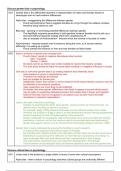
Discuss gender bias in psychology.
AO1 Gender bias is the differential treatment or representation of males and females based on
stereotypes and not real evidence differences
Alpha bias - exaggerating the differences between gender
- Freud psychodynamic theory suggests females do not go through the oedipus complex,
therefore being inferior to men
Beta bias - ignoring or minimising potential differences between gender
- The fight/flight response generalises to both genders however females tend to pick up a
tend and befriend response instead which isn’t considered by f/f
- also an example of Androcentrism - theories which are centred or focused on males
Androcentrism - biassed towards men’s behaviour being the norm, so if women behave
differently, it is seeing as a typical
- Freud scented his research on men and saw females as failed males
AO3 there is evidence of gender bias causing harm
- Freud’s theory results in negative stereotypes about women
- Men = standard
- Women = inferior
- He labels women as inferior due to their inability to resolve their electra complex
- This took place during the fights for equal rights resulting in a negative influence in society
One way to overcome gender bias is by making research less inherently sexist
- most research in psych is conducted by men
- Therefore the methods are biassed
- And not suitable for female ppts
- Additionally, there’s less women in senior research levels means female concerns may not
be reflected in the research questions
- male researchers are more likely to get published
- So studies that show gender differences more likely to appear in journal articles psych
may be guilty in supporting institutional sexism that creates bias in theory and research
however this bias must be recognised in processes such as peer review and staff
recruitment in research organisations
Lead to the start of feminist psychology
- Includes re-examining the ‘facts’ about gender, viewing women as normal humans, not
deficient men, focusing on women’s concerns.
- For example, Eagly (1978) claims that females are less effective leaders than males.
- However, the purpose of Eagly’s claim is to help researchers develop training programmes
aimed at reducing the lack of female leaders in the real-world
- Studies undertaken in ecologically valid environments show more accurately the real-life
experience of women, and so the systems used to accumulate data need addressing if
gender bias against women is to be removed from Psychology (Eagly & Johnson, 1990)
Gender bias is being addressed by growing the flexibility in psych research
- To produce less subjective conclusions based on findings
- Eg. Dambrin and Lambert include in the discussion of their study into the lack of women in
leadership in accountancy firms reflection on how their own experiences of working in a
male-dominated field may have influenced their understanding of their findings.
- This examination of personal bias is an important development in Psychology.
- Critical element of psychological study will improve objectivity and overcome gender bias.
Discuss cultural bias in psychology.
AO1 culture bias is the tendency to judge others in terms of owns own cultural assumptions
Alpha bias - when a theory in psychology assumes cultural groups are profoundly different
, Beta bias - when real cultural differences are ignored and minimised
Ethnocentrism - our own culture is taken as the norm that we judge other cultures against
- seeing the world from one's own cultural perspective
- eg. Strange situation - exerted western culture values within the research which may have
biassed findings
Cultural relativism - view that behaviour can only be understood when taken in cultural context
- eg. Any study which draws its sample from only one culture context and then generalises
its findings to all people is suspicious of this
AO3 culture bias in research
- smith and bond - 66% of studies were from USA, 32% Europe and only 2% from others
- These studies were in textbooks and are used to teach psychology to students
- = ethnocentric bias
- However, this study being 35 years old indicating the chance of improvement
- But Henrich et al (2010) found that 96% of participants involved in studies published in the
top 6 psychological journals all came from samples including wealthy, educated,
industrialised, rich and democratic cultures
- meaning that almost all research is potentially hugely flawed by beta cultural bias
Ways to overcome culture bias
- John berry said to use ‘emic’ approaches rather than ‘imposed emic’
- ‘imposed emic’ = how the methodologies and measures developed in one (usually
western) culture are assumed to be applicable to all cultures
- lead to important differences being minimised, ignored or judged negatively
- Eg. people assuming that Japanese child-rearing practices were not as good as those in
Europe following cross-cultural studies using the strange situation
- Berry argues that research methods based around understanding cultures are needed to
gain true understanding of cultures, all of which are unique
However, it is possible that Berry’s approach oversimplifies things
- The emic approach is limited to drawing conclusions about the one culture an emic study
has been created to investigate.
- This cannot be ‘transferred’ to other cultures to see if there are general, universal laws of
behaviour.
- yet there are universal behaviours that have been shown to exist through quite strong
cross-cultural research
- Eg. Buss et al (1990) illustrated that certain partner preferences were found to be true
across 37 different cultures.
- So Berry’s emic approach does not enable such universal behaviours to be discovered,
and instead differences between cultures may be exaggerated if we lose the ability to find
the commonalities between them
- Therefore, taking a culturally relative approach is not be the best solution to this problem.
Discuss free will and determinism in psychology.
AO1 Free will is the idea we have control over our own behaviour
- Humanistic approach - free will is required for mental health (Rogers) , otherwise can't
take control of negative behaviours.
- Moral responsibility - adults are accountable for their behaviour regardless of innate
factors or poor early environment.
Determinism: our behaviour is governed by internal and external forces over which we have no
control; consequently, our behaviour is viewed as predictable.
- Hard determinism is the view that forces outside of our control have complete authority
over behaviour
- soft determinism opposes this view and suggests that we are constrained by these forces,
AO1 Gender bias is the differential treatment or representation of males and females based on
stereotypes and not real evidence differences
Alpha bias - exaggerating the differences between gender
- Freud psychodynamic theory suggests females do not go through the oedipus complex,
therefore being inferior to men
Beta bias - ignoring or minimising potential differences between gender
- The fight/flight response generalises to both genders however females tend to pick up a
tend and befriend response instead which isn’t considered by f/f
- also an example of Androcentrism - theories which are centred or focused on males
Androcentrism - biassed towards men’s behaviour being the norm, so if women behave
differently, it is seeing as a typical
- Freud scented his research on men and saw females as failed males
AO3 there is evidence of gender bias causing harm
- Freud’s theory results in negative stereotypes about women
- Men = standard
- Women = inferior
- He labels women as inferior due to their inability to resolve their electra complex
- This took place during the fights for equal rights resulting in a negative influence in society
One way to overcome gender bias is by making research less inherently sexist
- most research in psych is conducted by men
- Therefore the methods are biassed
- And not suitable for female ppts
- Additionally, there’s less women in senior research levels means female concerns may not
be reflected in the research questions
- male researchers are more likely to get published
- So studies that show gender differences more likely to appear in journal articles psych
may be guilty in supporting institutional sexism that creates bias in theory and research
however this bias must be recognised in processes such as peer review and staff
recruitment in research organisations
Lead to the start of feminist psychology
- Includes re-examining the ‘facts’ about gender, viewing women as normal humans, not
deficient men, focusing on women’s concerns.
- For example, Eagly (1978) claims that females are less effective leaders than males.
- However, the purpose of Eagly’s claim is to help researchers develop training programmes
aimed at reducing the lack of female leaders in the real-world
- Studies undertaken in ecologically valid environments show more accurately the real-life
experience of women, and so the systems used to accumulate data need addressing if
gender bias against women is to be removed from Psychology (Eagly & Johnson, 1990)
Gender bias is being addressed by growing the flexibility in psych research
- To produce less subjective conclusions based on findings
- Eg. Dambrin and Lambert include in the discussion of their study into the lack of women in
leadership in accountancy firms reflection on how their own experiences of working in a
male-dominated field may have influenced their understanding of their findings.
- This examination of personal bias is an important development in Psychology.
- Critical element of psychological study will improve objectivity and overcome gender bias.
Discuss cultural bias in psychology.
AO1 culture bias is the tendency to judge others in terms of owns own cultural assumptions
Alpha bias - when a theory in psychology assumes cultural groups are profoundly different
, Beta bias - when real cultural differences are ignored and minimised
Ethnocentrism - our own culture is taken as the norm that we judge other cultures against
- seeing the world from one's own cultural perspective
- eg. Strange situation - exerted western culture values within the research which may have
biassed findings
Cultural relativism - view that behaviour can only be understood when taken in cultural context
- eg. Any study which draws its sample from only one culture context and then generalises
its findings to all people is suspicious of this
AO3 culture bias in research
- smith and bond - 66% of studies were from USA, 32% Europe and only 2% from others
- These studies were in textbooks and are used to teach psychology to students
- = ethnocentric bias
- However, this study being 35 years old indicating the chance of improvement
- But Henrich et al (2010) found that 96% of participants involved in studies published in the
top 6 psychological journals all came from samples including wealthy, educated,
industrialised, rich and democratic cultures
- meaning that almost all research is potentially hugely flawed by beta cultural bias
Ways to overcome culture bias
- John berry said to use ‘emic’ approaches rather than ‘imposed emic’
- ‘imposed emic’ = how the methodologies and measures developed in one (usually
western) culture are assumed to be applicable to all cultures
- lead to important differences being minimised, ignored or judged negatively
- Eg. people assuming that Japanese child-rearing practices were not as good as those in
Europe following cross-cultural studies using the strange situation
- Berry argues that research methods based around understanding cultures are needed to
gain true understanding of cultures, all of which are unique
However, it is possible that Berry’s approach oversimplifies things
- The emic approach is limited to drawing conclusions about the one culture an emic study
has been created to investigate.
- This cannot be ‘transferred’ to other cultures to see if there are general, universal laws of
behaviour.
- yet there are universal behaviours that have been shown to exist through quite strong
cross-cultural research
- Eg. Buss et al (1990) illustrated that certain partner preferences were found to be true
across 37 different cultures.
- So Berry’s emic approach does not enable such universal behaviours to be discovered,
and instead differences between cultures may be exaggerated if we lose the ability to find
the commonalities between them
- Therefore, taking a culturally relative approach is not be the best solution to this problem.
Discuss free will and determinism in psychology.
AO1 Free will is the idea we have control over our own behaviour
- Humanistic approach - free will is required for mental health (Rogers) , otherwise can't
take control of negative behaviours.
- Moral responsibility - adults are accountable for their behaviour regardless of innate
factors or poor early environment.
Determinism: our behaviour is governed by internal and external forces over which we have no
control; consequently, our behaviour is viewed as predictable.
- Hard determinism is the view that forces outside of our control have complete authority
over behaviour
- soft determinism opposes this view and suggests that we are constrained by these forces,