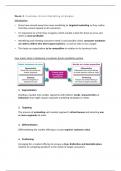
We e k 4 : C u s t o m e r d r i v e n M a r ke ti n g s t r a t e g i e s
Introduction
• Firms have moved away from mass marketing to targeted marketing as they realise
that they cannot appeal to all consumers
• It’s important to a firm they recognise which market is best for them to serve and
which is most profitable
• Identifying and meeting consumer needs is not possible unless consumer marketers
are able to define who their target market is, as well as who is not a target
• This helps an organization to be competitive in relation to its business rivals
Four major steps in designing a customer-driven marketing system
1. Segmentation
Dividing a market into smaller segments with distinct needs, characteristics or
behaviour that might require separate marketing strategies or mixes
2. Targeting
The process of evaluating each market segment’s attractiveness and selecting one
or more segments to enter
3. Differentiation
Differentiating the market offering to create superior customer value
4. Positioning
Arranging for a market offering to occupy a clear, distinctive and desirable place
relative to competing products in the minds of target consumers
,EXAMPLE: Total sports
Segmentation
• A market segment is a subgroup of people or organisations within a large market
• For segmentation to be successful, the members within each group must have
similar (homogenous) likes, tastes, needs, wants or preferences
• Market segmentation allows an organization to appeal accurately to consumers’
specific needs and wants
• It allows organizations to target their resources more effectively and make better
marketing decisions
Segmenting consumer markets
Consumer markets consist of purchasers and household members who intend to
consume or benefit from the purchased product and DO NOT buy products to make
profit by re-selling them
Variables in segmentation
- Demographic seg
- Geo seg
- Psychological seg
- Behavior segmentation
, 1.
1.
Demographic segmentation:
- Age (for eg, different types of centrum vitamins)
- Gender
- Marital status
- Income
2. Geographic segmentation
- Segmenting the market into geographic units such as communities, cities, countries etc.
- Some brands may find that their consumers lives in a specific geographic region
3. Psychographic Segmentation
- Marketers often segment their consumer base according to lifestyle & adapt their
marketing strategy accordingly
- Psychographic segmentation further filters the market into segments based on how the
consumer sees the world and takes into consideration different personality traits,
values, interests, and lifestyles factors
Introduction
• Firms have moved away from mass marketing to targeted marketing as they realise
that they cannot appeal to all consumers
• It’s important to a firm they recognise which market is best for them to serve and
which is most profitable
• Identifying and meeting consumer needs is not possible unless consumer marketers
are able to define who their target market is, as well as who is not a target
• This helps an organization to be competitive in relation to its business rivals
Four major steps in designing a customer-driven marketing system
1. Segmentation
Dividing a market into smaller segments with distinct needs, characteristics or
behaviour that might require separate marketing strategies or mixes
2. Targeting
The process of evaluating each market segment’s attractiveness and selecting one
or more segments to enter
3. Differentiation
Differentiating the market offering to create superior customer value
4. Positioning
Arranging for a market offering to occupy a clear, distinctive and desirable place
relative to competing products in the minds of target consumers
,EXAMPLE: Total sports
Segmentation
• A market segment is a subgroup of people or organisations within a large market
• For segmentation to be successful, the members within each group must have
similar (homogenous) likes, tastes, needs, wants or preferences
• Market segmentation allows an organization to appeal accurately to consumers’
specific needs and wants
• It allows organizations to target their resources more effectively and make better
marketing decisions
Segmenting consumer markets
Consumer markets consist of purchasers and household members who intend to
consume or benefit from the purchased product and DO NOT buy products to make
profit by re-selling them
Variables in segmentation
- Demographic seg
- Geo seg
- Psychological seg
- Behavior segmentation
, 1.
1.
Demographic segmentation:
- Age (for eg, different types of centrum vitamins)
- Gender
- Marital status
- Income
2. Geographic segmentation
- Segmenting the market into geographic units such as communities, cities, countries etc.
- Some brands may find that their consumers lives in a specific geographic region
3. Psychographic Segmentation
- Marketers often segment their consumer base according to lifestyle & adapt their
marketing strategy accordingly
- Psychographic segmentation further filters the market into segments based on how the
consumer sees the world and takes into consideration different personality traits,
values, interests, and lifestyles factors