SCCJA PPCT part 1 Exam with complete solutions
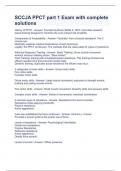
History of PPCT - Answer- Founded by Bruce Siddle in 1979. It provides research based training designed to minimize the ever present risk of liability Components of Acceptability - Answer- Tactically: from a tactical standpoint. The 3 minute rule. Medically: explores medical implications of each technique. Legally: the PPCT Continuum. The methods that are reasonable for types of resistance. Stimulus Response Training - Answer- Static Training: Gross muscle movement workout stimulus initiating action. "Slow motion". Fluid Training: training with simulated/relaxed resistance. This training shortens the officers reaction time and prevents mental stalls. Dynamic training: duplicates actual resistance the officers may incur. 3 categories of motor skills - Answer- Gross motor skills. Fine motor skills. Complex motor skills. Gross motor skills - Answer- Large muscle movement; explosive or strength events; pushing and pulling muscle events. Fine motor skills - Answer- Small muscle movement; dexterity skills and accuracy skills. Complex motor skills - Answer- Series of movements; hand/eye coordination. 4 common types of resistance - Answer- Resistance from escort position. Resistance while applying handcuffs. Passive resistance. Active aggression. Case law established the force continuum - Answer- Graham v. Connor. Provided a proper guide to the proper use of force. Levels of resistance - Answer- Psychological Intimidation. Verbal non-compliance. Passive Resistance. Defensive resistance. Active aggression. Deadly force assault. Levels of control - Answer- Officer presence. Verbal direction. Empty hand control. Intermediate weapons. Deadly force. Elements of justifying Deadly Force - Answer- Ability. Opportunity. Jeopardy. Case law that impacted the use of deadly force in law enforcement - Answer- Tennessee v. Garner. The deadly force justifications - Answer- 1.To prevent death or serious bodily injury to officer or another. 2.To prevent escape. 3.The officer should not unreasonably or unnecessarily endanger himself/herself or the public in the application of deadly force. 4. The officer should use verbal commands of authority and deterrence whenever feasible. The force continuum variables - Answer- Affects the officers decisions in escalation or de-escalation: 1. Type of crime 2. Officers or suspects size and gender 3. Exigent conditions 4. Reaction time 5. Access to weapons 6. Influence of alcohol/drugs 7. Injury or exhaustion of officer 8. Weather or terrain conditions 9. Special knowledge The elements of reporting force - Answer- Officer arrival. Approach. Suspects actions. Officers actions. Transport procedure. The principles of controlling resistive behavior - Answer- Pain compliance. Distraction technique. Balance displacement. Motor dysfunction. Stunning. The stages of reaction time - Answer- Perception. Analyze/evaluate. Formulate a strategy. Initiate motor action. The autonomic nervous system - Answer- It controls involuntary actions divided into 2 branches: Parasympathetic nervous system (PNS)- operates in non-stressful situations. Sympathetic nervous system (SNS)- operates in stressful situation. Homeostasis- the balance of the 2 branches. SNS activation triggers - Answer- The SNS provides us the ability to either "fight or flight" by: 1.Objective threat perception. (the proximity, time reaction, confidence, experience). 2. Objective fear perception. (fear of death, injury, killing, failurr, fear). 3. Physical exhaustion. (Inadequate nutrition). 4. Startle response. (Threat is spontaneous, unexpexted, loud noises, impact. The psychological changes that result from SNS activation - Answer- Adrenal activity. (Increased respiration/heart rate). Vascular activity. (Vasoconstriction, vascular flow re-directed from extremitied). Perceptual narrowing. (Auditory exclusion, selective attention). The relationship between the activation of the sympathetic nervous system and combat performance - Answer- Vision: tunnel vision, loss of near vision, ability to focus. Motor skills classification: fine; complex; gross; inverted u-law (different tasks require different levels of arousal for optimal performance); hicks law. Cognitive abilities: perceptual/senses; memory framework; hypervigilence SIDS - Answer- Sudden in-custody death syndrome Custody related deaths - Answer- Positional asphyxia. cocaine induced excited delirium. neroleptic malignant syndrome. cocaine abuse toxicity. excited delirium. The triggers of PNS backlash - Answer- Threat perception has diminished. Perception of injuries. Trauma to a vital system. Exhaustion of aerobic and anaerobic systems. The symptoms of PNS backlash - Answer- Dizziness from sudden drops in blood pressure and heart rate. Excessive bleeding. Symptoms of shock; paleness, nausea, excessive sweating, and clammy skin. Overwhelming sense of exhaustion. Excessive muscle tremors. The effects of Critical Incident Amnesia - Answer- Timetable to Memory recovery: before 1st sleep cycle memory is limited; after the first the memory increases by 50-70%; 2nd memory is most complete. Incident reporting: 1st report is "preliminary report or initial"; "supplemental" is after 1st sleep cycle; final report after the 2nd sleep cycle. Combat performance variables - Answer- Mindset: belief in the mission; refuse to give up. Motor skill selection: simplicity= confidence= fear management. Nutrition and hydration. Fitness: fatigue= fear= activation of SNS Belief system: personal relationships; kill versus murder; faith. The survival stress symptoms - Answer- Rapid breathing, cotton mouth, muscular tremors, increased heart rate, sweaty palms, visual difficulty, loss of ability to concentrate. The methods used to reduce survival stress effects - Answer- Confidence factor, motor skill selection, tactical breathing, visualization drills, an
Written for
- Institution
- SCCJA
- Course
- SCCJA
Document information
- Uploaded on
- May 24, 2023
- Number of pages
- 4
- Written in
- 2022/2023
- Type
- Exam (elaborations)
- Contains
- Questions & answers
Subjects
- sccja
- history of ppct
- gross motor skills
-
sccja ppct part 1 exam with complete solutions
-
components of acceptability
-
stimulus response training
-
3 categories of motor skills

Also available in package deal