ASVAB, Real asvab test!!! 2023 Solved Questions and Answers
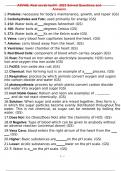
1. Proteins: necessary for body's maintenance, growth, and repair (GS) 2. Carbohydrates and Fats: used primarily for energy (GS) 3. 212: Water boils at degrees fahrenheit (GS) 4. 100: Water boils at degrees Celsius (GS) 5. 373: Water boils at Ks on the Kelvin scale (GS) 6. Veins: carry blood from capillaries toward the heart. (GS) 7. Arteries: carry blood away from the heart. (GS) 8. Ventricles: lower chamber of the heart (GS) 9. Red Blood Cells: component of blood which carries oxygen (GS) 10. Rust: Formed on Iron when an electrolyte (example: H2O) turns iron and oxygen into iron oxide (GS) 11. Fe2O3: iron oxide aka rust (GS) 12. Chemical: Iron forming rust is an example of a process. (GS) 13. Respiration: process by which animals convert oxygen and sugars into carbon dioxide and water (GS) 14. photosynthesis: process by which plants convert carbon dioxide and water into oxygen and sugar (GS) 15. Inert Noble Gases: Helium and neon are examples of , and do not react chemically. (GS) 16. Solution: When sugar and water are mixed together, they form a , in which the sugar particles become evenly distributed throughout the water. This is not chemical, as sugar can be restored by boiling the water. (GS) 17. Does Not: Ice (Does/Does Not) alter the chemistry of H2O. (GS) 18. O Negative: Type of blood which can be given to anybody without an adverse reaction (universal donor) (GS) 19. Vena Cava: blood enters the right atrium of the heart from the (GS) 20. Higher: Basic substances are on the pH scale. (GS) 21. Lower: Acidic substances are lower on the pH scale. (GS) 22. 7: Water is a on the pH scale. (GS) 23. Small Intestine: Digestive organ which does the most of the work in breaking down food. (GS) 24. Enzymes: Produced in the walls of the small intestine, pancreas, and liver, which completely breaks down food. (GS) 25. Testes: produces sperm (male reproductive system) (GS) 26. Oviduct: aka Fallopian tube (GS) 27. Gene: most basic unit of inheritance (GS) 28. Genotype: combination of alleles that code for a particular trait (GS) 29. Phenotype: physical expression of a certain genotype (GS) 30. Chromosomes: tightly coiled strands of DNA which contain multiple genes (GS) 31. Sedimentary: Shale is derived from clay, and is a rock. (GS) 32. Autotroph: known as a producer, can produce it's own food (GS) 33. Saprotroph: aka decomposer (GS) 34. Heterotroph: relies on other organisms to be it's food (GS) 35. Scavenger: relies on decaying flesh; example: Vulture (GS) 36. Momentum: tendency of an object to continue moving in the same direction (GS) 37. Velocity: rate at which an object changes direction (GS) 38. Acceleration: rate of change of velocity (GS) 39. Force: push or pull on an object that forces an object to change it's speed or direction (GS) 40. Centimeter: one hundredth of a meter (GS) 41. Millimeter: one thousandth of a meter (GS) 42. Decameter: 10 meters (GS) 43. Hectometer: 100 m
Written for
- Institution
- ASVAB
- Course
- ASVAB
Document information
- Uploaded on
- May 21, 2023
- Number of pages
- 28
- Written in
- 2022/2023
- Type
- Exam (elaborations)
- Contains
- Questions & answers

Also available in package deal