BUSINESS RESEARCH METHODS – QUANTITATIVE
Lecture 1.1
Why important
Managerial decisions that are based on :
- The result of “good” research tend to be more effective
- Hunches, intuition and past experiences are more likely to be wrong
Experiences without research lead to losses
To be able to perform business research
To be able to steer business research
To be able to evaluate business research
- To discriminate between good and bad research proposals of researchers / research
agencies
- To discriminate between good and bad published research studies
Myths about business research
1. There is no need to study business research for a future manager
Reality : managers with statistical background are better
2. Business research ends up in the bottom drawer
Reality : It does happen a lot, but its due to that people are intimidated by the report
For knowledgeable mangers, research need not be intimidating
3. Business research is only for the wealthiest organizations
Reality : for example the A/B research is not expensive, you don’t always need a whole
R&D team, but it can be very expensive
4. Business research is only useful when you have a major decision to make
Reality : for small decision, the best managers carry out their own research
5. There is just one best way of researching a business problem
Reality : there is no such thing as an absolute truth in business (.. but that does not imply
that any is research is good)
What is business research
= A series of well-thought-out and carefully executed activities that enable the manager to
know how organizational problems can be solved, or at least considerably minimized
A business researcher:
- Specifies the information necessary to address these issues
- Design the method for collecting information
- Manages and implements the data collection process
- Analyzes the results
- Communicates the findings and their implications
, HALLMARK
Purposiveness
= knowing the why of your research, does it lead to the goal you
have in mind
Rigor
= ensuring a sound theoretical base and methodological design
Testability
= being able to test logically developed ideas based on data
Replicability
= finding the same result if the research is repeated in similar
circumstances
Precision and confidence
= drawing accurate conclusion with a high degree of confidence
(can be seen in a confidence interval)
Objectivity
= drawing conclusions based on facts (rather than on subjective ideas)
Generalizability
= being able to apply findings in a wide variety of different settings
- Applied research → applies for one company and one problem
- Fundamental (or basic) research → is to generate new knowledge and can be
applied to different problems and settings
Parsimony
= did you include the amount of variables you need, and did you only include the ones that
you are interested in
Shaving away unnecessary details, explaining a lot with a little
‘things should be made as simple as possible, but not any simpler’, albert einstein
Research process
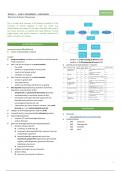
1. Problem definition : identify problem area, define problem statement
Decision problem : Manager focused
Needs to be transformed to a research problem : Research focused
Preliminary research :
- Organization/environmental context
- Discussion with decision makers
- Interviews with industry experts
- Initial secondary data analysis
2. Research approach development : theoretical framework, hypothesis, and model
A theoretical framework consists of :
Description of all relevant variables and their definitions
>motivate why these are important
Hypothesis : expected relationships between variables
>based on existing theory, testable, and unambiguous
Conceptual model
3. Research design development : determine nature of research, measures, sampling
4. Field work or data collection : data collection
5. Data integrity and analysis : data preparation and data analysis
6. Communicate research findings : data interpretation
,Cor()
Research design
= A framework or plan for conducting a research project. It details the procedures necessary
for obtaining the information needed to structure or solve research problems
Typically, it involves the following components or tasks:
- Define the information needed
- Decide on the nature of research
- Decide on techniques and measurement
- Construct and pre-test the research
- Decide on sampling process and sample size
- Develop a data analysis
Exploratory research
= a flexible and evolving approach to understand phenomena that are inherently difficult to
measure
Often required when prior theory is absent and an in-depth understanding is required
Create theory
Focus group discussion : when interaction helps
In-depth interviews : when interaction hurts, when detailed answers are needed complex
topics, expert respondents
You can also do quantitative explorative research ?
Conclusive research
= Characterized by clearly defined phenomena that can be measured by means of
quantitative data
Descriptive : testing correlational relationship between two or more variables
, Causal : testing the causal relationship between two or more variables by means of a
(laboratory or field) experiment
Correlation vs. causality
Condition for causality
>X and Y co-occur
>A logical explanation for the effect X on Y is needed
>X proceeds Y in time
>No other cause explains the co-occurrence of X and Y
Lecture 1.2:
1. Sources of error
2. Questionnaire design
3. Measurement levels
4. Scaling techniques
5. Relevant R commands for this week’s assignment
Sources of error
Total error = variation between the true mean value in the population of the variable of
interest and the observed value
Random sampling errors = error because the selected sample is an imperfect representation
of the population of interest
Non sampling errors = error that can be attributed to sources other than sampling and that
can be random or non-random
Lecture 1.1
Why important
Managerial decisions that are based on :
- The result of “good” research tend to be more effective
- Hunches, intuition and past experiences are more likely to be wrong
Experiences without research lead to losses
To be able to perform business research
To be able to steer business research
To be able to evaluate business research
- To discriminate between good and bad research proposals of researchers / research
agencies
- To discriminate between good and bad published research studies
Myths about business research
1. There is no need to study business research for a future manager
Reality : managers with statistical background are better
2. Business research ends up in the bottom drawer
Reality : It does happen a lot, but its due to that people are intimidated by the report
For knowledgeable mangers, research need not be intimidating
3. Business research is only for the wealthiest organizations
Reality : for example the A/B research is not expensive, you don’t always need a whole
R&D team, but it can be very expensive
4. Business research is only useful when you have a major decision to make
Reality : for small decision, the best managers carry out their own research
5. There is just one best way of researching a business problem
Reality : there is no such thing as an absolute truth in business (.. but that does not imply
that any is research is good)
What is business research
= A series of well-thought-out and carefully executed activities that enable the manager to
know how organizational problems can be solved, or at least considerably minimized
A business researcher:
- Specifies the information necessary to address these issues
- Design the method for collecting information
- Manages and implements the data collection process
- Analyzes the results
- Communicates the findings and their implications
, HALLMARK
Purposiveness
= knowing the why of your research, does it lead to the goal you
have in mind
Rigor
= ensuring a sound theoretical base and methodological design
Testability
= being able to test logically developed ideas based on data
Replicability
= finding the same result if the research is repeated in similar
circumstances
Precision and confidence
= drawing accurate conclusion with a high degree of confidence
(can be seen in a confidence interval)
Objectivity
= drawing conclusions based on facts (rather than on subjective ideas)
Generalizability
= being able to apply findings in a wide variety of different settings
- Applied research → applies for one company and one problem
- Fundamental (or basic) research → is to generate new knowledge and can be
applied to different problems and settings
Parsimony
= did you include the amount of variables you need, and did you only include the ones that
you are interested in
Shaving away unnecessary details, explaining a lot with a little
‘things should be made as simple as possible, but not any simpler’, albert einstein
Research process
1. Problem definition : identify problem area, define problem statement
Decision problem : Manager focused
Needs to be transformed to a research problem : Research focused
Preliminary research :
- Organization/environmental context
- Discussion with decision makers
- Interviews with industry experts
- Initial secondary data analysis
2. Research approach development : theoretical framework, hypothesis, and model
A theoretical framework consists of :
Description of all relevant variables and their definitions
>motivate why these are important
Hypothesis : expected relationships between variables
>based on existing theory, testable, and unambiguous
Conceptual model
3. Research design development : determine nature of research, measures, sampling
4. Field work or data collection : data collection
5. Data integrity and analysis : data preparation and data analysis
6. Communicate research findings : data interpretation
,Cor()
Research design
= A framework or plan for conducting a research project. It details the procedures necessary
for obtaining the information needed to structure or solve research problems
Typically, it involves the following components or tasks:
- Define the information needed
- Decide on the nature of research
- Decide on techniques and measurement
- Construct and pre-test the research
- Decide on sampling process and sample size
- Develop a data analysis
Exploratory research
= a flexible and evolving approach to understand phenomena that are inherently difficult to
measure
Often required when prior theory is absent and an in-depth understanding is required
Create theory
Focus group discussion : when interaction helps
In-depth interviews : when interaction hurts, when detailed answers are needed complex
topics, expert respondents
You can also do quantitative explorative research ?
Conclusive research
= Characterized by clearly defined phenomena that can be measured by means of
quantitative data
Descriptive : testing correlational relationship between two or more variables
, Causal : testing the causal relationship between two or more variables by means of a
(laboratory or field) experiment
Correlation vs. causality
Condition for causality
>X and Y co-occur
>A logical explanation for the effect X on Y is needed
>X proceeds Y in time
>No other cause explains the co-occurrence of X and Y
Lecture 1.2:
1. Sources of error
2. Questionnaire design
3. Measurement levels
4. Scaling techniques
5. Relevant R commands for this week’s assignment
Sources of error
Total error = variation between the true mean value in the population of the variable of
interest and the observed value
Random sampling errors = error because the selected sample is an imperfect representation
of the population of interest
Non sampling errors = error that can be attributed to sources other than sampling and that
can be random or non-random