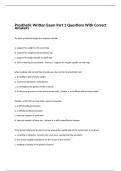
Prosthetic Written Exam Part 1 Questions With Correct Answers
To check prosthesis height the amputee should: a. support his weight on his sound leg b. support his weight on his prosthetic leg c. support his weight equally on both legs d. not be wearing his prosthesis - Answer c. support his weight equally on both legs when walking, the normal foot should pass close to the AK prosthetic foot: a. to facilitate shift of body weight b. to prevent hip flexion contractures c. to strengthen the gluteus medius muscle d. to decrease pressure on the lateral socket wall - Answer a. to facilitate shift of body weight Rotation of the foot at heel strike may be caused by: a. a stiff dorsiflexion bumper b. a stiff plantarflexion bumper c. external rotation of ankle axis d. internal rotation of knee axis - Answer b. a stiff plantarflexion bumper If the ischial tuberosity is placed too far toward the medial side of the ischial seat, it results in: a. crowding of adductor muscles into small area, causing burning sensation b. too musch weight being borne on the ramus of the ischium c. wedging of stump in the gluteus channel d. walking with leg internally rotated. - Answer a. crowding of adductor muscles into small area, causing burning sensation the knee bolt of the prosthesis is usually found to be a. perpendicular to the line of progression b. in approximately 5 degrees of internal rotation c. in approximately 5 degrees of external rotation d. in approximately 8 degrees of external rotation - Answer c. in approximately 5 degrees of external rotation when adductor longus tightness is observed during initial fitting the AK socket you would a. relieve the socket laterally b. roll and relieve medial posterior wall c. flare and contour anterior-medial corner d. increase flare above ischial level - Answer c. flare and contour anterior-medial corner when the above knee amputee must arch his back to maintain the center of gravity of his body in the proper position while pressing back with his stump, it is an indication that the: a. amputee has a pronounced lumbar lordosis b. foot on prosthesis is located too far laterally c. stump was fitted into a socket without adequate initial flexion d. stump was fitted into a socket with excessive abduction - Answer c. stump was fitted into a socket without adequate initial flexion As the AK amputee places his weight on the prosthesis the femur presses toward the lateral wall. Because of this the lateral socket wall should be: a. rounded to distribute pressure evenly b. adducted to stabilize the femur during locomotion c. padded to keep from injuring the stump d. abducted to allow the end of the femur to move freely - Answer b. adducted to stabilize the femur during locomotion the suction socket prosthesis is aligned so that involuntary alignment stability is minimized and voluntary knee control by stump action is emphasized: A. in order that a minimum amount of energy is consumed during walking. b. to provide valuable exercise for stump muscles c. to make it possible to use a simplified knee mechanism d. in order that the cosmetic appearance of the limb is improved. - Answer A. in order that a minimum amount of energy is consumed during walking. If a force of 10 lbs exerted on the five foot arm of a lever, what force must be exerted on the five foot arm to balance it? a. 25 lbs b. 50 lbs c. 20 lbs d. 30 lbs - Answer a. 25 lbs medial whip is caused by: a. improper placement of the toe break b. external rotation of ankle axis c. medial rotation of knee bolt d. excessive lateral rotation of knee bolt - Answer d. excessive lateral rotation of knee bolt In correcting an abducted socket on the adjustable leg, we should: a. release the medial tilt screw and tighten the lateral b. release the lateral tilt screw and tighten the medial c. release the lateral locking adjustment and move the shank medially d. give the amputee a wider walking base - Answer a. release the medial tilt screw and tighten the lateral when pulling the amputee into an ak socket the most important anatomical landmark is: a. gluteus maximus muscle b. hamstring muscle group c. adductor longus tendon d. rectus femoris tendon - Answer c. adductor longus tendon if the ischial seat of the ak socket is made too wide, it will cause: a. painful spasm of the gluteus maximus b. excessive pressure on the hamstring muscles, resulting in stump edema c. burning sensation when the wearer is seated, because of excessive stretching of the skin d. excessive adductor bulge because of insufficient room in the medial posterior area of socket - Answer b. excessive pressure on the hamstring muscles, resulting in stump edema which one of the following gait faults is due to incorrect function of the prosthesis a. circumduction b. pelvic rise c. unequal arm swing d. unequal step length - Answer a. circumduction how does an excessively stiff plantar flexion bumper in the prosthetic foot affect knee stability? a. increases knee stability excessively b. has no affect on knee stability c. decreases knee stability d. makes it necessary to move the socket forward in relation to the knee bolt - Answer c. decreases knee stability. at push off it is common for an AK amputee with well developed hamstrings muscles to force himself off the ischial seat as his stump extends. how can this trouble be avoided? a. align the socket so the extensor muscles are elongated slightly b. align the socket in a position of initial flexion c. align the socket in a position of initial extension d. align the socket so the abductor muscles are elongated slightly - Answer c. align the socket in a position of initial extension what is the effect of excessively shimming the dorsiflexion stop to place the shank in a vertical position? a. foot slap at heel strike b. excessive increase in range of plantar flexion with increase in knee stability c. foot and ankle stability at mid-stance d. excessive shortening in range of plantar flexion, resulting in stiffened plantar bumper action and knee instability. - Answer d. excessive shortening in range of plantar flexion, resulting in stiffened plantar bumper action and knee instability. If the AK amputee complains of pressure on the pubic ramus the prosthetist should: a. lower the ischial seat slightly b. relieve the scarpas triangle area c. lower the medial wall 1/8" at a time d. relieve the lateral socket wall - Answer b. relieve the scarpas triangle area pronounced impact shock at full extension of the prosthetic knee indicates a need for? a. shorter stride b. external rotation of knee bolt c. more extension dampening controls d. less extension dampening controls - Answer c. more extension dampening controls during swing phase, tendency for the AK prosthetic shin to make a marked inward movement of the knee accompanied by an outward movement of the foot is called: a. arcing b. medial whip c. shin swing d. lateral whip - Answer d. lateral whip if the medial/lateral dimension of the socket is too large: a. the ischial tuberosity protrudes over the posterior aspect of the socket b. the ischial tuberosity falls into the socket c. the amputee complains of tightness over the trochanter d. the ischial tuberosity will move laterally on the seat - Answer b. the ischial tuberosity falls into the socket what is the result of locating the toe-break too far forward in the prosthetic foot? a. causes foot slap at heel contact b. reduces moment of force around the ankle joint, causing knee instability at push-off c. causes instability of foot and ankle at mid-stance giving amputee a feeling at push-off. d. gives amputee a feeling of climbing a hill causing excessive energy consumption and awkward gait - Answer d. gives amputee a feeling of climbing a hill causing excessive energy consumption and awkward gait When hamstring muscle tightness is observed during initial fitting of the AK socket you should: a. relieve the lateral border of the scarpas bulge b. relieve the socket laterally. c. roll and relieve the medial posterior wall d. increase the AP dimension anteriorly - Answer c. roll and relieve the medial posterior wall Amputee Jones' weight of 200lbs. is assumed to be concentrated at his center of gravity. The effective length of the lever arm between his center of gravity and the support point on his socket is six inches. The effective length of the lever arm from the support point to the midpoint of his femur is ten inches. How many inch-pounds of force must be distributed on his femur to prevent mediolateral instability? a. 120 b. 600 c. 1200 d. 850 - Answer c. 1200 To determine the control system efficiency of the upper extremity prosthesis... a. divide the force measured at the hanger by the force at the terminal device. b. divide the force measure at the terminal device by the force at the hanger c. divide the amount of force necessary to displace the socket axially one half inch by the force needed to flex the elbow. d. multiply the force measured at the hanger (9.0 lbs, for instance) times 100% to get 90% efficiency. - Answer a. divide the force measured at the hanger by the force at the terminal device. An axial pull test on an upper extremity prosthesis should be... a. enough force to displace the socket one inch b. enough force to displace the socket 1/2 inch c. a force about 50 lbs and displace one inch. d. a force of 50 lbs and should not displace the socket more than one inch. - Answer d. a force of 50 lbs and should not displace the socket more than one inch. In the below elbow amputee, it is desirable too... a. retain as little pronation and supination as possible b. retain at least 50% of the pronation and supination available. c. always fit rigid hinges for stability regardless of rotation qualities retained. d. none of the above - Answer b. retain at least 50% of the pronation and supination available. The maximum pinch force of the two load hook is... a. 4lbs b. equal to the number of rubber bands on the TD c. 7lbs d. varies from an average 3lbs to 15lbs - Answer c. 7lbs When the arm is over head, the trapezius muscle... a. positions the glenoid cavity downwards. b. positions the glenoid cavity upward. c. abducts the should er girdle only. d. the trapezius muscle does not act. - Answer b. positions the glenoid cavity upward. The action of the deltoid muscle is too... a. adduction of the glenohumeral joint. b. extend the coracoid c. flex the radioulnar joint d. flex the gleno-humeral joint - Answer d. flex the gleno-humeral joint
Written for
- Institution
- Prosthetic Written
- Course
- Prosthetic Written
Document information
- Uploaded on
- May 20, 2023
- Number of pages
- 35
- Written in
- 2022/2023
- Type
- Exam (elaborations)
- Contains
- Questions & answers
Subjects
- prosthetic written
-
prosthetic written exam part 1
-
prosthetic written exam part 1 questions with correct answers
-
to check prosthesis height the amputee should a support his weight on his sound leg b

Also available in package deal