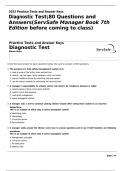
2023 Practice Tests and Answer Keys Diagnostic Test;80 Questions and Answers(ServSafe Manager Book 7th Edition before coming to class)
2023 Practice Tests and Answer Keys Diagnostic Test;80 Questions and Answers(ServSafe Manager Book 7th Edition before coming to class) 1 The purpose of a food safety management system is to A keep all areas of the facility clean and pest-free. B identify, tag, and repair faulty equipment within the facility. C prevent foodborne illness by controlling risks and hazards. D use the correct methods for purchasing and receiving food. 2 A manager’s responsibility to actively control risk factors for foodborne illnesses is called A hazard analysis critical control point (HACCP). B quality control and assurance. C food safety management. D active managerial control. 3 A manager asks a chef to continue cooking chicken breasts after seeing them cooked to an incorrect temperature. This is an example of which step in active managerial control? A Identifying risks B Monitoring C Corrective action D Re-evaluation 4 A manager walks around the kitchen every hour to answer questions and to see if staff members are following procedures. This is an example of which step in active managerial control? A Management oversight B Corrective action C Re-evaluation D Identify risks 5 One way for managers to show that they know how to keep food safe is to A become certified in food safety. B take cooking temperatures. C monitor employee behaviors. D conduct self-inspections. ⓐ A power outage has left hot TCS food out of temperature control for six hours. What must be done with the food? A Cool the food to 41°F (5°C) or lower. B Serve the food immediately. C Cook the food 165°F (74°C). D Throw the food away. 7 An imminent health hazard, such as a water supply interruption, requires immediate correction or A a HACCP plan. B closure of the operation. C evaluation of the situation. D normal operating procedures. 8 What is the best way to protect food from deliberate tampering? A Make it as difficult as possible for someone to tamper with it. B Allow former employees into the operation. C Perform spot inspections on new vendors. D Use the USDA A.L.A.R.M. system. 9 To prevent the deliberate contamination of food, a manager should know whom to contact about suspicious activity, monitor the security of products, keep information related to food security on file, and know A when to register with the EPA. B how to fill out an incident report. C where to find Safety Data Sheets in the operation. D who is in the facility. !0 Where should food handlers wash their hands? A Prep sink B Utility sink C Designated sink for handwashing D Three-compartment sink !1 What must food handlers do after touching their body or clothing? A Wash their hands B Rinse their gloves C Change their aprons D Use a hand antiseptic !2 When washing hands, what is the minimum time that food handlers should scrub hands and arms with soap? A 5 seconds B 8 seconds C 10 seconds D 18 seconds !3 After which activity must food handlers wash their hands? A Clearing tables B Putting on gloves C Serving customers D Applying hand antiseptic !4 What is the main reason for food handlers to avoid scratching their scalps? A Transferring a food allergen B Spreading pathogens to the food C Getting food in their hair D Causing toxic-metal poisoning !5 When may food handlers wear plain-band rings? A At any time B When not handling food C Only if wearing gloves D Only if washing dishes !6 What should a food handler do when working with an infected cut on the finger? A Cover the wound with a bandage. B Stay away from food and prep areas. C Cover the hand with a glove or a finger cot. D Cover the wound with an impermeable bandage or finger cot and a glove. !7 What is the only jewelry that may be worn on the hands or arms while handling food? A Plain-band ring B Medical ID bracelet C Leather-band watch D Diamond ring !8 In addition to other criteria, how many people must have the same symptoms in order for a foodborne illness to be considered an outbreak? A At least 1 B At least 2 C At least 10 D At least 20 !9 When should a food handler with a sore throat and fever be excluded from the operation? A Customers served are primarily a high-risk population B Fever is over 100°F (38°C) C Sore throat has lasted for more than 5 days D Before the regulatory authority is notified @0 What is a basic characteristic of a virus? A Destroyed by cooking B Grows in food C Requires a living host to grow D Commonly found in cattle intestines @1 After handling raw meat and before handling produce, what should food handlers do with their gloves? A Clean and sanitize them. B Continue working with them. C Set them aside if working with meat again later. D Wash hands and change them. @2 Where should personal items, like a coat, be stored in the operation? A On a shelf, above food B On a shelf, below food C In a designated area, away from food D In a kitchen, away from moving equipment @3 What should food handlers do after prepping food and before using the restroom? A Wash their hands B Take off their hats C Change their gloves D Take off their aprons @4 How should the temperature of a shipment of sour cream be taken when it arrives at an operation? A Place a hand on a container to see if it is cool to the touch. B Hold an infrared thermometer as close as possible to a case. C Place the thermometer stem between shipping boxes for a reading. D Remove the lid of a container and put the thermometer stem into the sour cream. @5 Ice crystals on a frozen food item indicate A time-temperature abuse. B cross-contamination. C poor cleaning and sanitizing. D poor personal hygiene. @6 What is the most important factor in choosing an approved food supplier? A It has a HACCP program or other food safety system. B It has documented manufacturing and packing practices. C Its warehouse is close to the operation, reducing shipping time. D It has been inspected and complies with local, state, and federal laws. @7 Which item should be rejected? A Bags of organic cookies in torn packaging B Bottled milk at 41°F (5°C) C Single-use cups in original packing D Live oysters with an internal temperature of 50°F (10°C) @8 Supplies should be stored away from the walls and at least off of the floor. A 2 inches (5 centimeters) B 4 inches (10 centimeters) C 5 inches (13 centimeters) D 6 inches (15 centimeters) @9 Soup on a buffet should be labeled with the A name of the food. B prep date. C soup’s ingredients. D use-by date. #0 How should chemicals be stored? A Above food B Away from prep areas C In food storage areas D With kitchenware #1 What should be done to ready-to-eat TCS food that will be prepped on-site and held for longer than 24 hours? A Date mark it. B Sell it. C Throw it away. D Serve it within the next hour. #2 What must a manager do with a recalled food item in the operation? A Combine the item with non-recalled items during preparation. B Record the names of customers who purchase the item. C Store the recalled item separately from other food. D Sell all recalled items within 24 hours. #3 A recall has been issued for a specific brand of orange juice. The store manager has matched the information from the recall notice to the item, removed the item from inventory, and stored it in a secure location. What should the manager do next? A Refer to the vendor notification for next steps. B Contact the supplier and arrange for the product to be picked up. C Label the item to prevent it from accidently being placed back in inventory. D Inform the local media, customers, and employees of the reason for the recall. #4 A food item that is received with an expired use-by date should be A rejected. B used immediately. C accepted but labeled differently. D accepted but kept separate from other items. #5 Cold food can be held intentionally without temperature control for hours as long as it does not exceed 70°F (21°C). A 2 B 4 C 6 D 8 #6 When delivering food for off-site service, raw poultry must be stored A at a lower temperature than ready-to-eat food. B separately from ready-to-eat food. C without temperature control. D above raw beef. #7 What is the minimum internal cooking temperature for seafood? A 135°F (57°C) or higher for 15 seconds B 145°F (63°C) or higher for 15 seconds C 155°F (68°C) or higher for 15 seconds D 165°F (74°C) or higher for 15 seconds #8 Food must be cooled from 135°F (57°C) to within 2 hours. A 80°F (27°C) B 45°F (7°C) C 70°F (21°C) D 41°F (5°C) #9 Hot TCS food being hot-held for service must be at what temperature? A 70°F (21°C) or above B 125°F (52°C) or above C 135°F (57°C) or above D 155°F (68°C) or above $0 Which method is a safe way to thaw food? A As part of the cooking process B Under running water at 125°F (52°C) or higher C Submerged in a sink of standing water at 70°F (21°C) D On the counter at room temperature $1 Food being cooled must pass quickly through which temperature range to reduce pathogen growth? A 65°F to 20°F (18°C to -6°C) B 125°F to 70°F (52°C to 21°C) C 180°F to 130°F (82°C to 54°C) D 220°F to 195°F (104°C to 90°C) $2 What food item does the FDA advise against offering on a children’s menu? A Rare cheeseburgers B Cheese pizza C Peanut butter and jelly sandwiches D Fried shrimp $3 A food handler with a sore throat and a fever should be excluded from working in a day-care center, because the children A will not receive the same level of service. B could make the food handler more sick. C are a high-risk population. D will refuse to eat. $4 Which is a chemical contaminant? A Bones in a chicken fillet B Norovirus in shellfish C Metal shavings in a can of peaches D Tomato juice served in a pewter pitcher $5 Which is a biological contaminant? A Bones in a chicken fillet B Norovirus in shellfish C Metal shavings in a can of peaches D Tomato juice served in a pewter pitcher $6 The 6 conditions bacteria need to grow are food, acidity, temperature, time, oxygen, and A meat. B moisture. C melatonin. D management. $7 Using the same knife to chop carrots for a salad immediately after cutting up raw chicken is an example of A time-temperature abuse. B cross-contamination. C poor personal hygiene. D purchasing from an unapproved supplier. $8 Which is an example of physical contamination? A Sneezing on food B Touching dirty food-contact surfaces C Bones in fish D Cooking tomato sauce in a copper pan $9 Which symptom could mean a customer is having an allergic reaction to food? A Coughing B Dehydration C Swollen lips D Sneezing %0 To prevent food allergens from being transferred to food, A clean and sanitize utensils before preparing an allergen special order. B buy food from trusted suppliers. C store cold food at 41°F (5°C) or lower. D avoid pewter tableware and utensils and copper cookware. %1 Which is a Big Eight food allergen? A Broccoli B Wheat C Grapes D Pork %2 What is the minimum temperature that must be maintained when holding hot soup for service? A 100°F (38°C) B 120°F (49°C) C 135°F (57°C) D 155°F (68°C) %3 Cold food being held without temperature control for up to six hours cannot exceed which temperature while it is being served? A 41°F (5°C) B 50°F (10°C) C 60°F (16°C) D 70°F (21°C) %4 A food handler has been holding chicken salad for sandwiches in a cold well for seven hours. When she checks the temperature of the chicken salad, it is 54°F (12°C). What must the food handler do? A Sell the remaining chicken salad immediately B Sell the remaining chicken salad within 2 hours C Cool the chicken salad to 41°F (5°C) D Discard the chicken salad %5 A food handler working in a hotel removes cold tuna salad from the cooler at 9:00 am and delivers it to a conference room for an 11:00 am buffet luncheon, where it is held without temperature control. By what time must the tuna salad be served or thrown out? A 12:00 p.m. B 2:00 p.m. C 3:00 p.m. D 4:00 p.m. %6 An operation has a buffet with 8 different items on it. How many serving utensils are needed to serve the items on the buffet? A 1 B 2 C 4 D 8 %7 Which food item may be handled with bare hands? A Sliced cheese for sandwiches B Boiled egg slices for salad C Chopped carrots for stew D Parsley for garnish %8 A cook wore single-use gloves while forming raw ground beef into patties. The cook continued to wear them while slicing hamburger buns. What mistake was made? A The cook did not wear reusable gloves while handling the raw ground beef and hamburger buns. B The cook did not clean and sanitize the gloves before handling the hamburger buns. C The cook did not wash hands before putting on the same gloves to slice the hamburger buns. D The cook did not wash hands and put on new gloves before slicing the hamburger buns. %9 When must a consumer advisory be provided for menu items containing TCS food? A When the item is raw or undercooked. B When the item contains a potential allergen. C When the operation provides only counter service. D When the operation primarily serves a high-risk population. ^0 Which feature is most important for a chemical storage area? A Good lighting B Single-use towels C Nonskid floor mats D Emergency shower system ^1 What is the correct way to store mops in between uses? A Propped in a corner B In a clean bucket C In a utility sink D Hanging on a hook ^2 A buser poured some cleaner from its original container into a smaller working container. What else does the buser need to do? A Label the working container with its contents. B Read the safety data sheet (SDS) for the cleaner. C Use a new wiping cloth when first using the working container. D Note on the original container that some cleaner was put into a working container. ^3 Which does not require sanitizing? A Plates B Knives C Walls D Tongs ^4 Which surfaces must be both cleaned and sanitized? A Walls B Cutting boards C Storage shelves D Garbage containers ^5 The first step in cleaning and sanitizing items in a three-compartment sink is A air-drying items. B washing items in detergent. C immersing items in sanitizer. D rinsing, scraping, or soaking items. ^6 After scraping and washing, what is the third step in cleaning and sanitizing a prep table? A Sanitizing B Air-drying C Rinsing D Rewashing ^7 In a heat-sanitizing dishwasher, what is the minimum temperature for the final rinse? A 152°F (67°C) B 180°F (82°C) C 192°F (89°C) D 200°F (93°C) ^8 A food-contact surface must be cleaned and sanitized A before working with a different type of food. B every 6 hours. C only if the food handler changes gloves. D at the end of the food handler’s shift. ^9 Where should garbage cans be cleaned? A Away from food and utensils B Next to food-prep areas C In dishwashing areas D In food storage areas &0 When the kitchen garbage can was full, an employee placed the full garbage bag on a prep table and tied it securely. Then he carried it to the Dumpster and disposed of it. What was done incorrectly? A The employee waited until the garbage was full. B The bag was disposed of in a dumpster. C The bag was placed on a prep table. D The employee tied the bag shut. &1 Grease and condensation buildup on surfaces can be avoided with correct A garbage disposal. B lighting. C sanitizing. D ventilation. &2 To prevent backflow, a sink must be equipped with a(n) A Air gap B Vacuum assist C Overflow drain D Touchless controls &3 What are the most important food safety features to look for when selecting flooring, wall, and ceiling materials? A Absorbent and durable B Hard and durable C Porous and durable D Smooth and durable &4 What information should a master cleaning schedule contain? A What should be cleaned and when B What should be cleaned, when, and by whom C What should be cleaned, when, by whom, and how D What should be cleaned, when, by whom, how, and why &5 A handwashing station should have hot and cold water, soap, a way to dry hands, and a A garbage container. B second timer. C clock. D gloves. &6 A food handler drops the end of a hose into a mop bucket and turns the water on to fill it. What has the food handler done wrong? A Created a cross-connection B Created an air-gap separation C Prevented backflow D Prevented atmospheric vacuuming &7 The water provided to a handwashing sink must be A hot water only. B cold water only. C potable water only. D fluoridated water only. &8 Which individual should apply pesticides in a foodservice operation? A A pest control operator B A shift manager C A busboy D A cook &9 A food handler who is receiving a food delivery observes signs of pests in the food. What should be done? A The head chef should be warned of the pests. B The food handler should remove all evidence of the pests. C The shipment should be refused and prevented from entering the operation. D The shipment should be stored outside the kitchen until a manager inspects it. *0 How high must legs be on table-mounted equipment? A At least 1 inch (3 centimeters) B At least 2 inches (5 centimeters) C At least 4 inches (10 centimeters) D At least 6 inches (15 centimeters)
Written for
- Institution
- ServSafe Manager
- Course
- ServSafe Manager
Document information
- Uploaded on
- May 19, 2023
- Number of pages
- 18
- Written in
- 2022/2023
- Type
- Exam (elaborations)
- Contains
- Questions & answers
Subjects
- servsafe manager
-
2023 practice tests and answer keys diagnostic test80 questions and answersservsafe manager book 7th edition before coming to class
-
1 the purpose of a food safety management system

Also available in package deal