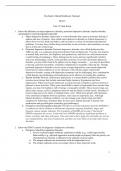
Psychiatric Mental Healthcare Nursing I NU673 Unit 15 Final Exam
1. Know the difference in major depressive disorder, persistent depressive disorder, bipolar disorder, and disruptive mood dysregulation disorder. a. Major depressive disorder: Depression is a mood disorder that causes a persistent feeling of sadness and loss of interest. Also called major depressive disorder or clinical depression, it affects how you feel, think and behave and can lead to a variety of emotional and physical problems. You may have trouble doing normal day-to-day activities, and sometimes you may feel as if life isn't worth living b. Persistent depressive disorder Persistent depressive disorder, also called dysthymia (disTHIE-me-uh), is a continuous long-term (chronic) form of depression. You may lose interest in normal daily activities, feel hopeless, lack productivity, and have low self-esteem and an overall feeling of inadequacy. These feelings last for years and may significantly interfere with your relationships, school, work and daily activities. If you have persistent depressive disorder, you may find it hard to be upbeat even on happy occasions — you may be described as having a gloomy personality, constantly complaining or incapable of having fun. Though persistent depressive disorder is not as severe as major depression, your current depressed mood may be mild, moderate or severe. Because of the chronic nature of persistent depressive disorder, coping with depression symptoms can be challenging, but a combination of talk therapy (psychotherapy) and medication can be effective in treating this condition. c. Bipolar disorder formerly called manic depression, is a mental health condition that causes extreme mood swings that include emotional highs (mania or hypomania) and lows (depression). When you become depressed, you may feel sad or hopeless and lose interest or pleasure in most activities. When your mood shifts to mania or hypomania (less extreme than mania), you may feel euphoric, full of energy or unusually irritable. These mood swings can affect sleep, energy, activity, judgment, behavior and the ability to think clearly. Episodes of mood swings may occur rarely or multiple times a year. While most people will experience some emotional symptoms between episodes, some may not experience any. Although bipolar disorder is a lifelong condition, you can manage your mood swings and other symptoms by following a treatment plan. In most cases, bipolar disorder is treated with medications and psychological counseling (psychotherapy). d. Disruptive mood dysregulation disorder: Disruptive mood dysregulation disorder (DMDD) is a condition in which children or adolescents experience ongoing irritability, anger, and frequent, intense temper outbursts. The symptoms of DMDD go beyond a “bad mood.” DMDD symptoms are severe. Youth who have DMDD experience significant problems at home, at school, and often with peers. They also tend to have high rates of health care service use, hospitalization, and school suspension, and they are more likely to develop other mood disorders. 2. Know the DSM 5 criteria for diagnosis of depressive disorders. a. Disruptive Mood Dysregulation Disorder: i. Severe recurrent temper outbursts manifested verbally (e.g., verbal rages) and/or behaviorally (e.g., physical aggression toward people or property) that are grossly out of proportion in intensity or duration to the situation or provocation. ii. The temper outbursts are inconsistent with developmental level. iii. The temper outbursts occur, on average, three or more times per week. 2 iv. The mood between temper outbursts is persistently irritable or angry most of the day, nearly every day, and is observable by others (e.g., parents, teachers, peers). v. Criteria A–D have been present for 12 or more months. Throughout that time, the individual has not had a period lasting 3 or more consecutive months without all of the symptoms in Criteria A–D. vi. Criteria A and D are present in at least two of three settings (i.e., at home, at school, with peers) and are severe in at least one of these. vii. The diagnosis should not be made for the first time before age 6 years or after age 18 years. viii. By history or observation, the age at onset of Criteria A–E is before 10 years. ix. There has never been a distinct period lasting more than 1 day during which the full symptom criteria, except duration, for a manic or hypomanic episode have been met. x. Note: Developmentally appropriate mood elevation, such as occurs in the context of a highly positive event or its anticipation, should not be considered as a symptom of mania or hypomania. xi. The behaviors do not occur exclusively during an episode of major depressive disorder and are not better explained by another mental disorder (e.g., autism spectrum disorder, posttraumatic stress disorder, separation anxiety disorder, persistent depressive
Document information
- Uploaded on
- May 17, 2023
- Number of pages
- 29
- Written in
- 2022/2023
- Type
- Exam (elaborations)
- Contains
- Questions & answers