Asset Management: A systemic approach to factor investing
By Andrew Ang
WEEK 1
CHAPTER 1 Asset Owners
Sovereign Wealth Funds
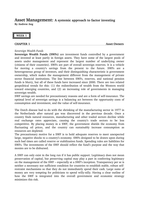
Sovereign Wealth Funds (SWFs) are investment funds controlled by a government
and invested at least partly in foreign assets. They have some of the largest pools of
assets under management and represent the largest number of underlying owner
(citizens of their countries). SWFs are part of overall sovereign reserves. It is a vehicle
for moving a country’s savings from the present to the future. SWFs are a
heterogeneous group of investors, and their distinguishing characteristic is government
ownership, which makes the management different from the management of private
sector financial institutions. The line between SWFs, reserves, and national pension
funds is blurry, but all of these funds have increased since 2000. There are two related
geopolitical trends for this: (1) the redistribution of wealth from the Western world
toward emerging countries, and (2) an increasing role of governments in managing
sovereign wealth.
SWF savings are needed for precautionary reasons and are a form of self-insurance. The
optimal level of sovereign savings is a balancing act between the opportunity costs of
consumption and investment, and the value of self-insurance.
The Dutch disease had to do with the shrinking of the manufacturing sector in 1977 in
the Netherlands after natural gas was discovered in the previous decade. Once a
country finds natural resources, manufacturing and other traded sectors decline while
real exchange rates appreciate, causing the country’s trade sectors to be less
competitive. By placing money in a SWF, the government shields the economy from
fluctuating oil prices, and the country can sustainably increase consumption as
resources are depleted.
The precautionary motive for a SWF is to hold adequate reserves to meet unexpected
large, negative shocks to a country’s economy. SWFs designed to be drawn upon during
such bad times are called reserve or stabilization funds. Spending rules are liabilities for
SWFs. The investments of the SWF should reflect the fund’s purpose and the way that
monies are to be disbursed.
A SWF can only exist in the long run if it has public support. Legitimacy does not mean
preservation of capital, but preserving capital may play a part in conferring legitimacy
on the management of the SWF – especially at a SWF’s inception. Transparency per se is
neither a necessary nor sufficient condition for countries to establish stable, robust self-
restraint mechanisms so that they do not immediately spend their cash. Large sums of
money are very tempting for politicians to spend willy-nilly. Having a clear outline of
how the SWF is integrated into the overall government and economic strategy
minimizes this risk.
By Andrew Ang
WEEK 1
CHAPTER 1 Asset Owners
Sovereign Wealth Funds
Sovereign Wealth Funds (SWFs) are investment funds controlled by a government
and invested at least partly in foreign assets. They have some of the largest pools of
assets under management and represent the largest number of underlying owner
(citizens of their countries). SWFs are part of overall sovereign reserves. It is a vehicle
for moving a country’s savings from the present to the future. SWFs are a
heterogeneous group of investors, and their distinguishing characteristic is government
ownership, which makes the management different from the management of private
sector financial institutions. The line between SWFs, reserves, and national pension
funds is blurry, but all of these funds have increased since 2000. There are two related
geopolitical trends for this: (1) the redistribution of wealth from the Western world
toward emerging countries, and (2) an increasing role of governments in managing
sovereign wealth.
SWF savings are needed for precautionary reasons and are a form of self-insurance. The
optimal level of sovereign savings is a balancing act between the opportunity costs of
consumption and investment, and the value of self-insurance.
The Dutch disease had to do with the shrinking of the manufacturing sector in 1977 in
the Netherlands after natural gas was discovered in the previous decade. Once a
country finds natural resources, manufacturing and other traded sectors decline while
real exchange rates appreciate, causing the country’s trade sectors to be less
competitive. By placing money in a SWF, the government shields the economy from
fluctuating oil prices, and the country can sustainably increase consumption as
resources are depleted.
The precautionary motive for a SWF is to hold adequate reserves to meet unexpected
large, negative shocks to a country’s economy. SWFs designed to be drawn upon during
such bad times are called reserve or stabilization funds. Spending rules are liabilities for
SWFs. The investments of the SWF should reflect the fund’s purpose and the way that
monies are to be disbursed.
A SWF can only exist in the long run if it has public support. Legitimacy does not mean
preservation of capital, but preserving capital may play a part in conferring legitimacy
on the management of the SWF – especially at a SWF’s inception. Transparency per se is
neither a necessary nor sufficient condition for countries to establish stable, robust self-
restraint mechanisms so that they do not immediately spend their cash. Large sums of
money are very tempting for politicians to spend willy-nilly. Having a clear outline of
how the SWF is integrated into the overall government and economic strategy
minimizes this risk.