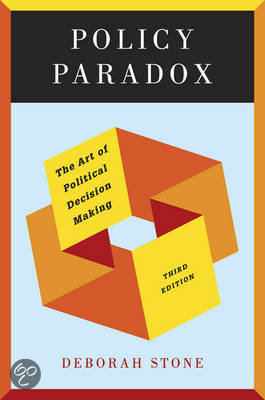
Policy Paradox
A paradox violates the most elementary principle of logic: something cannot be two different
things at once. A paradox is just such an impossible situation, and political life is full of
them.
Examples: Multiculturalism (Chinese man killed his wife, manslaughter instead of murder)
and Are low prices good or bad? (Walmart, prices are also symbols)
Rationality project: the project of making public policy more rational and scientific by
removing policy-making authority from elected bodies and giving it to expert professionals.
Three pillars:
A model of reasoning: rational decision-making, decisions are med in many steps (1)
identify objectives (2) identify alternative courses of action for achieving objectives
(3) predict the possible consequences of each alternative (4) evaluate the possible
consequences of each alternative (5) select the alternative that maximizes the
attainment of objectives → this model ignores our emotional feelings and moral
institutions
A model of society: society is a collection of autonomous and rational decision-makers
who pursue self-interest through rational calculation → strictly related to the “market
model” (vedi dopo)
A model of policymaking: production model where policy is created and “placed on
the agenda”, problems are defined and solutions are proposed/ legitimized
Chapter 1 - The market and the polis
Market model: social system in which individuals pursue their own welfare by exchanging
things with others whenever trade mutually beneficial. Participants compete over scarce
resources (ex: convert raw materials into valuable things, sold at highest possible price) and
only act to maximize their self-interest
Community: public policy is about communities trying to achieve something, it must have
members and a way of defining who is a member and who is not → ex: religious groups have
former rituals for new members to join, private clubs have procedures by which people can
join
, -
Membership: is the primary political issue of a community, it defines social, economic and
political rights, we must distinguish between (1) political community, a group of people who
live under the same political rules and governance structure (2) cultural community, group of
people who share a culture, language, history, ecc → in the polis members of a community
help each other in all kind of non-monetary ways (“mutual aid”) to protect each other and
their community, in the market model buyers buy in order to create economic security for
themselves
Integration policy: dilemma of how to integrate cultural communities into into a
single political one without destroying identity (remember: multiculturalism
paradox), it focuses on what values and behaviours immigrants must espouse in order
to become citizens
Altruism: means acting in order to benefit others rather than oneself → paradox of altruism is
that when people act to benefit others they feel satisfaction and fulfillment, which can be
seen as self-interest
Public interest: could be individual interests held in common, could be individuals’ goals for
the community → there is virtually never full agreement on the public interest, in market
theory public interest is the result of all individuals pursuing self-interests, in the polis
people fill the box intentionally
Situations where self-interest and public interest work against each other are known as
common problems, in the polis common problems are common, in market theory common
problems are more exceptions rather rules
In the polis, the gap between self-interest and public interest is bridged by:
1. Influence: actions and ideas influenced by others → boundary between
influence and coercion is vague
2. Cooperation: politics involve alliances and cooperation and are essential to
power (even more effective than coercion) → in the market model, pure
competition, no cooperation
3. Loyalty: cooperation often goes hand in hand with loyalty and is usually very
enduring, in politics people are binded over time and relationships are not fluid,
in the market model a rise in price can affect seller’s loyalty towards a store
(= fluidity)
A paradox violates the most elementary principle of logic: something cannot be two different
things at once. A paradox is just such an impossible situation, and political life is full of
them.
Examples: Multiculturalism (Chinese man killed his wife, manslaughter instead of murder)
and Are low prices good or bad? (Walmart, prices are also symbols)
Rationality project: the project of making public policy more rational and scientific by
removing policy-making authority from elected bodies and giving it to expert professionals.
Three pillars:
A model of reasoning: rational decision-making, decisions are med in many steps (1)
identify objectives (2) identify alternative courses of action for achieving objectives
(3) predict the possible consequences of each alternative (4) evaluate the possible
consequences of each alternative (5) select the alternative that maximizes the
attainment of objectives → this model ignores our emotional feelings and moral
institutions
A model of society: society is a collection of autonomous and rational decision-makers
who pursue self-interest through rational calculation → strictly related to the “market
model” (vedi dopo)
A model of policymaking: production model where policy is created and “placed on
the agenda”, problems are defined and solutions are proposed/ legitimized
Chapter 1 - The market and the polis
Market model: social system in which individuals pursue their own welfare by exchanging
things with others whenever trade mutually beneficial. Participants compete over scarce
resources (ex: convert raw materials into valuable things, sold at highest possible price) and
only act to maximize their self-interest
Community: public policy is about communities trying to achieve something, it must have
members and a way of defining who is a member and who is not → ex: religious groups have
former rituals for new members to join, private clubs have procedures by which people can
join
, -
Membership: is the primary political issue of a community, it defines social, economic and
political rights, we must distinguish between (1) political community, a group of people who
live under the same political rules and governance structure (2) cultural community, group of
people who share a culture, language, history, ecc → in the polis members of a community
help each other in all kind of non-monetary ways (“mutual aid”) to protect each other and
their community, in the market model buyers buy in order to create economic security for
themselves
Integration policy: dilemma of how to integrate cultural communities into into a
single political one without destroying identity (remember: multiculturalism
paradox), it focuses on what values and behaviours immigrants must espouse in order
to become citizens
Altruism: means acting in order to benefit others rather than oneself → paradox of altruism is
that when people act to benefit others they feel satisfaction and fulfillment, which can be
seen as self-interest
Public interest: could be individual interests held in common, could be individuals’ goals for
the community → there is virtually never full agreement on the public interest, in market
theory public interest is the result of all individuals pursuing self-interests, in the polis
people fill the box intentionally
Situations where self-interest and public interest work against each other are known as
common problems, in the polis common problems are common, in market theory common
problems are more exceptions rather rules
In the polis, the gap between self-interest and public interest is bridged by:
1. Influence: actions and ideas influenced by others → boundary between
influence and coercion is vague
2. Cooperation: politics involve alliances and cooperation and are essential to
power (even more effective than coercion) → in the market model, pure
competition, no cooperation
3. Loyalty: cooperation often goes hand in hand with loyalty and is usually very
enduring, in politics people are binded over time and relationships are not fluid,
in the market model a rise in price can affect seller’s loyalty towards a store
(= fluidity)