BIO 152 Exam 4 Questions & answers latest update 2023
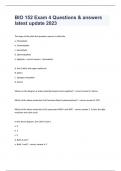
BIO 152 Exam 4 Questions & answers latest update 2023The stage of the plant that produces spores is called the a. Charophyte b. Gametophyte c. Sporophyte d. Spermatophyte e. Epiphyte - correct answer c. Sporophyte A. btw Cuticle and upper epidermis B. Xylem C. Spongey mesophyll D. Stoma Where on this diagram is water potential lowest (most negative)? - correct answer D. Stoma Which of the above molecules (A-E) becomes fixed in photosynthesis? - correct answer B. CO2 Which of the above molecules (A-E) represents NADP+ and ADP? - correct answer C. In btw. the light reactions and calvin cycle In the above diagram, the Calvin Cycle is a. X b. Y c. Z d. Both X and Y e. Both Y and Z - correct answer b. Y Which color(s) of light does chlorophyll reflect? a. blue b. red c. green d. red and blue - correct answer c. green The purpose of the light reactions of photosynthesis is to _____. a. Produce ATP from the electron transport chain b. Make NADPH c. Fix carbon dioxide d. Make water from H+ and O2 e. Both A and B - correct answer e. Both A and B Oxygen gas produced during photosynthesis originates as: a) oxygen atoms are released by the metabolism of carbohydrates. b) oxygen atoms contained in carbon dioxide are released when the carbon is fixed. c) a by-product of nitrogen-fixing bacteria. d) a molecule of chlorophyll oxidized by a photon. e) oxygen atoms contained in water molecules. - correct answer e) oxygen atoms contained in water molecules. If a plant had a mutation in the gene coding for its RuBisCo enzyme, it would affect its ability to a. Make ATP b. Fix carbon c. Produce oxygen d. Absorb sunlight - correct answer b. Fix carbon
Written for
- Institution
- BIO 152
- Course
- BIO 152
Document information
- Uploaded on
- May 15, 2023
- Number of pages
- 20
- Written in
- 2022/2023
- Type
- Exam (elaborations)
- Contains
- Questions & answers
Subjects
-
bio 152 exam 4 questions amp answers latest update 2023
-
the stage of the plant that produces spores is called the a charophyte b gametophyte c sporophyte d spermatophyte e epiphyte c sporophyt

Also available in package deal