NUR 02 PHARMACOLOGY EXAM 1
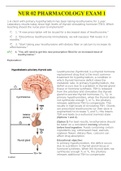
NUR 02 PHARMACOLOGY EXAM 1 1-A client with primary hypothyroidism has been taking levothyroxine for 1 year. Laboratory results today show high levels of thyroid stimulating hormone (TSH). Which teaching should the nurse plan to implement? 1. "A new prescription will be issued for a decreased dose of levothyroxine." 2. "Discontinue levothyroxine immediately; we will reassess TSH levels in 3 months." 3. "Start taking your levothyroxine with dietary fiber or calcium to increase its effectiveness." 4. "You will need to get this new prescription filled for an increased dose of levothyroxine." Explanation: Levothyroxine (Synthroid) is a thyroid hormone replacement drug that is the most common treatment for hypothyroidism, a condition in which thyroid hormone deficit slows the metabolic rate. In primary hypothyroidism, the deficit occurs due to a problem in thyroid gland tissue or hormone synthesis. TSH is released from the pituitary and stimulates the thyroid gland to secrete thyroid hormones (T3, T4). In primary hypothyroidism, when the thyroid does not synthesize enough T3 or T4, the pituitary releases additional TSH to compensate. This results in high levels of circulating TSH. Clients are prescribed levothyroxine (or their dose is augmented) to increase T3 and T4; this lowers TSH and leads to a euthyroid (normal) state (Options 1 and 2). (Option 3) For best results, levothyroxine should be taken on a consistent morning schedule before food ingestion. Foods containing certain ingredients (eg, cottonseed meal, walnuts, soybean flower, dietary fiber, calcium) can affect drug absorption. Educational objective: In primary hypothyroidism, the deficit occurs due to a problem in thyroid gland tissue or hormone synthesis. When the thyroid does not synthesize enough T3 or T4, the pituitary releases additional TSH to compensate. This results in high levels of circulating TSH. Levothyroxine is usually started/increased to lead to a euthyroid (normal) state. 2-A client with chronic kidney disease has received a continuous intravenous infusion of heparin for 5 days. The nurse reviews the coagulation studies and the medication administration record. Which prescription would the nurse question? Click on the exhibit button for additional information. 1. Epoetin 2. Sodium polystyrene sulfonate 3. Vitamin K 4. Warfarin Vitamin K (phytonadione) is a fat-soluble vitamin that is administered as an antidote for warfarin-related bleeding. This medication prescription should be questioned as vitamin K reverses the anticoagulant effect of warfarin, and the client's coagulation studies are in the therapeutic range (aPTT 46-70 sec, INR 2- 3). (Option 1) Epoetin (Procrit) is a synthetic hormone that stimulates the production of erythropoietin and is used to treat anemia associated with chronic kidney disease. This is an appropriate prescription. (Option 2) Sodium polystyrene sulfonate (Kayexalate) is a sodium exchange resin administered to reduce elevated serum potassium levels in clients with chronic kidney disease and hyperkalemia. This is an appropriate prescription for this client.
Written for
- Institution
- NUR 02 PHARMACOLOGY
- Course
- NUR 02 PHARMACOLOGY
Document information
- Uploaded on
- May 13, 2023
- Number of pages
- 68
- Written in
- 2022/2023
- Type
- Exam (elaborations)
- Contains
- Questions & answers
Subjects
-
nur 02 pharmacology exam 1 1 a client with primary hypothyroidism has been taking levothyroxine for 1 year laboratory results today show high levels of thyroid stimulating hormone tsh which teach