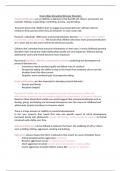
Hoorcollege Disruptive Behavior Disorders
Prosocial behaviors can we definite as behaviors that benefit self, others, and society. For
example: helping, cooperating, comforting, sharing, and donating.
Research shows that children start to engage in prosocial behavior without external
reinforces from parents when they are between 1,5 and 2 years old.
However, individuals’ differences in prosocial behaviors become more stable when children
are between 2 and 7 years old. This means that children who show more prosocial behaviors
are 7 years old are also more inclined to behave prosaically.
Children don’t develop those prosocial orientations on their own, in early childhood parental
discipline style and parent-child relationships quality are very important. Whereas during
adolescents’ peers and friends become more important.
But several cognitive, affective, and behavioral factors underlying the development of
prosocial behavior are:
- Conscience (moral emotions (guilt) and follow rules of conduct)
- Perspective-taking: the ability to step in the shoes from someone else en see the
situation from this other person
- Empathy: more emotional part of perspective-taking
Social relationships are also important to develop prosocial behavior:
- Parents and friends
- Recipient (targets)
Theoretical models such as social cognitive processes and perspective taking and
effectiveness processes such as empathy underly the development of prosocial behavior.
Based on these theoretical models you would suggest that prosocial tendencies such as
sharing, giving, and helping are increased infrequency over the course of childhood and
adolescents. Empirical evidence is however mixed.
There is a large amount of stability in prosocial development.
In her own research they found that only one specific aspect of social development
increased during late adolescents: giving and sharing. Giving emotional support to friends
remained quite stable over time.
Antisocial behaviors can be defined as behavior that harm the wellbeing of self or others
such as hitting, kicking, aggression, stealing and bullying.
Aggression always means that there is behaviors that meant to cause immediate harm:
- Instrumental/proactive aggression is planned
- Reactive aggression occurs in response to provocation
- Overt aggression involves harmful physical behaviors or name-calling
- Covert aggression includes indirect means like rejection or exclusion
, Bullying involves:
- Negative actions intended to hurt
- These acts are repeated over time
- A power difference between bully and victim
We know from research that bullying occurs in families, school, and neighborhood. In
schools bullying is already observed in the preschool years, in all grade levels. But it is most
frequent during the middle school years.
Also, for antisocial behaviors there are several cognitive, affective, and behavioral factors
that underlie the development of antisocial behavior:
- Social information processing (SIP): must encoding and how individuals perceive
social situations. We know that especially hostile intent attributions are important
determinant that are underlie social behavior.
- Emotion-regulation
- Self-regulation
The development of antisocial development:
Prosocial behaviors can we definite as behaviors that benefit self, others, and society. For
example: helping, cooperating, comforting, sharing, and donating.
Research shows that children start to engage in prosocial behavior without external
reinforces from parents when they are between 1,5 and 2 years old.
However, individuals’ differences in prosocial behaviors become more stable when children
are between 2 and 7 years old. This means that children who show more prosocial behaviors
are 7 years old are also more inclined to behave prosaically.
Children don’t develop those prosocial orientations on their own, in early childhood parental
discipline style and parent-child relationships quality are very important. Whereas during
adolescents’ peers and friends become more important.
But several cognitive, affective, and behavioral factors underlying the development of
prosocial behavior are:
- Conscience (moral emotions (guilt) and follow rules of conduct)
- Perspective-taking: the ability to step in the shoes from someone else en see the
situation from this other person
- Empathy: more emotional part of perspective-taking
Social relationships are also important to develop prosocial behavior:
- Parents and friends
- Recipient (targets)
Theoretical models such as social cognitive processes and perspective taking and
effectiveness processes such as empathy underly the development of prosocial behavior.
Based on these theoretical models you would suggest that prosocial tendencies such as
sharing, giving, and helping are increased infrequency over the course of childhood and
adolescents. Empirical evidence is however mixed.
There is a large amount of stability in prosocial development.
In her own research they found that only one specific aspect of social development
increased during late adolescents: giving and sharing. Giving emotional support to friends
remained quite stable over time.
Antisocial behaviors can be defined as behavior that harm the wellbeing of self or others
such as hitting, kicking, aggression, stealing and bullying.
Aggression always means that there is behaviors that meant to cause immediate harm:
- Instrumental/proactive aggression is planned
- Reactive aggression occurs in response to provocation
- Overt aggression involves harmful physical behaviors or name-calling
- Covert aggression includes indirect means like rejection or exclusion
, Bullying involves:
- Negative actions intended to hurt
- These acts are repeated over time
- A power difference between bully and victim
We know from research that bullying occurs in families, school, and neighborhood. In
schools bullying is already observed in the preschool years, in all grade levels. But it is most
frequent during the middle school years.
Also, for antisocial behaviors there are several cognitive, affective, and behavioral factors
that underlie the development of antisocial behavior:
- Social information processing (SIP): must encoding and how individuals perceive
social situations. We know that especially hostile intent attributions are important
determinant that are underlie social behavior.
- Emotion-regulation
- Self-regulation
The development of antisocial development: