Pathology
Lecture 1 – Beljaars – Introduction
Pathology is the study of the patterns, origins, causes, mechanisms and effects of a disease.
It describes the abnormal or undesired condition, whereas pathophysiology seeks to explain the
functional changes that are occurring within an individual due to a disease or pathologic state.
- Description of abnormal condition + explanation of processes and mechanisms
Cellular disturbances arise from alterations in molecules such as genes and proteins.
Immunology is the branch of biology that deals with the immune system and the cell-mediated and
humoral aspects of immunity and immune responses.
Detection of abnormalities in
structure and functions of cells and
organs
- Diagnostics
- Macroscopic inspection
- Microscopy
▪ Light microscopy → is not visible under the microscope
How to detect and make it visible:
▪ Dyes (histochemistry)
HE-staining: hematoxylin-eosin is most commonly used in medical diagnostics
Hematoxylin: basophilic structure blue/purple nuclei
Eosin: eosinophilic structures pink cytoplasm
Commonly used stains for the histologic assessment of renal fibrosis are
Masson’s trichrome, PAS and Sirius Red.
▪ Antibodies
(immunohistochemistry)
Localisation of specific
structures (antigens) in
biological tissues with
antibodies
▪ Substrates (enzyme
histochemistry)
Pharmacist:
- Understand terminology MD
- Understand therapeutic activities of drugs and its implications
- Co-determinate choice of medication: rational proposals to MD for changes to medication
profiles (side
effects/interactions/contra-
indications)
Pathology
- Terminology:
- Characteristics of disease &
its progression
▪ Etiologies
▪ Symptoms
▪ Molecular and
cellular processes
▪ Macroscopic and microscopic characteristics
▪ Clinical chemistry / diagnostics
,Pathology
Lecture 2 – Beljaars – Cell injury, cell death and adaptions
ETIOLOGY: WHAT CAUSES DISEASES
Limited number of cellular responses are caused by cell adaptation and cell death.
Causes of diseases:
- Various injurious stimuli
1. Toxins
2. Infectious agents
3. Genetic abnormalities
4. Physical agents
5. Nutritional imbalances
6. Immunologic reactions
7. Hypoxia and ischemia
Most common causes of cell injury
Hypoxia means that there is not enough oxygen due to low O2 concentrations
• Oxygen deprivation
CO poisoning, anemia, respiratory problems, altitude sickness
Ischemia means that there is not enough oxygen due to reduced blood supply
• Oxygen deprivation + deficiency of essential nutrients + build-up of toxic
metabolites
Occlusion of artery (blood clot, embolism, atherosclerotic plaque) or vene
(stowing)
Anoxia means that there is no oxygen available
8. Aging
Results from combination of
multiple, progressive cellular
alterations. The chance to get a
disease or chronic disease is
higher at an older age. In the
cells there are all kinds of
injuries leading up to
accumulation of mutations in
DNA. Besides, the telomeres
shorten, which results in a
decrease in cellular replication.
This telomere shortening will
eventually lead to cell cycle
arrest and to cellular senescence, which means that cells have are less available to
respond to stress. Moreover, there is a decreased number of proteins and an increased
number of damaged proteins because of an abnormal protein homeostasis.
CELL ADAPTATION are all reversible processes and can be changes in number, size, phenotype,
metabolic activity or function of cells
- Physiological adaptations: normal stimulation by hormones or endogenous chemical
mediators.
- Pathological adaptations: responses to stress that allow cells to modulate their structure and
function and thus escape injury, but at the expense of normal function.
,There are four types of cell adaptation:
1. Hypertrophy
- Increase in cell size (no
new cells), which results in
an increased organ size. It
is associated with
increased amounts of
structural proteins and
organelles caused by an increased functional demand or due to growth factor or hormone
stimulation.
- Occurs in cells with a limited dividing capacity (e.g. heart muscle and heart)
- Reversible processes, but if stress is too much or not relieved and organ cannot enlarge
further → progression towards more degenerative organ changes
- Examples:
Physiological hypertrophy: increased workload striated muscle cells
Pathological hypertrophy: cardiac enlargement resulting from hypertension or aortic valve
disease
2. Hyperplasia
- Increase in cell number (proliferation)
- These cells are capable of replication and are stimulated by growth factors or hormones
- Reversible but if it persists it is a fertile soil for cancer.
- Examples:
Physiological hyperplasia:
▪ proliferation of glandular epithelium of the female breast at puberty and pregnancy
(hormonal hyperplasia)
▪ residual tissue growth after loss of part of the organ (liver regeneration)
(compensatory hyperplasia)
Pathological hyperplasia:
▪ benign prostatic hyperplasia; papilloma virus induced wart formation or mucosal
lesions
Hyperplasia and hypertrophy can occur together resulting in an enlarged organ.
3. Atrophy
- Decrease in cell size resulting
in a decreased organ size.
Diminished cell function but
not death and is associated
with decreased protein
synthesis and increased
protein degradation. Atrophy
is often associated with
autophagy.
- Common causes:
Decreased workload, loss of innervation, diminished blood supply, inadequate nutrition, loss
of endocrine stimulation and aging
- Examples
Physiological atrophy: decreased workload (immobilization to permit fracture healing)
Pathological atrophy: aging and reduced blood supply → brain atrophy
- Degradation of the cells occur in two cellular compartments:
1. Lysosomes: lysosomal digestion of the cell’s own organelles and recycling in order to
provide energy and nutrients is used as a form of survival → self-eating
, 2. Proteasomes:
proteasome
degradation goes
via the ubiquitin
pathway. Proteins
are digested into
amino acids
4. Metaplasia
- Is a reversible process and is a change in the
phenotype of differentiated cells. It happens
often in response to chronic irritation and occurs
mostly in epithelial or mesenchymal cells.
- It results in reduced functions or increased
propensity for malignant transformation
- Example:
Change in lung epithelium due to smoking cigarettes
- It is part of cell adaptation leading to neoplasia:
Hyperplasia → metaplasia → dysplasia → neoplasia.
Dysplasia is an increase in the variation in cell and nuclear sizes and disordered cell
arrangements.
There is a variety of epithelial cells, from single to multilayer. In the lung simple squamous epithelium
is found, in the kidney simple cuboidal epithelium and in the GI tract simple columnar epithelium.
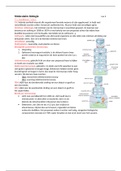
CELL DEATH is caused when the injury is so severe and
progressive that it is irreversible. This will lead to necrosis
and apoptosis.
Reversible injury are characterised in two morphological
ways:
- Cellular swelling by the uptake of water caused by
the failure of energy dependent ion pumps in
plasma membrane.
- Fatty change will occur principally in organs involved
in lipid metabolism.
- Others:
▪ Plasma membrane alterations
▪ Swelling mitochondria
▪ Dilation ER and detachment of ribosomes
▪ Nuclear alteration (clumping of chromatin)
▪ Formation of ‘myelin figures’
Reversible to irreversible damage occurs because there is no
point of return. This is caused for example by:
- The inability to restore mitochondrial function
(oxidative phosphorylation and ATP generation)
- Loss of structure and functions of the plasma
membrane and intracellular membranes
- Loss of DNA and chromatin structural integrity
The irreversible injury leads to cell death and whether it is
necrosis or apoptosis depends on the nature and severity of
the insult.
Lecture 1 – Beljaars – Introduction
Pathology is the study of the patterns, origins, causes, mechanisms and effects of a disease.
It describes the abnormal or undesired condition, whereas pathophysiology seeks to explain the
functional changes that are occurring within an individual due to a disease or pathologic state.
- Description of abnormal condition + explanation of processes and mechanisms
Cellular disturbances arise from alterations in molecules such as genes and proteins.
Immunology is the branch of biology that deals with the immune system and the cell-mediated and
humoral aspects of immunity and immune responses.
Detection of abnormalities in
structure and functions of cells and
organs
- Diagnostics
- Macroscopic inspection
- Microscopy
▪ Light microscopy → is not visible under the microscope
How to detect and make it visible:
▪ Dyes (histochemistry)
HE-staining: hematoxylin-eosin is most commonly used in medical diagnostics
Hematoxylin: basophilic structure blue/purple nuclei
Eosin: eosinophilic structures pink cytoplasm
Commonly used stains for the histologic assessment of renal fibrosis are
Masson’s trichrome, PAS and Sirius Red.
▪ Antibodies
(immunohistochemistry)
Localisation of specific
structures (antigens) in
biological tissues with
antibodies
▪ Substrates (enzyme
histochemistry)
Pharmacist:
- Understand terminology MD
- Understand therapeutic activities of drugs and its implications
- Co-determinate choice of medication: rational proposals to MD for changes to medication
profiles (side
effects/interactions/contra-
indications)
Pathology
- Terminology:
- Characteristics of disease &
its progression
▪ Etiologies
▪ Symptoms
▪ Molecular and
cellular processes
▪ Macroscopic and microscopic characteristics
▪ Clinical chemistry / diagnostics
,Pathology
Lecture 2 – Beljaars – Cell injury, cell death and adaptions
ETIOLOGY: WHAT CAUSES DISEASES
Limited number of cellular responses are caused by cell adaptation and cell death.
Causes of diseases:
- Various injurious stimuli
1. Toxins
2. Infectious agents
3. Genetic abnormalities
4. Physical agents
5. Nutritional imbalances
6. Immunologic reactions
7. Hypoxia and ischemia
Most common causes of cell injury
Hypoxia means that there is not enough oxygen due to low O2 concentrations
• Oxygen deprivation
CO poisoning, anemia, respiratory problems, altitude sickness
Ischemia means that there is not enough oxygen due to reduced blood supply
• Oxygen deprivation + deficiency of essential nutrients + build-up of toxic
metabolites
Occlusion of artery (blood clot, embolism, atherosclerotic plaque) or vene
(stowing)
Anoxia means that there is no oxygen available
8. Aging
Results from combination of
multiple, progressive cellular
alterations. The chance to get a
disease or chronic disease is
higher at an older age. In the
cells there are all kinds of
injuries leading up to
accumulation of mutations in
DNA. Besides, the telomeres
shorten, which results in a
decrease in cellular replication.
This telomere shortening will
eventually lead to cell cycle
arrest and to cellular senescence, which means that cells have are less available to
respond to stress. Moreover, there is a decreased number of proteins and an increased
number of damaged proteins because of an abnormal protein homeostasis.
CELL ADAPTATION are all reversible processes and can be changes in number, size, phenotype,
metabolic activity or function of cells
- Physiological adaptations: normal stimulation by hormones or endogenous chemical
mediators.
- Pathological adaptations: responses to stress that allow cells to modulate their structure and
function and thus escape injury, but at the expense of normal function.
,There are four types of cell adaptation:
1. Hypertrophy
- Increase in cell size (no
new cells), which results in
an increased organ size. It
is associated with
increased amounts of
structural proteins and
organelles caused by an increased functional demand or due to growth factor or hormone
stimulation.
- Occurs in cells with a limited dividing capacity (e.g. heart muscle and heart)
- Reversible processes, but if stress is too much or not relieved and organ cannot enlarge
further → progression towards more degenerative organ changes
- Examples:
Physiological hypertrophy: increased workload striated muscle cells
Pathological hypertrophy: cardiac enlargement resulting from hypertension or aortic valve
disease
2. Hyperplasia
- Increase in cell number (proliferation)
- These cells are capable of replication and are stimulated by growth factors or hormones
- Reversible but if it persists it is a fertile soil for cancer.
- Examples:
Physiological hyperplasia:
▪ proliferation of glandular epithelium of the female breast at puberty and pregnancy
(hormonal hyperplasia)
▪ residual tissue growth after loss of part of the organ (liver regeneration)
(compensatory hyperplasia)
Pathological hyperplasia:
▪ benign prostatic hyperplasia; papilloma virus induced wart formation or mucosal
lesions
Hyperplasia and hypertrophy can occur together resulting in an enlarged organ.
3. Atrophy
- Decrease in cell size resulting
in a decreased organ size.
Diminished cell function but
not death and is associated
with decreased protein
synthesis and increased
protein degradation. Atrophy
is often associated with
autophagy.
- Common causes:
Decreased workload, loss of innervation, diminished blood supply, inadequate nutrition, loss
of endocrine stimulation and aging
- Examples
Physiological atrophy: decreased workload (immobilization to permit fracture healing)
Pathological atrophy: aging and reduced blood supply → brain atrophy
- Degradation of the cells occur in two cellular compartments:
1. Lysosomes: lysosomal digestion of the cell’s own organelles and recycling in order to
provide energy and nutrients is used as a form of survival → self-eating
, 2. Proteasomes:
proteasome
degradation goes
via the ubiquitin
pathway. Proteins
are digested into
amino acids
4. Metaplasia
- Is a reversible process and is a change in the
phenotype of differentiated cells. It happens
often in response to chronic irritation and occurs
mostly in epithelial or mesenchymal cells.
- It results in reduced functions or increased
propensity for malignant transformation
- Example:
Change in lung epithelium due to smoking cigarettes
- It is part of cell adaptation leading to neoplasia:
Hyperplasia → metaplasia → dysplasia → neoplasia.
Dysplasia is an increase in the variation in cell and nuclear sizes and disordered cell
arrangements.
There is a variety of epithelial cells, from single to multilayer. In the lung simple squamous epithelium
is found, in the kidney simple cuboidal epithelium and in the GI tract simple columnar epithelium.
CELL DEATH is caused when the injury is so severe and
progressive that it is irreversible. This will lead to necrosis
and apoptosis.
Reversible injury are characterised in two morphological
ways:
- Cellular swelling by the uptake of water caused by
the failure of energy dependent ion pumps in
plasma membrane.
- Fatty change will occur principally in organs involved
in lipid metabolism.
- Others:
▪ Plasma membrane alterations
▪ Swelling mitochondria
▪ Dilation ER and detachment of ribosomes
▪ Nuclear alteration (clumping of chromatin)
▪ Formation of ‘myelin figures’
Reversible to irreversible damage occurs because there is no
point of return. This is caused for example by:
- The inability to restore mitochondrial function
(oxidative phosphorylation and ATP generation)
- Loss of structure and functions of the plasma
membrane and intracellular membranes
- Loss of DNA and chromatin structural integrity
The irreversible injury leads to cell death and whether it is
necrosis or apoptosis depends on the nature and severity of
the insult.