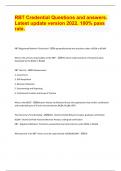
RBT Credential Questions and answers. Latest update version 2022. 100% pass rate
RBT Credential Questions and answers. Latest update version 2022. 100% pass rate Document Content and Description Below RBT (Registered Behavior Technician) - ☑☑A paraprofessional who practices under a BCBA or BCaBA What is the primary responsibility of the RBT? - ☑☑The direct implementation of treatment pla ns developed by the BCBA or BCaBA RBT Task List - ☑☑1.Measurement 2. Assessment 3. Skill Acquisition 4. Behavior Reduction 5. Documenting and Reporting 6. Professional Conduct and Scope of Practice What is the BACB? - ☑☑Behavior Analyst Certification Board; the organization that confers certification and credentialing to all 3 levels of practitioners (BCBA, BCaBA, RBT) The Hierarchy of Credentialing - ☑☑BCBA - Board Certified Behavior Analyst; graduate certification BCaBA - Board Certified Assistant Behavior Analyst; undergrad certification RBT - Registered Behavior Technician; paraprofessional who practices under BCBA or BCaBA What percent of an RBT's hours must be supervised by a BCBA/BCaBA? - ☑☑5% What is ABA? - ☑☑One of the only research based methods for the treatment of behavior in Autism; aims to improve clients' life by increasing prosocial behaviors and decreasing maladaptive behaviors Characteristics of ABA - ☑☑1. Applied 2. Behavioral 3. Analytic 4. Technological 5. Conceptually Systematic 6. Effective 7. Generality Characteristics: Applied - ☑☑ABA is used to make improvements that are socially significant in clients' daily lives. Characteristics: Behavioral - ☑☑The subject of ABA therapy must be the exact observable behavior targeted for change. Characteristic: Analytic - ☑☑Treatment must based off of observable and repeatable methods and demonstrate functional relationships. Characteristics: Technological - ☑☑Procedures must be identified and described with detail and clarity so that any reader has the ability to replicate the application with the same results. Characteristics: Conceptually Systematic - ☑☑Procedures must be based around evidence-based methods. Characteristics: Effective - ☑☑Treatments must be shown to produce significant positive change in subject's life. Characteristics: Generality - ☑☑The behavior changed by the procedure must be able to last over time and be applied to multiple socially appropriate situations. Reinforcement - ☑☑The addition or removal of a stimulus following a behavior that INCREASES the probability that the behavior will be repeated. Punishment - ☑☑The addition or removal of a stimulus following a behavior that DECREASES the probability that the behavior will be repeated. Motivating Operation - ☑☑An environmental variable that alters the reinforcing or punishing aspect of a stimulus/object/event OR alters the frequency of all behavior reinforced or punished by that stimulus/object/behavior. Stimulus Control - ☑☑A situation where the frequency/duration/severity of behavior is altered by the presence or absence of an antecedent stimulus. Operant Conditioning - ☑☑The basic principle of learning of which behavior is controlled by consequences. Key concepts in operant conditioning are positive reinforcement, negative reinforcement, positive punishment and negative punishment. Schedules of Reinforcement - ☑☑Rules specifying environmental arrangements and response conditions for reinforcement. 2 Categories of Schedules of Reinforcement - ☑☑1. Continuous - reinforcement is given after every correct response 2. Intermittent - not continuous 4 Types of Intermittent Schedules of Reinforcement - ☑☑1. Fixed-Ratio (FR) - reinforcement given after a constant or "fixed" number of correct responses 2. Fixed-Interval (FI) - reinforcement becomes available after a specific period of time; reinforcement is given if the correct response is emitted after the given time period has ended 3. Variable-Ratio (VR) - the delivery of reinforcement will "vary" but must average out at a specific number 4. Variable-Interval (VI) - the time periods that must pass before reinforcement becomes available will vary but must average out at a specific time interval Measurement - ☑☑The process of applying quantitative labels to observed properties of events using a standard set of rules. Data - ☑☑The common term used for measurement in the practice of ABA. Why do practitioners use data/measurement? - ☑☑To evaluate the effectiveness of interventions - if they are effective, we continue them; if they are ineffective, we use research to guide alterations to the interventions until an efficient and appropriate solution is found. Baseline Measurements - ☑☑The initial data on targets in which we test future successes of an intervention against. Examples of Measurement/Data Collection - ☑☑5 trial data sheets; 1 trial probe data sheets; Behavior frequency tracking forms; Behavior duration tracking forms; ABC behavior charts Definitional Measures: Topography - ☑☑The physical form or shape of behavior Ex. - A hit is defined as the movement of the client's hand towards others that causes injury Definitional Measures: Magnitude - ☑☑The force or intensity with which a response is emitted. Ex. - A scream vs. a whisper Properties of The Measurable Dimensions of Behavior - ☑☑1. Repeatability/ Countable 2. Temporal Locus 3. Temporal Extent Repeatability/Countable - ☑☑Behavior can be counted Temporal Locus - ☑☑When the behavior occurs Temporal Extent - ☑☑Duration of the behavior Measures Based on Repeatability - ☑☑1. Count 2. Rate/Frequency 3. Celeration Count - ☑☑Number or responses emitted during an observed period Count Examples - ☑☑Joe smiled 3 times to peers. Bob slapped a peer 4 times. We saw 0 instances of verbal refusal. Rate/Frequency - ☑☑- Ratio of count per observation period - Reported as a number per standard unit of time ____ is a combination of count and the observable time, making it a stronger and more comprehensive form of measurement than count alone. - ☑☑Rate Rate/Frequency Example - ☑☑Bob hit 5 times in 30 minutes. Celeration - ☑☑Measure of the change in rate of responding per unit of time (Acceleration, Deceleration) Measure Based on Temporal Extent - ☑☑Duration Duration - ☑☑The amount of time a behavior occurs reported in standard time units Measures Based on Temporal Locus - ☑☑1. Response Latency 2. Inter Response Time (IRT) Response Latency - ☑☑Delay between the stimulus and response Ex. - It took Bob 3 seconds to clap after being asked Inter Response Time (IRT) - ☑☑The measure of elapsed time between two successive responses Ex. - Bob clapp
Written for
- Institution
- RBT
- Course
- RBT
Document information
- Uploaded on
- May 9, 2023
- Number of pages
- 16
- Written in
- 2022/2023
- Type
- Exam (elaborations)
- Contains
- Questions & answers
Subjects
-
rbt credential questions and answers latest update version 2022 100 pass rate document content and description below rbt registered behavior technician ☑☑a paraprofessional who practices under

Also available in package deal