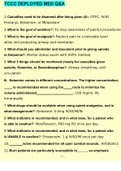
TCCC DEPLOYED MED Q&A
.Casualties need to be disarmed after being given (4):: OTFC, IV/IO Fentanyl, Ketamine, or Midazolam
2.What is the goal of sedation?: To stop awareness of painful procedures
3.What is the goal of analgesia?: Reduce pain to a tolerable level while still protecting airway and mentation
4.What should you administer and document prior to giving opioids or Ketamine?: Mental status exam with AVPU method
5.What 3 things should be monitored closely for casualties given opioids, Ketamine, or Benzodiazepines?: Airway, breathing, and circulation
6.Ketamine comes in different concentrations. The higher concentration, , is recommended when using the route to minimize the volume administered .: 100 mg/ml, IN, intranasally
7.What drugs should be available when using opioid analgesics, and in what dosage/route?: Naloxone, 0.4mg IV/IO/IM/IN
8.What antibiotic is recommended, and in what dose, for a patient who is able to swallow?: Moxifloxacin, 400 mg PO once per day
9.What antibiotic is recommended, and in what does, for a patient who is UNABLE to swallow?: Ertapenem, 1 g IV/IO/IM once per day
10. is/are recommended for all open combat wounds.: Antibiotics
11.Burn patients are particularly susceptible to , so emphasis TCCC DEPLOYED MED Q&A
should be placed on prevention methods.: Hypothermia, heat loss
12.If burns are greater than of body area, should be initiated as
soon as IV/IO access is established.: 20%, fluid resuscitation
13. Fluid resuscitation for burn victims should be initiated with , , or .: Lactated ringers, normal saline, or Hextend
14.If Hextend is used for fluid resuscitation, no more than ml should be
given, followed by or as needed.: 1000, Lactated ringers,
normal saline
15.What must be considered in patients with facial burns?: Possible
inhala- tion injury
16.Initial IV/IO fluid rate is calculated as for adults weighing
between and .: %TBSA X 10ml/hr, 40-80kg (about 88-176 lbs.)
17.When calculating IV/IO fluid rate, for every kg above 80kg, increase the
initial rate by .: 10kg (about 22 pounds), 100 ml/hr
.Casualties need to be disarmed after being given (4):: OTFC, IV/IO Fentanyl, Ketamine, or Midazolam
2.What is the goal of sedation?: To stop awareness of painful procedures
3.What is the goal of analgesia?: Reduce pain to a tolerable level while still protecting airway and mentation
4.What should you administer and document prior to giving opioids or Ketamine?: Mental status exam with AVPU method
5.What 3 things should be monitored closely for casualties given opioids, Ketamine, or Benzodiazepines?: Airway, breathing, and circulation
6.Ketamine comes in different concentrations. The higher concentration, , is recommended when using the route to minimize the volume administered .: 100 mg/ml, IN, intranasally
7.What drugs should be available when using opioid analgesics, and in what dosage/route?: Naloxone, 0.4mg IV/IO/IM/IN
8.What antibiotic is recommended, and in what dose, for a patient who is able to swallow?: Moxifloxacin, 400 mg PO once per day
9.What antibiotic is recommended, and in what does, for a patient who is UNABLE to swallow?: Ertapenem, 1 g IV/IO/IM once per day
10. is/are recommended for all open combat wounds.: Antibiotics
11.Burn patients are particularly susceptible to , so emphasis TCCC DEPLOYED MED Q&A
should be placed on prevention methods.: Hypothermia, heat loss
12.If burns are greater than of body area, should be initiated as
soon as IV/IO access is established.: 20%, fluid resuscitation
13. Fluid resuscitation for burn victims should be initiated with , , or .: Lactated ringers, normal saline, or Hextend
14.If Hextend is used for fluid resuscitation, no more than ml should be
given, followed by or as needed.: 1000, Lactated ringers,
normal saline
15.What must be considered in patients with facial burns?: Possible
inhala- tion injury
16.Initial IV/IO fluid rate is calculated as for adults weighing
between and .: %TBSA X 10ml/hr, 40-80kg (about 88-176 lbs.)
17.When calculating IV/IO fluid rate, for every kg above 80kg, increase the
initial rate by .: 10kg (about 22 pounds), 100 ml/hr